


Grade 5 brings another step up in math. Children work with larger numbers, solve more complex multiplication and division problems, and build a deeper understanding of fractions and decimals.
Parents often wonder how much their child should know before the school year begins.
Children do not need to have mastered every grade 4 skill. Teachers expect students to arrive with different strengths and areas that still need practice, and important concepts will be reviewed throughout grade 5.
What matters most is that children understand how numbers work, can use the four operations with some confidence, and are developing a solid understanding of fractions, decimals, measurement and geometry.
The following skills can help make the transition to grade 5 math a little easier.
Understanding place value to 1,000,000
Before grade 5, children should understand that the value of a digit depends on where it appears in a number.
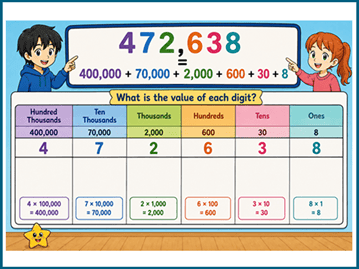
In the number 472,638:
4 represents 4 hundred thousands
7 represents 7 ten thousands
2 represents 2 thousands
6 represents 6 hundreds
3 represents 3 tens
8 represents 8 ones
They should also be able to show the number in expanded form:
472,638 = 400,000 + 70,000 + 2,000 + 600 + 30 + 8
Try writing a six-digit number and asking:
What is the value of each digit?
How many hundred thousands, ten thousands, thousands, hundreds, tens and ones are there?
Can you write the number in expanded form and in words?
Grade 4 place value worksheets
Our grade 4 place value worksheets give students practice reading and writing large numbers, finding the value of digits, writing numbers in expanded form, comparing numbers and rounding.
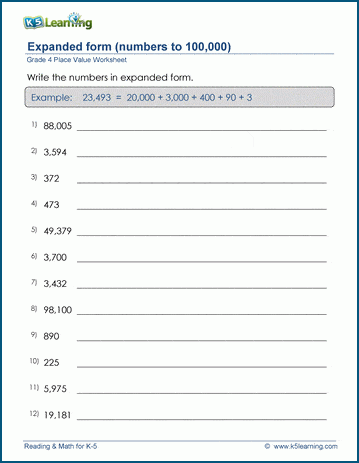
These worksheets ask students to write up to six-digit numbers in expanded form.
Comparing, ordering and rounding large numbers
Children entering grade 5 should be able to read, write, compare and order numbers to 1,000,000.
They might compare:
356,402 and 356,240
The hundred thousands, ten thousands and thousands are the same, so they need to compare the hundreds. Since 4 hundreds is greater than 2 hundreds, 356,402 is greater.
Children should be comfortable using:
> greater than
< less than
= equal to
They should also be able to round numbers to a given place, such as the nearest 10, 100, 1,000, 10,000 or 100,000.
For example:
347,628 rounds to 348,000 to the nearest 1,000.
347,628 rounds to 300,000 to the nearest 100,000.
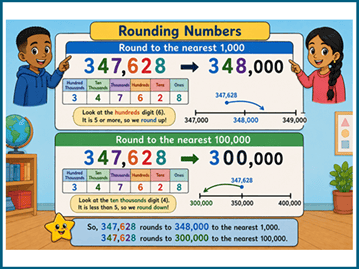
A number line can help children see which multiple is closest. It also helps rounding make sense rather than becoming only a rule about looking at one digit.
Grade 4 comparing and rounding worksheets
Our grade 4 place value and rounding worksheets include comparing and ordering large numbers and rounding numbers to different place values.
Choose one rounding place at a time if your child finds the changing place values confusing.
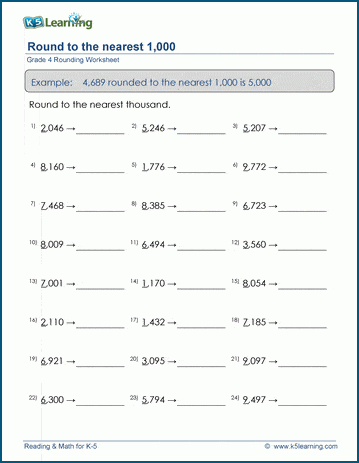
In these worksheets, students round large numbers to the nearest 1,000.
Adding and subtracting multi-digit numbers
By the end of grade 4, children are usually adding and subtracting numbers with several digits.
They should understand how to line up digits by place value when working in columns. They should also understand what happens when they regroup across one or more places.
For example, when subtracting:
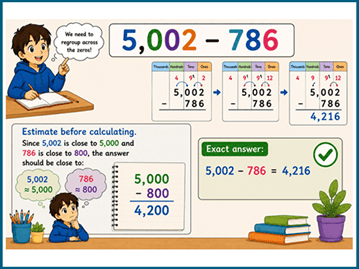
5,002 − 786
A child needs to regroup across the zeros before subtracting the ones, tens and hundreds.
They should also be able to estimate before calculating. Since 5,002 is close to 5,000 and 786 is close to 800, the answer should be close to:
5,000 − 800 = 4,200
The exact answer is 4,216, so the estimate helps confirm that it is reasonable.
Children may use mental math, written methods or a combination of the two. They should be able to explain their thinking and check their work using estimation or the inverse operation.
Grade 4 addition and subtraction worksheets
Our grade 4 addition and subtraction worksheets cover mental math, adding and subtracting in columns, regrouping and calculations with larger numbers.
If regrouping across zeros is difficult, use place value blocks or expanded form to show what is happening before returning to the written method.
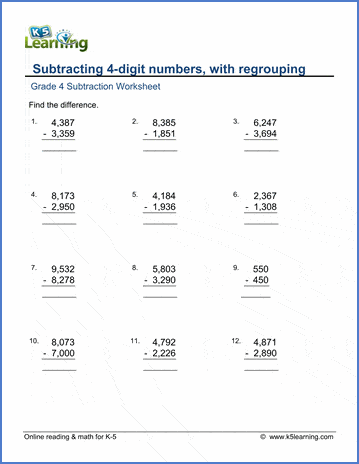
These subtraction worksheets ask students to subtract large numbers in columns.
Knowing multiplication and division facts
Multiplication facts continue to be important in grade 5. They are used in multi-digit multiplication, division, fractions, area, volume and many other topics.
Children entering grade 5 should be developing fluency with multiplication facts through 10 × 10 and, in many programs, through 12 × 12.
Fluency does not have to mean answering every fact instantly. A child who cannot immediately recall 7 × 8 might think:
7 × 4 = 28
Double 28 = 56
They should also be able to use multiplication to find related division facts:
8 × 7 = 56
56 ÷ 8 = 7
56 ÷ 7 = 8
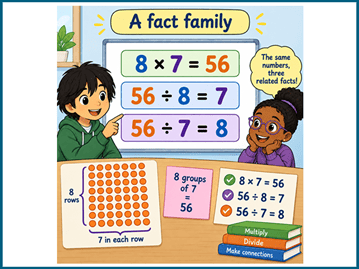
Understanding these relationships gives children a way to find an answer when they cannot recall it immediately.
Grade 4 multiplication and division facts worksheets
Our grade 4 multiplication and division worksheets provide practice with facts, fact families, missing numbers and related calculations.
Short, regular practice with a small group of facts is usually more useful than repeatedly working through every fact at once.
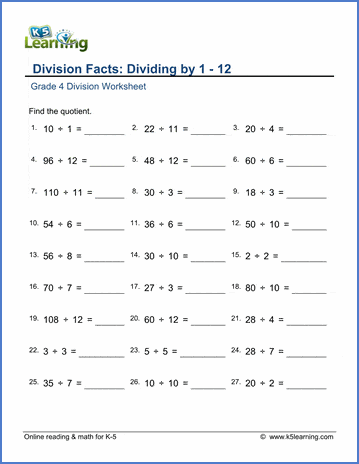
These division facts worksheets ask students to divide numbers by a single-digit divisor.
Multiplying by one- and two-digit numbers
Children entering grade 5 should be able to multiply larger numbers by a one-digit number and should have some experience multiplying by two-digit numbers.
For example:
6 × 243
A child might break 243 into hundreds, tens and ones:
6 × 200 = 1,200
6 × 40 = 240
6 × 3 = 18
1,200 + 240 + 18 = 1,458
They may also use an area model or a written method to calculate:
23 × 14
23 × 10 = 230
23 × 4 = 92
230 + 92 = 322
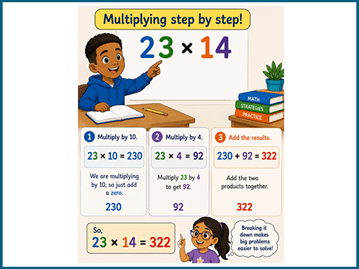
Breaking apart the factors helps children understand the partial products in the written method. It also gives them a way to check whether the answer is sensible.
Grade 4 multiplication worksheets
Our grade 4 multiplication worksheets cover multiplication facts, multiplying by multiples of 10 and 100, multiplication in columns and multiplying by one- and two-digit numbers.
Encourage your child to estimate first. Since 23 is close to 20 and 14 is close to 15, an answer a little above 300 is reasonable.
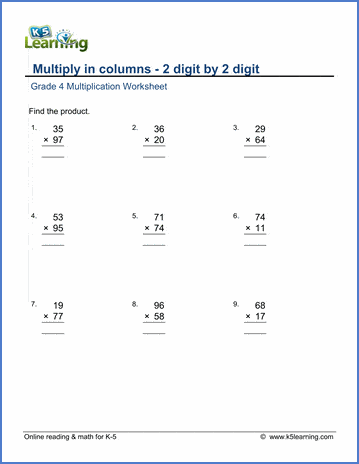
These worksheets ask students to multiply two-digit numbers in columns.
Dividing larger numbers and interpreting remainders
Children should understand division as sharing equally and making equal groups. They should also be able to divide larger numbers by a one-digit number.
For example:
156 ÷ 4
A child might break 156 apart:
120 ÷ 4 = 30
36 ÷ 4 = 9
30 + 9 = 39
Children may also use a written division method. Whichever method they use, they should understand how the quotient connects to the original amount.
They should also be able to interpret remainders in context.
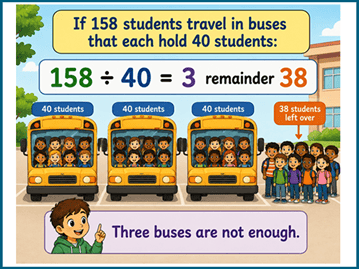
If 158 students travel in buses that each hold 40 students:
158 ÷ 40 = 3 remainder 38
Three buses are not enough. A fourth bus is needed for the remaining 38 students.
In another problem, the remainder might be left over, discarded or written as part of a fraction. Children need to think about what the question is asking rather than treating every remainder in the same way.
Grade 4 division worksheets
Our grade 4 division worksheets cover division facts, dividing by one-digit numbers, division in columns, remainders and word problems.
If written division is difficult, return to place value and use an area model or partial quotients to show how the number is being divided.
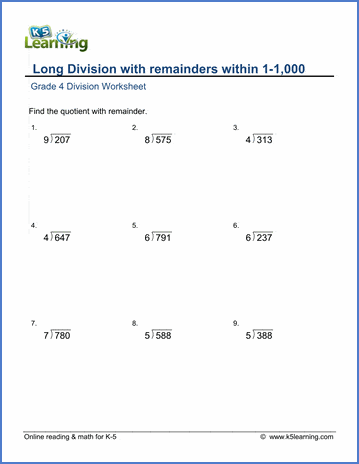
These worksheets ask students to divide three-digit numbers by one-digit numbers with remainders.
Recognizing factors and multiples
Children entering grade 5 should understand the meaning of factors and multiples.
Factors are numbers that multiply to make another number. The factor pairs of 24 are:
1 × 24
2 × 12
3 × 8
4 × 6
The multiples of 6 include:
6, 12, 18, 24, 30, 36 and so on.
Children should also be beginning to recognize prime and composite numbers. A prime number has exactly two factors: 1 and itself. A composite number has more than two factors.
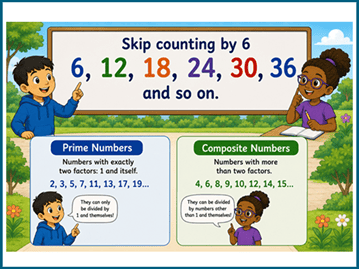
Factor pairs can be shown with arrays or rectangles. This helps children see the connection among factors, multiplication, division and area.
Grade 4 factors and multiples worksheets
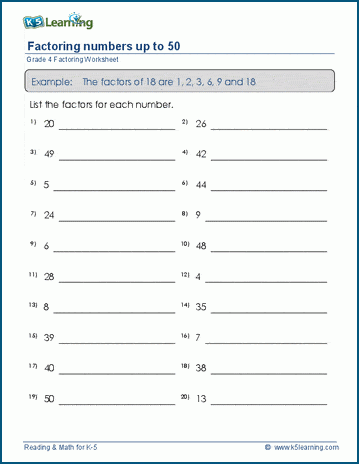
Our grade 4 factoring worksheets include practice finding factors, identifying multiples and working with prime numbers.
Ask your child to explain how they know they have found all the factor pairs. This encourages them to look for a system instead of guessing.
Students find the factors of numbers in these worksheets.
Solving multi-step word problems
Grade 5 word problems often require children to choose from all four operations and complete more than one step.
For example:
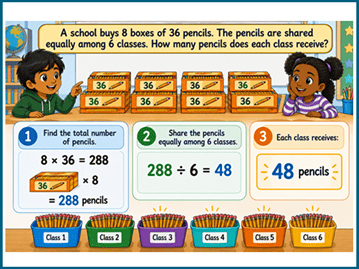
A school buys 8 boxes of 36 pencils. The pencils are shared equally among 6 classes. How many pencils does each class receive?
First find the total number of pencils:
8 × 36 = 288
Then divide the pencils among the classes:
288 ÷ 6 = 48
Each class receives 48 pencils.
Encourage your child to:
read the whole problem
identify what they need to find
decide which information is useful
choose the operation or operations
show their work with equations, pictures or models
estimate and check whether the answer makes sense
Avoid teaching children to choose an operation from a keyword alone. The same word can appear in problems that require different operations, so children need to think about what is happening.
Grade 4 word problem worksheets
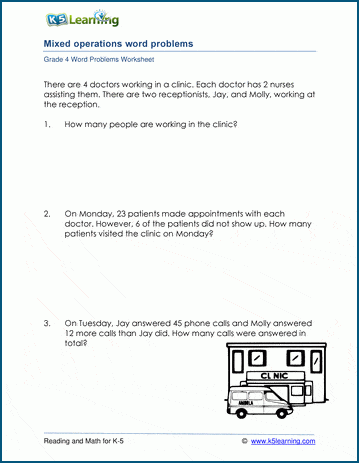
Our grade 4 word problem worksheets cover addition, subtraction, multiplication, division, fractions, measurement, time and mixed problems.
Mixed worksheets are particularly useful because children must decide how to solve each problem instead of repeating the same type of calculation.
These worksheets present mixed word problems using the four operations.
Understanding equivalent fractions
Before grade 5, children should understand that equivalent fractions name the same amount even though they use different numerators and denominators.
For example:
1/2 = 2/4 = 4/8
A child might see this by folding the same-sized strip into 2, 4 and 8 equal parts. The number of shaded pieces changes, but the amount shaded stays the same.
Children should also understand that multiplying the numerator and denominator by the same number creates an equivalent fraction:
3/5 = 6/10
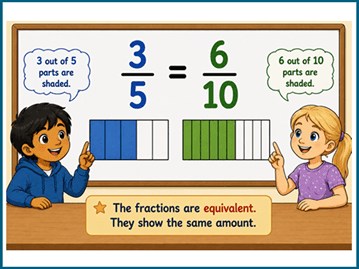
Fraction strips, number lines and area models can help children see why the fractions are equivalent. The goal is to understand the amounts, not simply apply a rule.
Grade 4 equivalent fraction worksheets
Our grade 4 fraction worksheets give students practice finding equivalent fractions, simplifying fractions and using visual models.
If a child knows the procedure but is unsure why it works, return to pictures or a number line before using larger numbers.
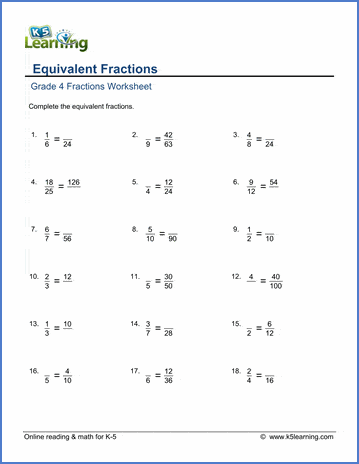
Students complete equivalent fractions in these worksheets.
Comparing and ordering fractions
Children entering grade 5 should be able to compare fractions with the same numerator or denominator. They should also have some experience comparing fractions with different numerators and denominators.
For example:
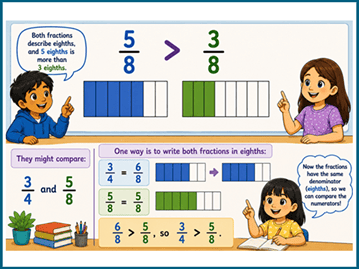
5/8 > 3/8
Both fractions describe eighths, and 5 eighths is more than 3 eighths.
They might compare:
3/4 and 5/8
One way is to write both fractions in eighths:
3/4 = 6/8
6/8 > 5/8, so 3/4 > 5/8.
Children can also compare fractions with benchmark numbers such as 0, 1/2 and 1. For example, 5/8 is greater than 1/2 because 1/2 is equal to 4/8.
Ask your child to explain the comparison with words, a picture or a number line. Cross-multiplication may produce an answer, but it does not by itself help children understand the size of the fractions.
Grade 4 comparing fractions worksheets
Our grade 4 fraction worksheets include comparing like and unlike fractions, ordering fractions and using equivalent fractions.
Encourage your child to estimate first. Is each fraction less than, equal to or greater than one-half? Sometimes that is enough to compare them.
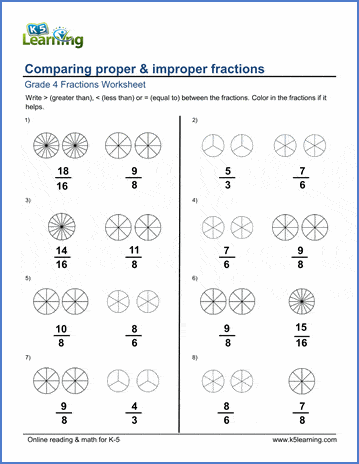
These worksheets ask students to compare proper and improper fractions.
Adding and subtracting fractions
By the end of grade 4, children should be able to add and subtract fractions with the same denominator.
For example:
3/8 + 2/8 = 5/8
The pieces are still eighths, so the denominator stays the same.
Children may also work with mixed numbers:
2 3/5 + 1 1/5 = 3 4/5
They should understand fractions greater than one and be able to move between improper fractions and mixed numbers:
7/4 = 1 3/4
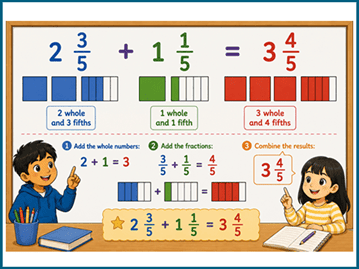
Visual models help children see why the denominator does not change when the pieces are the same size. They also make regrouping with mixed numbers easier to understand.
Grade 4 adding and subtracting fractions worksheets
Our grade 4 fraction worksheets include adding and subtracting like fractions, working with improper fractions and mixed numbers, and solving fraction word problems.
Ask your child to estimate before calculating. Should the answer be less than one, close to one or greater than one?
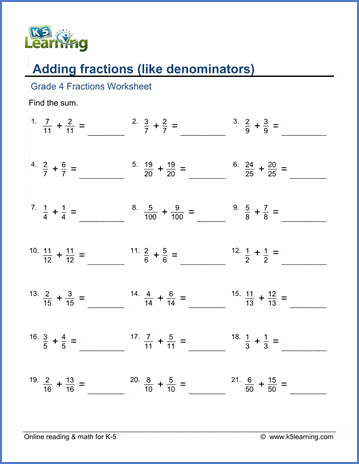
These worksheets ask students to add fractions with the same denominator.
Understanding decimals to hundredths
Children entering grade 5 should understand that decimals are another way to represent parts of a whole.
In the number 3.47:
3 represents 3 ones
4 represents 4 tenths
7 represents 7 hundredths
They should be able to connect common fractions and decimals:
1/10 = 0.1
7/10 = 0.7
25/100 = 0.25
They should also be able to compare decimals by considering place value. For example:
0.6 > 0.54
Writing 0.6 as 0.60 makes it easier to see that 60 hundredths is greater than 54 hundredths.
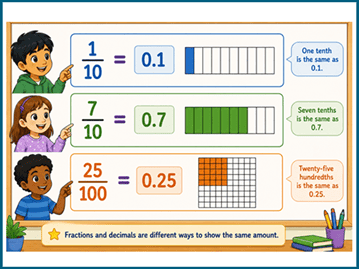
Money, base-ten blocks and hundred grids can help make tenths and hundredths more concrete. Children should not assume that the decimal with more digits is always larger.
Grade 4 decimals worksheets
Our grade 4 decimals worksheets cover decimal place value, comparing decimals, and adding and subtracting decimals, and our fractions to/from decimals page converting between fractions and decimals.
Begin with tenths before adding hundredths if your child is unsure about decimal place value.
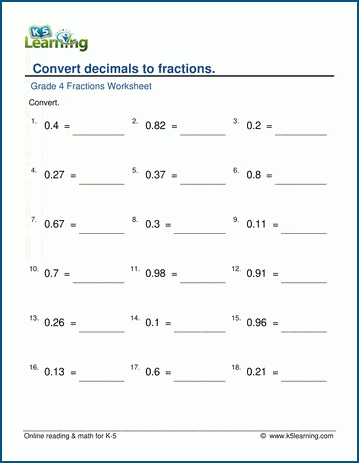
These worksheets ask students to convert fractions with denominators of 10 or 100 to decimals.
Measuring and converting units
Children entering grade 5 should have experience measuring length, weight, volume and temperature using standard units.
They should be familiar with units such as:
millimeters, centimeters, meters and kilometers
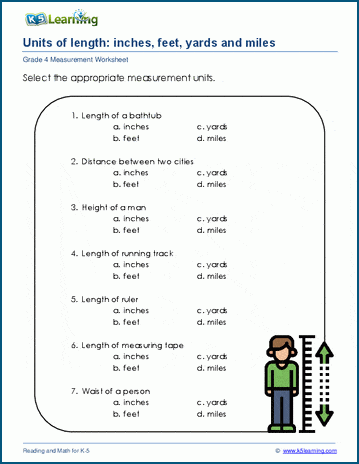
inches, feet, yards and miles
grams and kilograms
ounces and pounds
milliliters and liters
cups, pints, quarts and gallons
They should also be able to make simple conversions within the same measurement system.
For example:
3 meters = 300 centimeters
5 feet = 60 inches
2 liters = 2,000 milliliters
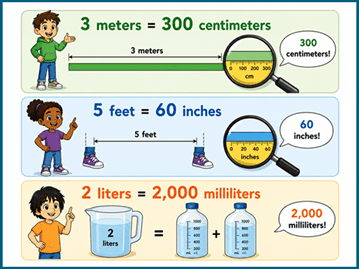
Conversion tables and number lines can help children see the relationship between the units. Practical experience with rulers, scales and measuring cups makes the numbers more meaningful.
Grade 4 measurement worksheets
Our grade 4 measurement worksheets cover length, weight, capacity, temperature and conversions in metric and customary units.
Whenever possible, combine worksheet practice with real measuring. Ask your child to estimate first, measure or convert, and then decide whether the answer is reasonable.
Students convert units of length in these worksheets.
Understanding area and perimeter
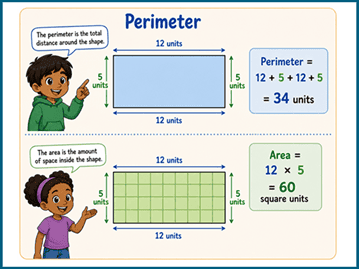
Children should understand that perimeter is the distance around a shape and area is the amount of space inside it.
For a rectangle that is 12 units long and 5 units wide:
Perimeter = 12 + 5 + 12 + 5 = 34 units
Area = 12 × 5 = 60 square units
Children should also be able to find the area of a shape made from two rectangles. They can split the shape into smaller rectangles, find each area and add the results.
It is common for children to confuse area and perimeter. Asking whether they are measuring around a shape or covering its surface can help them decide what to find.
Grade 4 area and perimeter worksheets
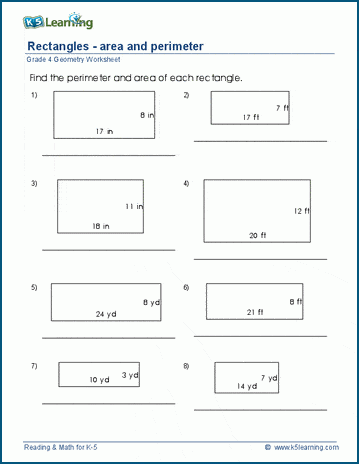
Our grade 4 geometry worksheets include finding the area and perimeter of rectangles and more complex shapes.
Encourage children to include the correct units in their answers: units for perimeter and square units for area.
In these worksheets, students find the area and perimeter of rectangular shapes.
Recognizing angles and describing shapes
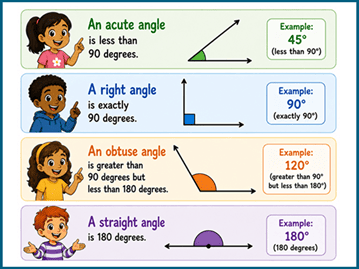
Children entering grade 5 should be able to identify and compare different types of angles.
They should understand that:
an acute angle is less than 90 degrees
a right angle is exactly 90 degrees
an obtuse angle is greater than 90 degrees but less than 180 degrees
a straight angle is 180 degrees
They should also be able to identify parallel and perpendicular lines and classify shapes by their properties.
For example, they might explain that a square is both a rectangle and a rhombus because it has four right angles and four equal sides.
Children should look at a shape's properties rather than relying only on how it is turned or how it looks. A long, narrow rectangle is still a rectangle, and a square remains a square when it is rotated.
Grade 4 geometry worksheets
Our grade 4 geometry worksheets cover angles, lines, triangles, quadrilaterals, symmetry, area and perimeter.
Ask your child to explain why a shape belongs in more than one group. This builds a more flexible understanding of shape classifications.
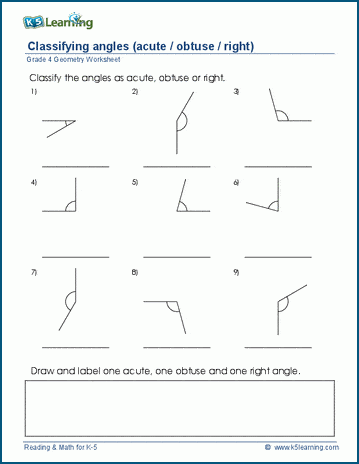
Students classify angles as acute, right or obtuse in these worksheets.
Reading graphs and interpreting data
Children should have experience reading and creating tables, bar graphs, line plots and line graphs.
They should be able to answer questions such as:
Which category has the greatest value?
What is the difference between two values?
What is the total or average of a set of values?
How does the scale affect the information shown?
What changes over time?
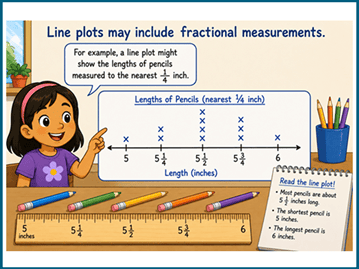
Line plots may include fractional measurements. For example, a line plot might show the lengths of pencils measured to the nearest 1/4 inch.
Children should understand that a graph needs a title, labels and an appropriate scale. They should also read the scale carefully rather than assuming that each space represents one.
Grade 4 data and graphing worksheets
Our grade 4 data worksheets give children practice reading and creating bar graphs, line plots and line graphs and using data to solve problems.
Ask your child to explain the graph in words before answering the questions. This can help them notice the title, labels, scale and overall pattern.
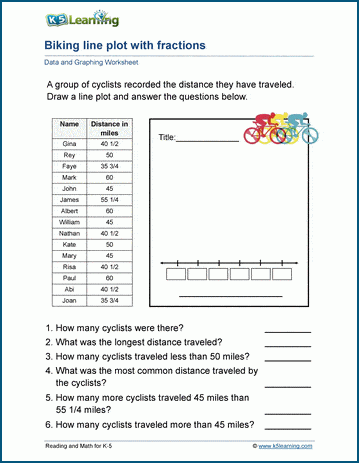
These worksheets ask students to answer questions about data shown on a line plot.
Using math in everyday life
Some of the most useful preparation for grade 5 does not look like schoolwork.
Ask your child to estimate the cost of several groceries and calculate the change. Let them double or halve a recipe. Compare prices using decimals. Work out how many cars are needed to transport a group of people. Measure a room and find its area and perimeter. Look for fractions on measuring cups, angles in buildings and factors in rows of tiles.
These small activities help children connect math with real situations and give them a reason to think about what the numbers mean.
Worksheets can then provide focused practice with the same concepts and help children become more comfortable working independently.
What if my child cannot do all of these things?
Do not treat this as a checklist that every child has to complete before the first day of grade 5.
Children develop at different rates, and grade 5 teachers expect students to arrive with different levels of math knowledge. A child might be confident with multiplication but still find division difficult. Another might understand fractions clearly but need more practice with multi-step problems or decimal place value.
Instead, use the list to identify a few skills that could use some review.
Short, regular practice is usually more helpful than trying to cover everything at once. Spend 10 or 15 minutes on one skill, play a math game or use an everyday activity to talk through a problem.
The goal is not to teach all of grade 5 math before grade 5 starts. It is to refresh the grade 4 concepts your child will build on when they get there.
Practice math skills before grade 5
If your child is starting grade 5 soon, reviewing grade 4 math can be a simple way to refresh skills they may not have practiced much over the summer.
K5 Learning's free grade 4 math worksheets cover many of these foundational skills, including place value, addition, subtraction, multiplication, division, fractions, decimals, measurement, geometry, data and word problems.
Start with skills your child already knows to build confidence, then gradually introduce areas where they could use a little more practice.