


Starting grade 1 is a big step. Children are moving from the play-based learning of kindergarten toward more structured reading, writing and math.
For parents, that can bring up an obvious question: What math skills should my child know before starting grade 1?
The good news is that children don't need to arrive in grade 1 knowing how to do pages of addition problems or recite their times tables. What matters more is having a solid understanding of numbers, quantities, shapes, patterns and other basic math concepts.
Here are some of the math skills that can help children get off to a confident start in grade 1.
Counting objects accurately
Most children entering grade 1 can count a group of objects one at a time.
This is a little different from simply being able to recite "one, two, three, four..." A child needs to understand that each object is counted once and that the last number they say tells them how many objects there are altogether.
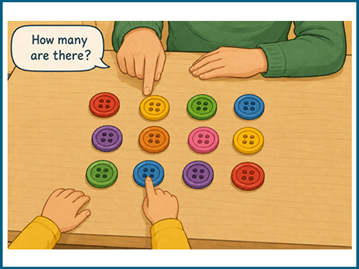
Try putting 12 buttons or small toys on a table and asking:
How many are there?
Watch whether your child touches or points to each object as they count and whether they can tell you the total when they finish.
Kindergarten counting worksheets
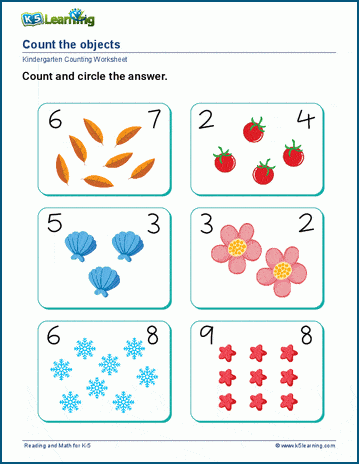
In our Kindergarten math worksheet we have a section dedicated to counting.
These count and match worksheets ask students to count the objects and circle the correct number.
Recognizing and writing numbers
Children should also be becoming familiar with written numerals.
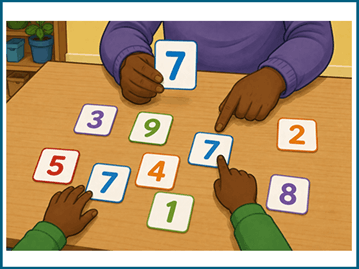
If you show your child the number 7, for example, can they name it? Can they find the 7 among several other numbers?
Writing numbers is another useful skill to practice. Reversals such as writing a 3 or 5 backwards are still quite common at this age, so don't worry if number formation isn't perfect.
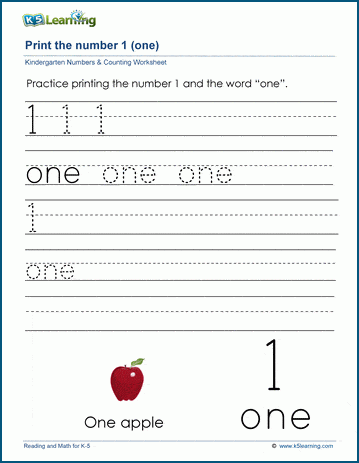
Learning numbers worksheets
This section covers Kindergarten learning numbers worksheets.
On this page, students can practice writing the numbers 1 – 20.
Connecting numbers with quantities
Recognizing the numeral 8 is one skill. Understanding that it represents eight things is another.
This connection between written numbers and actual quantities is an important part of early number sense.
You can practice it with everyday objects. Write a number on a piece of paper and ask your child to put that many blocks, crackers or crayons beside it.
For example:
5 → ● ● ● ● ●
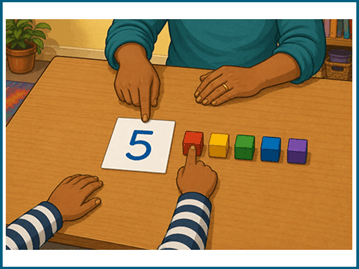
Children who understand this relationship have an important foundation for addition and subtraction.
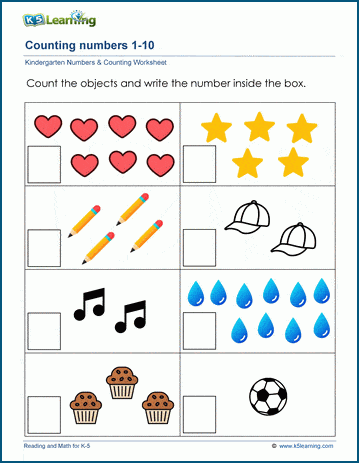
In these worksheets, students count objects and write the number for each group of objects.
Comparing numbers and groups
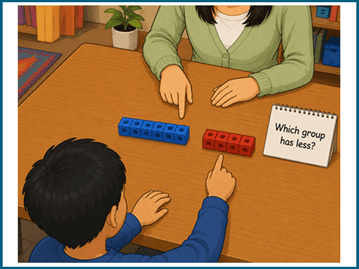
Before grade 1, children should be developing an understanding of ideas such as more, fewer and the same.
Put six blocks in one group and four in another.
Ask:
Which group has more?
Which has fewer?
How could we make the groups the same?
As children become more confident, they can begin comparing written numbers as well.
Which is greater: 8 or 5?
They don't necessarily need to have mastered the greater-than and less-than symbols yet. Understanding the idea behind the comparison is more important.
More than or less than worksheets
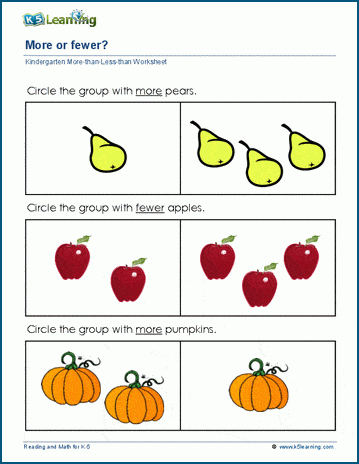
This kindergarten math page covers more than / less than worksheets.
These worksheets ask students to compare two groups of objects to circle the ones that are more than or less than.
Understanding simple addition
Children entering grade 1 don't need to be speedy at addition, but they should be beginning to understand what addition means.
Using objects makes the idea concrete.
Put three counters on the table. Add two more.
You had 3. I added 2 more. How many do you have now?
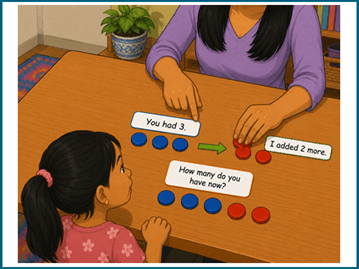
A child might count all five objects rather than immediately knowing that 3 + 2 = 5. That's completely appropriate. At this stage, understanding what is happening is more important than memorizing addition facts.
Simple addition worksheets
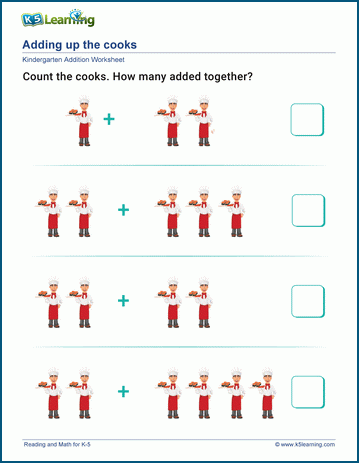
This is a section of simple addition at the kindergarten level.
In these worksheets students add two groups of objects and write the sum.
Understanding simple subtraction
The same applies to subtraction.
Give your child five crackers and take two away.
There were 5 crackers. We took away 2. How many are left?
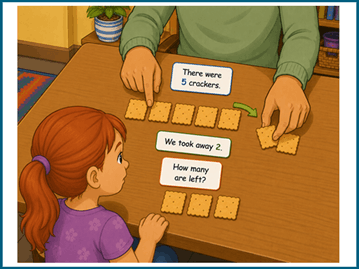
Children can use fingers, counters, drawings or other objects to work out the answer.
These hands-on experiences help children understand that subtraction can mean taking something away from a group.
Simple subtraction worksheets
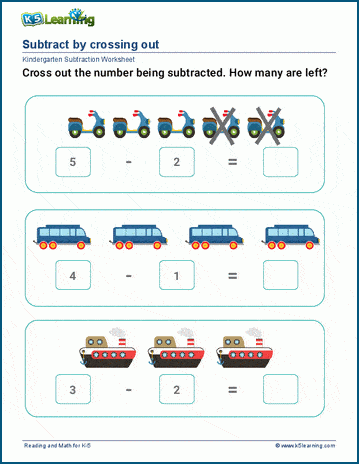
This kindergarten section covers simple subtraction.
These worksheets have students cross out objects to understand taking away.
Recognizing and making patterns
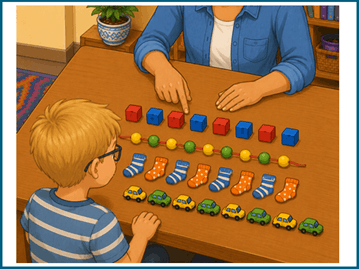
Patterns are an important early math skill because they help children learn to notice relationships and predict what comes next.
Start with a simple repeating pattern:
🔵 🟡 🔵 🟡 🔵 ___
Ask your child what should come next.
You can make patterns with almost anything: blocks, beads, socks, toy cars, movements or sounds.
As children get better at spotting simple AB patterns, try something a little more challenging:
🔴 🔴 🔵 🔴 🔴 🔵 ___
Kindergarten pattern worksheets
This section has worksheets covering recognizing and completing patterns.
In these worksheets, students use their scissor skills to paste the correct images in patterns.

Recognizing basic shapes
Children entering grade 1 should be familiar with common two-dimensional shapes such as:
circles
squares
triangles
rectangles
Rather than only memorizing shape names, encourage children to notice their features.
How many sides does a triangle have?
How is a square different from a rectangle?
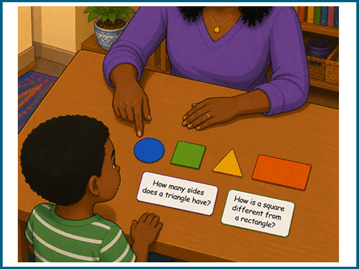
You can also look for shapes around the house. A plate might look like a circle, a window like a rectangle and a floor tile like a square.
Some children will also be familiar with three-dimensional shapes such as cubes, spheres and cones.
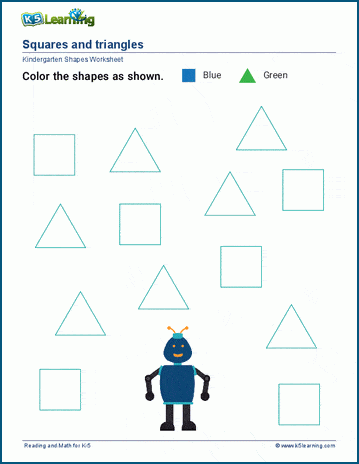
Shapes worksheets for kindergarten students
We’ve created this shapes section of worksheets for students to practice 2D and 3D shapes.
These worksheets ask students to identify specific shapes and color them.
Comparing size and measurement
Formal measurement with rulers comes later, but young children can already compare objects using everyday mathematical language.
They might recognize that:
one pencil is longer than another
one box is heavier
one cup holds more
one child is taller
one toy is smaller
Try asking your child to put three objects in order from shortest to longest or smallest to biggest.
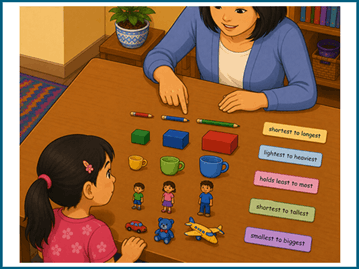
Activities like these build the concepts children will eventually use when they begin measuring length, weight and capacity more formally.
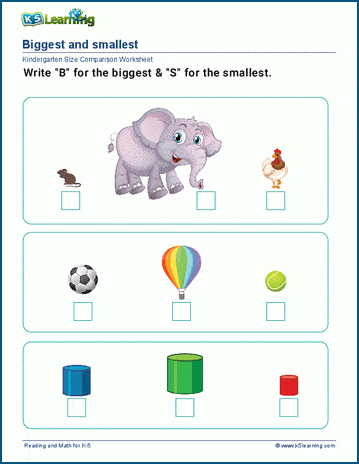
Size comparison worksheets
This section of worksheets covers big vs. small, tall vs. short, long vs. short, heavy vs. light and same vs. different.
These sets of worksheets cover comparing the biggest and smallest objects.
Understanding position words
Math isn't only about numbers. Children also need language to describe where things are.
Before grade 1, children should be becoming comfortable with words such as:
above, below, beside, between, inside, outside, in front of and behind.
You can practice these concepts naturally:
Put the teddy bear beside the box.
Now put it behind the box.
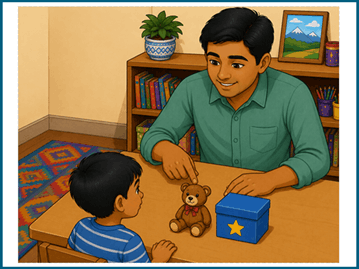
Which toy is between the car and the ball?
These spatial concepts will later support children's understanding of geometry, directions and position.
Position worksheets for kindergarten
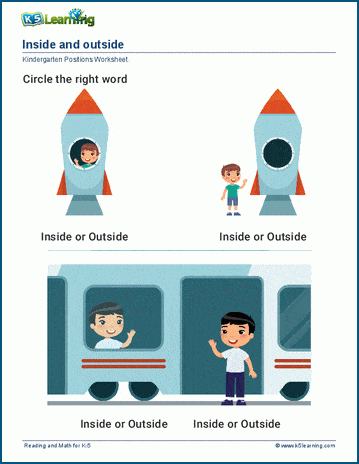
This section covers above and below, left and right, between, before and after, inside and outside, and in front of and behind.
These worksheets ask students to identify inside and outside.
Sorting and classifying
Sorting may look like a simple activity, but it involves important mathematical thinking.
Give your child a collection of buttons, blocks or other objects and ask them to put similar ones together.
They might sort them by:
color
shape
size
type
Then ask:
Why did you put these together?
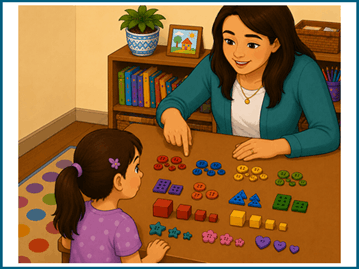
There isn't always one correct way to sort a collection. Being able to explain the rule they used is part of the learning.
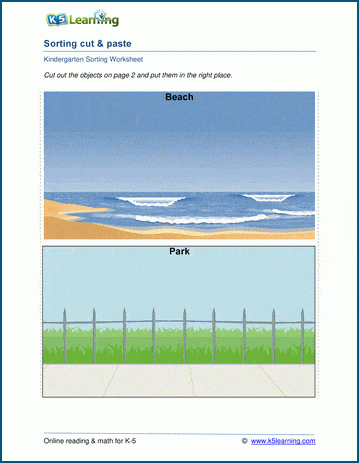
Kindergarten sorting worksheets
Here’s a section of worksheets that have students practice sorting.
Students use their scissor skills to sort objects in these worksheets.
Using math in everyday life
Some of the best math practice doesn't look like schoolwork at all.
Ask your child to count six strawberries into a bowl. Let them help divide crackers between two people. Compare the sizes of two apples. Look for numbers while you're out walking. Make a repeating pattern with blueberries and raspberries.
Simple activities like these help children see that numbers and math are useful beyond a worksheet.
Worksheets can then provide extra practice with the same concepts and help children become more comfortable working independently.
What if my child can't do all of these things?
Don't treat this as a checklist that every child has to complete before the first day of grade 1.
Children develop at different rates, and grade 1 teachers expect children to arrive with different levels of math knowledge. A child might be a confident counter but still struggle with writing numbers. Another might understand addition with objects but have trouble recognizing patterns.
Instead, use the list to identify a few skills that could use some practice.
Short, regular practice is usually more useful than trying to cover everything at once. Count objects while making dinner, look for shapes on a walk or spend 10 minutes on a kindergarten math worksheet.
The goal isn't to teach grade 1 math before grade 1 starts. It's to strengthen the basic math ideas your child will build on when they get there.
Practice math skills before grade 1
If your child is starting grade 1 soon, reviewing kindergarten math can be a simple way to refresh skills they may not have practiced much over the summer.
K5 Learning's free kindergarten math worksheets cover many of these foundational skills, including counting, numbers, addition, subtraction, shapes, patterns, measurement and other early math concepts.
Start with skills your child already knows to build confidence, then gradually introduce areas where they could use a little more practice.