


Subtracting across zeros can be tricky for elementary school students. Learn how to regroup when subtracting numbers with zeros, follow step-by-step examples and help your child practice with subtraction worksheets.
Why is subtracting across zeros difficult?
Most children learn to subtract two-digit and three-digit numbers by working from right to left, starting with the ones column. When the top digit is smaller than the bottom digit, they regroup by borrowing from the next place value.
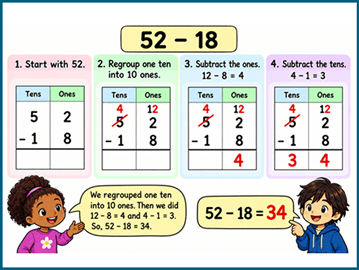
For example, in 52 − 18, children regroup one ten into 10 ones, giving them 12 − 8 = 4 in the ones column. They then subtract 4 − 1 = 3 in the tens column, giving an answer of 34.
But what happens when the next column contains a zero?
Consider 302 − 157.
Children cannot subtract 7 from 2 without regrouping. Normally, they would take one ten from the tens column. However, the tens column contains a zero, so there are no tens available to regroup.
Instead, they need to move one place further to the left and regroup from the hundreds column.
This is called “regrouping across zeros”, and it is a skill that often takes extra practice.
How to subtract across zeros: step by step
Let's work through 302 − 157.
Step 1: Write the numbers in columns
Make sure the hundreds, tens and ones are lined up correctly.
H T O
3 0 2
- 1 5 7
---------
We always start subtracting in the ones column.
Step 2: Look at the ones column
We need to subtract 7 from 2.
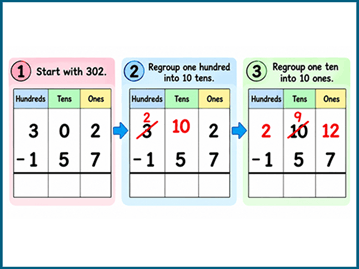
Since 2 is smaller than 7, we need to regroup. But there are zero tens, so we must go to the hundreds column.
Step 3: Regroup one hundred into ten tens
Take one hundred from the 3 hundreds.
That leaves 2 hundreds and gives us 10 tens.
H T O
2 10 2
- 1 5 7
-----------
Step 4: Regroup one ten into ten ones
Now take one ten from the 10 tens.
This leaves 9 tens and increases the ones from 2 to 12.
H T O
2 9 12
- 1 5 7
-----------
Step 5: Subtract each column
Now we can subtract from right to left.
- Ones: 12 − 7 = 5
- Tens: 9 − 5 = 4
- Hundreds: 2 − 1 = 1
The answer is:
302 − 157 = 145
The important thing for children to understand is that regrouping changes how a number is represented, but it doesn't change its value.
We started with 3 hundreds, 0 tens and 2 ones. After regrouping, we had 2 hundreds, 9 tens and 12 ones. Both represent 302.
Another example: subtracting across zeros in a four-digit number
Once children understand three-digit subtraction across zeros, they can apply the same method to larger numbers.
Let's try:
4,005 − 1,768
Step 1: Start with the ones column
We need to subtract 8 from 5, but there are no tens or hundreds available to regroup.
We must move all the way to the thousands column.
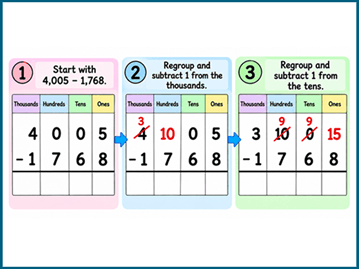
Step 2: Regroup across the zeros
Take one thousand from the 4 thousands, leaving 3 thousands.
Regroup that thousand into 10 hundreds.
Then regroup one hundred into 10 tens, leaving 9 hundreds.
Finally, regroup one ten into 10 ones, leaving 9 tens and increasing the ones from 5 to 15.
Our regrouped number now has:
- 3 thousands
- 9 hundreds
- 9 tens
- 15 ones
Step 3: Subtract from right to left
3 9 9 15
4 0 0 5
- 1 7 6 8
---------------
2 2 3 7
- Ones: 15 − 8 = 7
- Tens: 9 − 6 = 3
- Hundreds: 9 − 7 = 2
- Thousands: 3 − 1 = 2
4,005 − 1,768 = 2,237
Although the numbers are larger, the regrouping process is exactly the same.
Visualizing regrouping with place value
Some children find regrouping easier to understand when they can see what happens to the numbers.
Place-value blocks are particularly useful.
For the problem 302 − 157, begin with:
- 3 hundred blocks
- 0 ten rods
- 2 one cubes
Ask your child how they could take away 7 ones when they only have 2.
First, exchange one hundred block for 10 ten rods. Then exchange one ten rod for 10 one cubes.
The child now has:
- 2 hundred blocks
- 9 ten rods
- 12 one cubes
They can physically remove 7 ones, 5 tens and 1 hundred to find the answer.
This helps children understand that regrouping isn't simply crossing out digits and writing new numbers. They are exchanging one unit of a larger place value for ten units of the next smaller place value.
If you don't have place-value blocks, you can draw squares for hundreds, lines for tens and dots for ones.
Common mistakes when subtracting across zeros
Subtracting across zeros involves several steps, so it's easy for children to lose track of the numbers. Here are some common mistakes to watch for.
Mistake 1: Treating zero as a number they can borrow from
A child might try to borrow directly from a zero in the tens column.
Remind them that they must move left until they find a place value with something available to regroup.
Mistake 2: Forgetting to reduce a column after regrouping
In 302 − 157, children sometimes change the ones from 2 to 12 but forget that the tens column must be reduced from 10 to 9.
Encourage them to cross out and rewrite each number as they regroup.
Mistake 3: Subtracting the smaller digit from the larger digit
For example, when solving 302 − 157, a child might calculate 7 − 2 = 5 without regrouping.
Although that happens to produce the correct digit in this example, the method is incorrect and will lead to mistakes in other problems.
Remind children that subtraction works from the top number to the bottom number in each column.
Mistake 4: Losing track of multiple zeros
In a problem such as 5,003 − 2,847, children must regroup through both the hundreds and tens columns.
Working one column at a time and writing down every change makes the process easier to follow.
Mistake 5: Misaligning place values
When working with three-digit and four-digit numbers, children sometimes place digits in the wrong columns.
Using squared paper or writing H, T and O above the columns can help keep the numbers aligned.
Practice subtracting across zeros
Once your child understands the regrouping steps, give them a few problems to solve independently.
Start with three-digit numbers.
1. 403 − 175 =
2. 506 − 238 =
3. 702 − 456 =
4. 804 − 367 =
Then move on to four-digit numbers.
5. 2,004 − 1,356 =
6. 5,006 − 2,789 =
7. 6,030 − 2,485 =
8. 8,002 − 3,674 =
Encourage children to write out each regrouping step rather than trying to work everything out mentally.
Answers
1. 228
2. 268
3. 246
4. 437
5. 648
6. 2,217
7. 3,545
8. 4,328
If your child makes a mistake, look at the regrouping steps together to find where the error occurred.
Practice with subtraction worksheets
Children usually need repeated practice to become comfortable with regrouping across zeros.
Start with simpler subtraction problems that involve regrouping from the tens or hundreds column before moving on to problems containing one or more zeros.
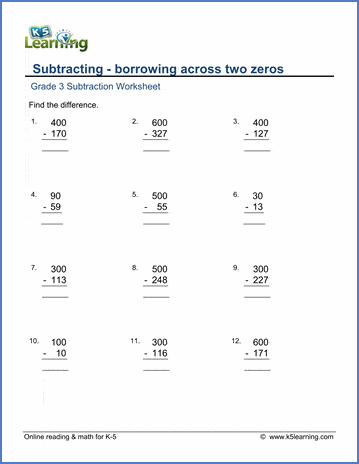
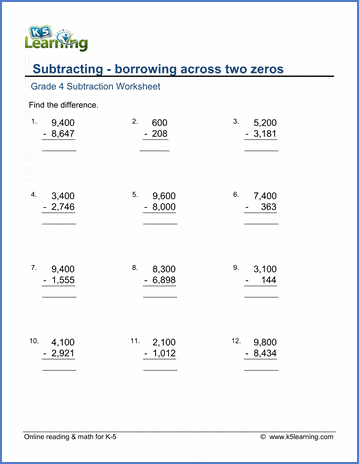
K5 Learning has free subtraction worksheets that allow children to practice at their own pace.
Grade 3 subtraction worksheets
In these worksheets students regroup across two zeros and three zeros.
Grade 4 subtraction worksheets
In these grade 4 subtraction worksheets, students regroup across two zeros and three zeros.
Children who are still learning place value may benefit from practicing with hundreds, tens and ones before attempting more difficult problems.
Helping your child become confident with regrouping
Subtracting across zeros may seem complicated at first, but the process becomes easier once children understand what happens to each place value.
Start with three-digit problems, use drawings or place-value blocks when necessary, and encourage children to write down each regrouping step.
As they gain confidence, gradually introduce larger numbers and problems with multiple zeros.
With clear explanations and regular worksheet practice, children can learn to subtract across zeros accurately and independently.