


Starting grade 2 brings some important changes in math. Children begin working with larger numbers, more complex addition and subtraction problems, and a wider range of measurement, geometry and data concepts.
For parents, that can bring up an obvious question: What math skills should my child know before starting grade 2?
The good news is that children do not need to have mastered every Grade 1 skill. Teachers expect students to arrive with different strengths and areas that still need practice.
What matters most is that children have a basic understanding of numbers, place value, addition and subtraction, along with some experience using math to solve everyday problems.
Here are some of the math skills that can help children get off to a confident start in Grade 2.
Counting forward and backward
Children entering grade 2 should be comfortable counting forward to at least 100.
They should also be developing the ability to start at a number other than 1 and continue counting.
For example, ask:
Start at 36 and count to 45.
Start at 82 and count backward to 75.
Counting backward is often more difficult than counting forward, so it may need extra practice.
Children should also be beginning to skip-count by 2s, 5s and 10s:
2, 4, 6, 8, 10
5, 10, 15, 20, 25
10, 20, 30, 40, 50
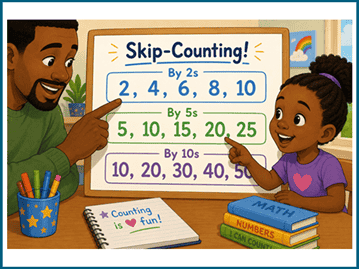
Skip-counting helps children recognize number patterns and prepares them for multiplication in later grades.
Grade 1 counting worksheets
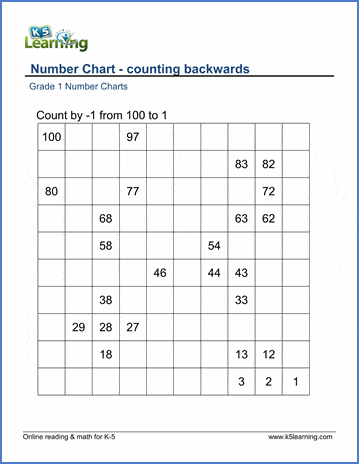
Our grade 1 number charts and counting worksheets give students practice counting forward and backward and skip-counting by 2s, 5s and 10s.
The worksheets also help children recognize and write numbers and number words.
In these worksheets, students count backwards from 100.
Reading, writing and comparing numbers
Before grade 2, children should generally be able to read and write numbers to 100.
If you say “seventy-four,” can your child write 74?
If you show them 58, can they read the number correctly?
Children should also understand that numbers can be compared and put in order.
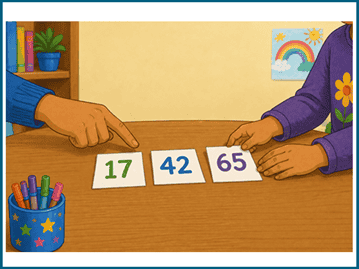
Try writing three numbers on separate pieces of paper:
42
17
65
Ask your child to arrange them from smallest to largest.
Children may also be familiar with the comparison symbols:
greater than: >
less than: <
equal to: =
It is more important, however, that they understand the comparison itself.
For example:
Which is greater: 63 or 36?
How do you know?
Comparing numbers worksheets
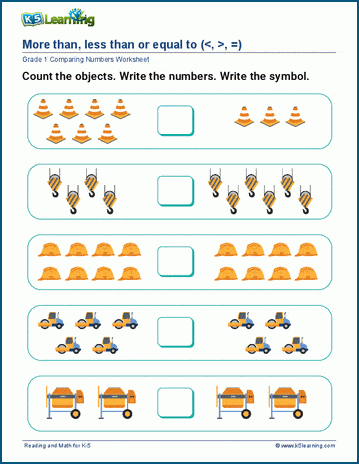
Our grade 1 comparing numbers worksheets cover comparing and ordering numbers up to 100.
Children practice using the greater-than, less-than and equal-to symbols and arranging numbers from smallest to greatest or greatest to smallest.
Students use the more than, less than and equal symbols in these worksheets.
Understanding tens and ones
Place value is one of the most important concepts children learn in Grade 1.
A child entering grade 2 should be developing an understanding that a two-digit number is made up of tens and ones.
For example:
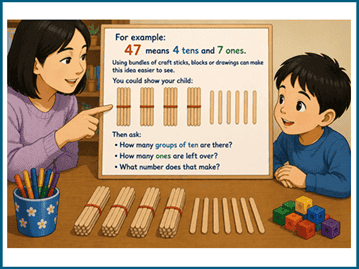
47 means 4 tens and 7 ones.
Using bundles of craft sticks, blocks or drawings can make this idea easier to see.
You could show your child:
|||||||||| |||||||||| |||||||||| |||||||||| |||||||
Then ask:
How many groups of ten are there?
How many ones are left over?
What number does that make?
Children may also be able to show a number in expanded form:
47 = 40 + 7
Understanding tens and ones prepares children to work with larger numbers and to add and subtract two-digit numbers in grade 2.
Grade 1 place value worksheets
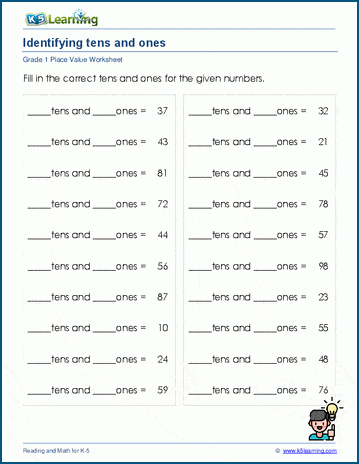
Our grade 1 place value worksheets help students work on understanding the base 10 number system.
These worksheets ask students to identify the tens and ones in 2-digit numbers.
Knowing basic addition facts
Children entering grade 2 should understand that addition means combining quantities or finding a total.
They should be able to solve simple addition problems using objects, drawings, fingers, a number line or mental strategies.
For example:
6 + 3 = 9
8 + 5 = 13
7 + 7 = 14
Some children will know many addition facts automatically. Others may still count on their fingers or use a number line. That is not unusual.
More important than speed is understanding useful addition strategies.
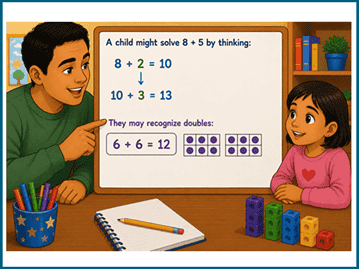
A child might solve 8 + 5 by thinking:
8 + 2 = 10
10 + 3 = 13
They may recognize doubles:
6 + 6 = 12
Or use a known double to solve a nearby fact:
6 + 7 is one more than 6 + 6, so it equals 13.
These strategies help children become more flexible and confident with numbers.
Grade 1 addition worksheets
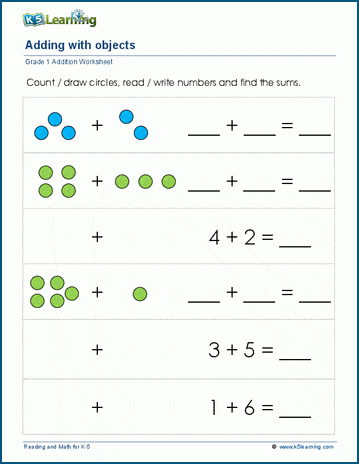
Our grade 1 addition worksheets begin with pictures and number lines before moving to addition facts, number bonds, doubles, missing addends and adding whole tens.
The grade 1 exercises focus mainly on addition without regrouping.
Students combine two groups of objects to add single digit numbers up to 10 in these worksheets.
Knowing basic subtraction facts
Children should also understand that subtraction can mean taking away, finding how many remain or comparing two quantities.
For example:
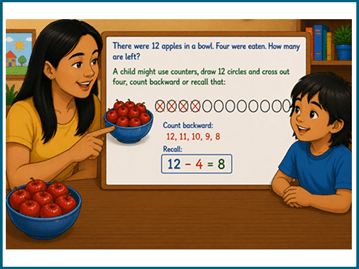
There were 12 apples in a bowl. Four were eaten. How many are left?
A child might use counters, draw 12 circles and cross out four, count backward or recall that:
12 − 4 = 8
Addition and subtraction are related. If a child knows:
7 + 5 = 12
They can use that fact to solve:
12 − 5 = 7
Children do not need to have every subtraction fact memorized before grade 2, but they should have strategies for working out simple problems.
Grade 1 subtraction worksheets
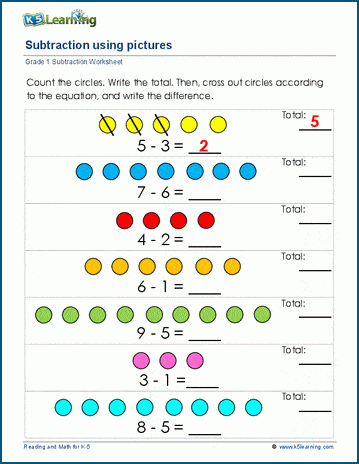
Our grade 1 subtraction worksheets give children practice subtracting with pictures, number lines and equations.
The worksheets progress from subtracting small numbers to working with numbers up to 20 and subtracting whole tens.
Students are asked to cross out objects to subtract in these worksheets.
Solving simple word problems
Being able to calculate 9 + 4 is useful, but children also need to recognize when addition or subtraction can help solve a problem.
Try asking:
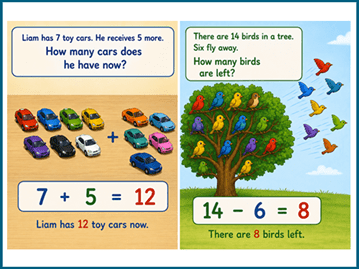
Liam has 7 toy cars. He receives 5 more. How many cars does he have now?
There are 14 birds in a tree. Six fly away. How many birds are left?
Children should think about what is happening before choosing an operation.
Words such as “altogether” and “left” can provide clues, but it is better to understand the story than to rely only on keywords.
Encourage your child to:
Listen to or read the problem.
Decide what they need to find.
Draw a picture or use objects if needed.
Choose addition or subtraction.
Check whether the answer makes sense.
Grade 1 word problem worksheets
Our grade 1 word problem worksheets connect math with everyday situations.
The worksheets cover addition, subtraction, time, money, fractions and measurement, as well as mixed problems in which children decide which operation to use.
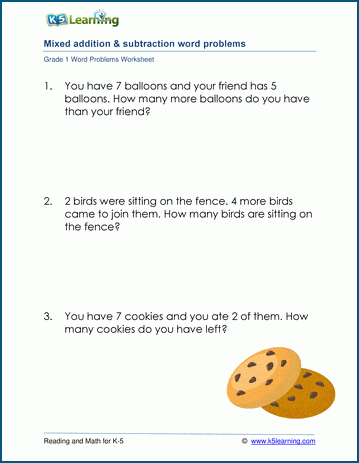
These are mixed addition and subtraction word problem worksheets for student practice.
Recognizing simple fractions
Children entering grade 2 should have some experience dividing objects and shapes into equal parts.
They may recognize:
one-half
one-third
one-quarter
The word “equal” is important. If a sandwich is cut into two pieces but one piece is much larger, the pieces are not halves.
You can explore fractions naturally when preparing food.
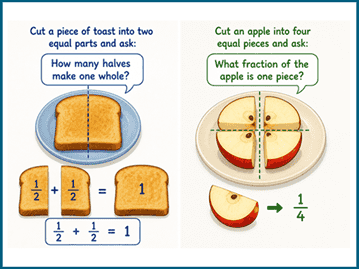
Cut a piece of toast into two equal parts and ask:
How many halves make one whole?
Cut an apple into four equal pieces and ask:
What fraction of the apple is one piece?
Children may also be able to identify fractions of a group.
For example, if two of eight counters are blue, they can see that two-eighths of the counters are blue, even if they have not yet learned to simplify the fraction.
Grade 1 fraction worksheets
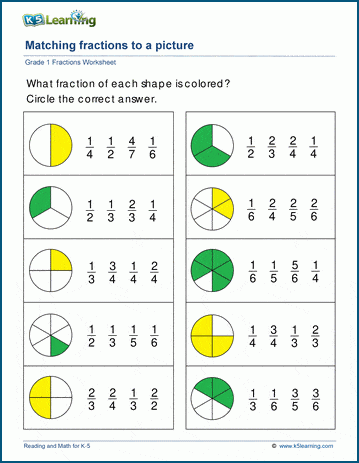
Our grade 1 fraction worksheets introduce equal parts, halves, thirds and quarters.
Children practice identifying fractions of shapes and groups of objects.
Students identify parts of a whole in these worksheets.
Measuring and comparing objects
Children entering Grade 2 should understand basic measurement language, including:
longer and shorter
taller and shorter
heavier and lighter
more and less
full, half-full and empty
They may have measured objects using non-standard units such as paper clips, blocks or cubes.
For example:
How many blocks long is this book?
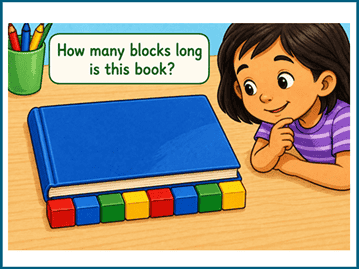
Children should understand that the units need to be the same size and placed end to end without gaps or overlaps.
Some children will also have begun measuring with rulers in inches or centimeters.
You can practice at home by choosing several objects and asking your child to estimate which is longest before measuring them.
Grade 1 measurement worksheets
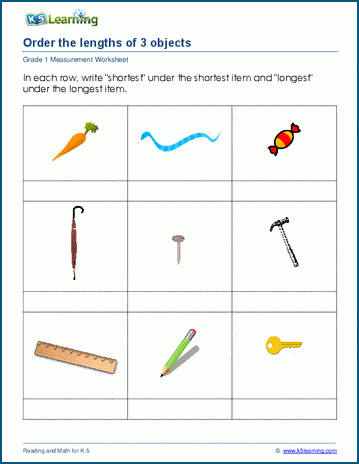
Our grade 1 measurement worksheets cover length, height, weight and capacity.
Children compare objects, measure with non-standard units and begin using customary and metric units of length.
Students order objects from shortest to longest to tallest in these worksheets.
Telling time
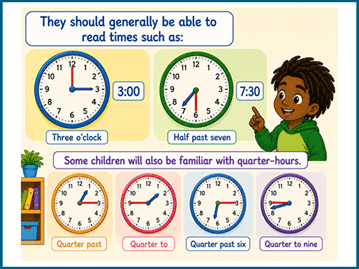
Before grade 2, children should be developing an understanding of hours, half-hours and the parts of an analog clock.
Ask your child to find:
the hour hand
the minute hand
the numbers on the clock
They should generally be able to read times such as:
3:00
7:30
Some children will also be familiar with quarter-hours.
Children should be developing a sense of how long common units of time are.
For example:
Brushing your teeth takes a few minutes.
Eating dinner may take half an hour.
Sleeping at night takes several hours.
They should also be familiar with the days of the week and months of the year.
Grade 1 telling-time worksheets
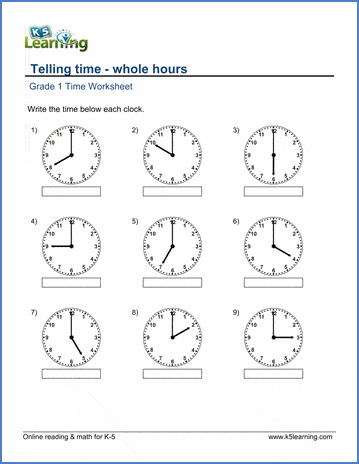
Our grade 1 telling-time worksheets give students practice reading and drawing times on analog clocks.
The section includes whole hours, half-hours, quarter-hours, elapsed time, days of the week and months of the year.
These worksheets ask students to tell time to the whole hour.
Recognizing and counting coins
Children entering grade 2 may be able to identify common coins and name their values.
Depending on the coins used where you live, ask:
What coin is this?
How much is it worth?
Which is worth more?
Children should begin to understand that a coin’s size does not necessarily tell us its value.
They may also be able to count simple groups of coins, especially when the coins have the same value.
For example:
5¢ + 5¢ + 5¢ = 15¢
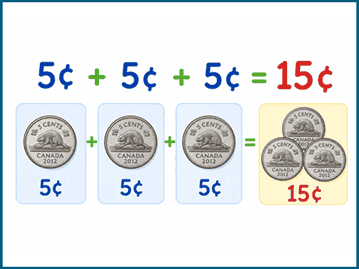
Using real or play coins can make this skill more meaningful. Set up a pretend store and let your child count the money needed to buy small items.
Grade 1 money worksheets
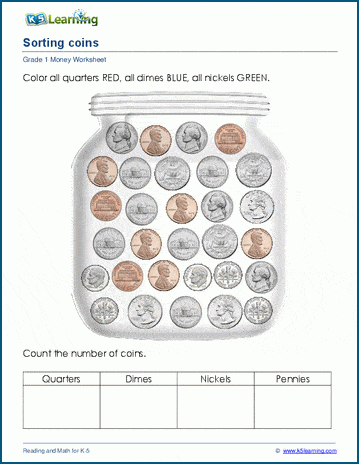
Our grade 1 money worksheets help children identify, sort and count coins.
The section includes worksheets using U.S., Canadian and several other currencies, as well as simple money word problems.
Students identify and sort coins in these worksheets.
Recognizing shapes and their attributes
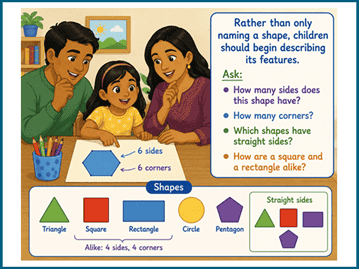
By the end of grade 1, children should be familiar with common two-dimensional shapes, including:
circles
triangles
squares
rectangles
They may also recognize three-dimensional shapes such as:
cubes
cones
cylinders
spheres
rectangular prisms
Rather than only naming a shape, children should begin describing its features.
Ask:
How many sides does this shape have?
How many corners?
Which shapes have straight sides?
How are a square and a rectangle alike?
Children should also understand that turning a shape does not change what it is. A square is still a square when it appears to be standing on one corner.
Grade 1 geometry worksheets
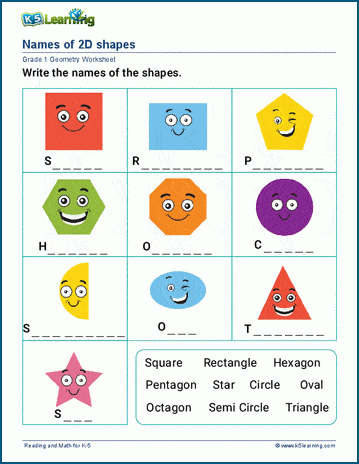
Our grade 1 geometry worksheets help students recognize, draw and describe two- and three-dimensional shapes.
The worksheets also introduce ideas such as symmetry, equal parts and the relative positions of objects.
Students name 2-dimensional shapes in these worksheets.
Reading simple graphs
Children entering grade 2 should have some experience organizing information and reading simple graphs.
They may be familiar with:
tally charts
picture graphs
bar graphs
You can create a simple graph at home by asking family members to choose their favorite fruit.
Fruit Number of votes
Apples 3
Bananas 2
Strawberries 5
Then ask:
Which fruit received the most votes?
Which received the fewest?
How many more people chose strawberries than bananas?
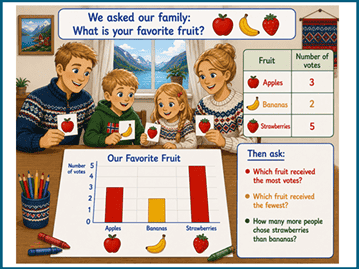
These questions help children learn to read information, compare amounts and draw conclusions from data.
Grade 1 data and graphing worksheets
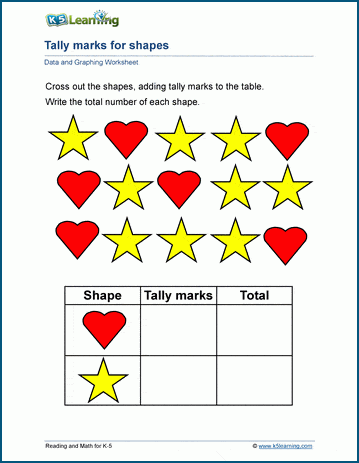
Our grade 1 data and graphing worksheets introduce sorting, tally marks, tally sheets, picture graphs and bar charts.
Children practice creating graphs and answering questions about the information shown.
Students practice using tally marks in these data worksheets.
Using math in everyday life
Some of the best grade 2 preparation can happen during ordinary activities.
Ask your child to count by 5s while setting out coins. Let them measure ingredients while you cook. Ask what time an activity begins or how many minutes remain before bedtime.
At the grocery store, compare prices or count pieces of fruit. On a walk, look for two- and three-dimensional shapes. At home, create a bar graph showing everyone’s favorite meals, colors or animals.
These activities show children that math is something they can use, not simply a collection of questions on a worksheet.
Worksheets can then provide focused practice and help children become more comfortable completing math problems independently.
What if my child can’t do all of these things?
Don’t treat this as a checklist that every child must complete before the first day of grade 2.
Children develop at different rates, and grade 2 teachers expect students to arrive with different levels of math knowledge. A child might be confident with addition but still find subtraction difficult. Another might understand place value but need more practice telling time.
Instead, use the list to identify a few areas that could use some review.
Short, regular practice is usually more useful than trying to cover everything at once. Spend 10 minutes on an addition worksheet, count backward while walking up the stairs or practice place value with blocks.
If your child consistently struggles to understand quantities, recognize numbers or solve very simple addition and subtraction problems, you may want to speak with their teacher. The teacher can help identify which skills need support and suggest appropriate activities.
The goal is not to teach the grade 2 curriculum before Grade 2 begins. It is to refresh the Grade 1 concepts your child will build on during the coming year.
Practice math skills before grade 2
If your child is starting grade 2 soon, reviewing grade 1 math can be a simple way to refresh skills they may not have practiced much over the summer.
K5 Learning’s free grade 1 math worksheets cover numbers and counting, place value, addition, subtraction, fractions, measurement, money, time, geometry, graphing and word problems.
Start with skills your child already knows to build confidence. Then gradually introduce areas where they could use a little more practice. Keep sessions short, offer hands-on materials when needed and focus on understanding rather than speed.