

Grade 3 introduces children to new ways of thinking about math. They work with bigger numbers, explore multiplication and division, and tackle problems that may take several steps to solve.
Parents often wonder how prepared their child should be before the school year begins.
Children do not need to remember or master everything they learned in grade 2. Some skills will be stronger than others, and teachers will continue to review important concepts throughout grade 3.
A good foundation is what matters. Children should understand numbers and place value, have some confidence with addition and subtraction, and be familiar with early concepts involving multiplication, fractions and measurement.
The following skills can make the transition to grade 3 math a little easier.
Understanding place value to 1,000
Before grade 3, children should understand that the value of a digit depends on its position in a number.
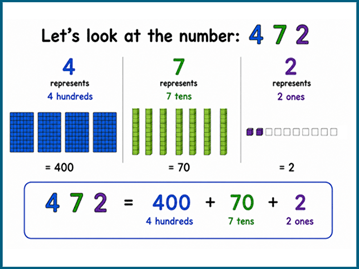
In the number 472:
4 represents 4 hundreds
7 represents 7 tens
2 represents 2 ones
They should also be able to show the number in different ways:
472 = 400 + 70 + 2
Try writing a three-digit number and asking:
What is the value of each digit?
How many hundreds, tens and ones are there?
Can you write the number in expanded form?
Grade 2 place value worksheets
Our grade 2 place value worksheets give students practice with hundreds, tens and ones, expanded form, comparing numbers and rounding.
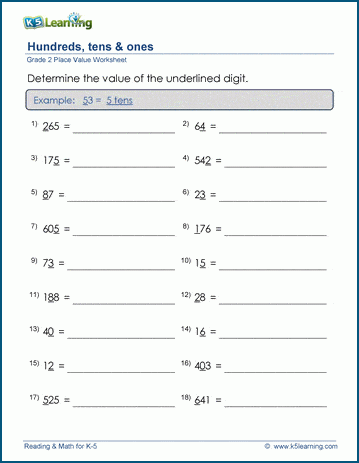
In these worksheets, students identify the value of an underlined digit in a three-digit number.
Reading, writing and comparing numbers
Children entering grade 3 should be able to read and write numbers to 1,000.
They might see:
608
and write:
six hundred eight
They should also be able to compare and order numbers. For example:
Which is greater: 583 or 538?
A child who understands place value can look at the hundreds first. If those are the same, they can compare the tens and then the ones.
Children should be familiar with the symbols:
> greater than
< less than
= equal to
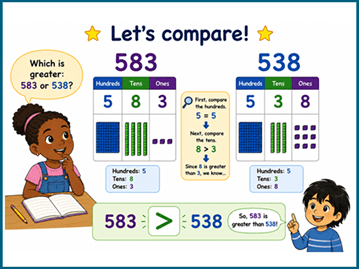
If the symbols are still confusing, first ask the child to explain which number is larger and why. Understanding the comparison is more important than remembering a trick for the symbol.
Comparing and ordering numbers worksheets
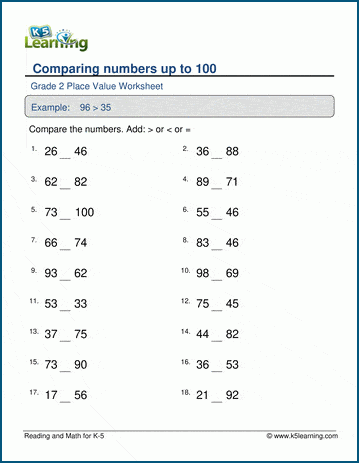
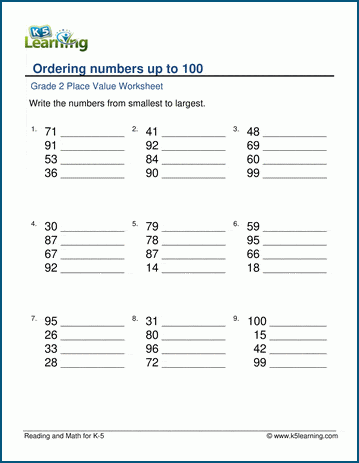
These grade 2 worksheets ask students to compare numbers up to 100 or 1,000.
/free-math-worksheets/second-grade-2/place-value-rounding/compare-numbers
Students can also practice putting numbers in order from smallest to largest.
Adding two- and three-digit numbers
By the end of grade 2, children are usually working with two-digit addition and beginning to add three-digit numbers.
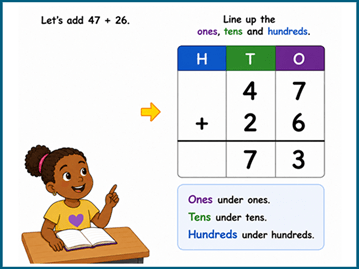
They should understand how to line up ones, tens and hundreds when adding in columns.
For example:
47
26
= 73
They should also be developing strategies for adding mentally. To work out 38 + 20, a child might add two tens to 38 and get 58.
For 38 + 7, they might make a friendly number:
38 + 2 = 40
40 + 5 = 45
Children do not need to solve every question in the same way. Being able to explain a sensible strategy is a sign that they understand the numbers involved.
Grade 2 addition worksheets
Our grade 2 addition worksheets cover addition facts, mental addition, adding in columns and addition with regrouping.
Choose questions that match your child's current level. If addition with regrouping is difficult, begin with two-digit questions without regrouping and build from there.
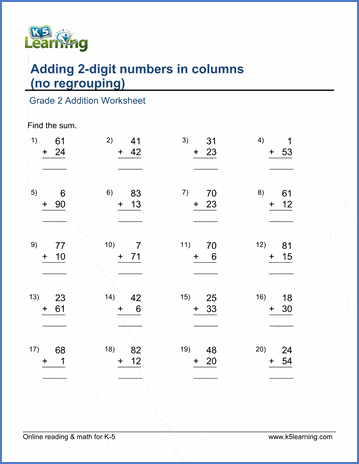
These worksheets have students add two 2-digit numbers in columns with no carrying.
Subtracting two- and three-digit numbers
Children should also understand subtraction as taking away, finding the difference or finding a missing amount.
For example:
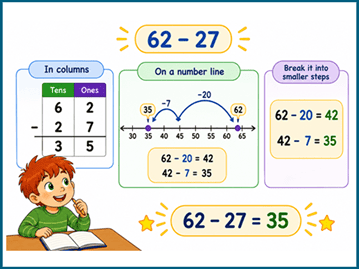
There were 62 books on a shelf. Twenty-seven were borrowed. How many are left?
A child might solve 62 − 27 in columns, use a number line or break the problem into smaller steps.
62 − 20 = 42
42 − 7 = 35
Subtraction with regrouping can take time to master. It is more useful for a child to understand why they are regrouping one ten as 10 ones than to follow a procedure they do not understand.
Grade 2 subtraction worksheets
Our grade 2 subtraction worksheets include subtraction facts, mental subtraction, two- and three-digit subtraction and subtraction with regrouping.
These worksheets can help children practice one type of subtraction at a time before moving on to mixed questions.
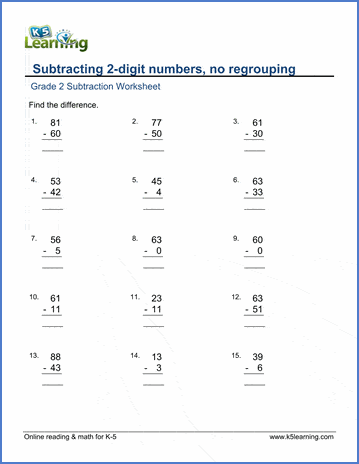
In these worksheets students subtract two 2-digit numbers in columns with no borrowing.
Knowing basic addition and subtraction facts
Children do not need to answer every fact instantly before grade 3, but having reasonable fluency with addition and subtraction facts makes more difficult math easier.
Useful facts include:
pairs that make 10, such as 6 + 4
doubles, such as 7 + 7
near doubles, such as 7 + 8
addition facts within 20
related subtraction facts, such as 15 − 7 = 8
Rather than relying only on memorization, help your child notice how facts are connected.
If 8 + 7 = 15, then:
7 + 8 = 15
15 − 8 = 7
15 − 7 = 8
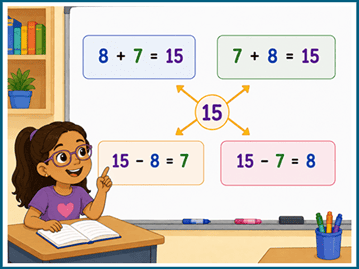
These groups of related equations are called fact families.
Addition and subtraction fact worksheets
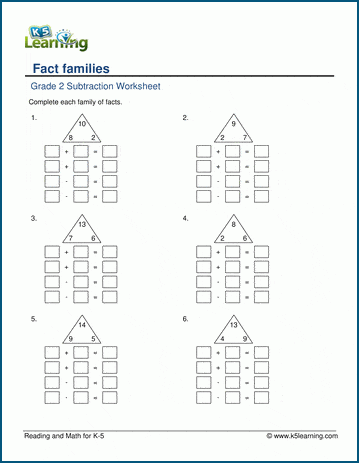
These fact family worksheets help children practice addition and subtraction facts while reinforcing the relationship between the two operations.
Short practice sessions are usually more helpful than a long page of timed questions, especially if a child is still working out efficient strategies.
Understanding the meaning of multiplication
Grade 3 places much more emphasis on multiplication. Children will have an easier start if they already understand what multiplication represents.
At this stage, that matters more than knowing every multiplication fact by memory.
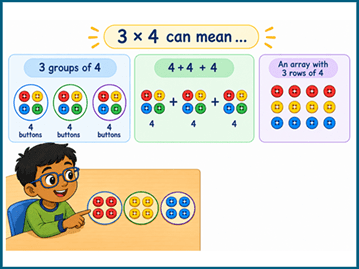
Children might see 3 × 4 as:
3 groups of 4
4 + 4 + 4
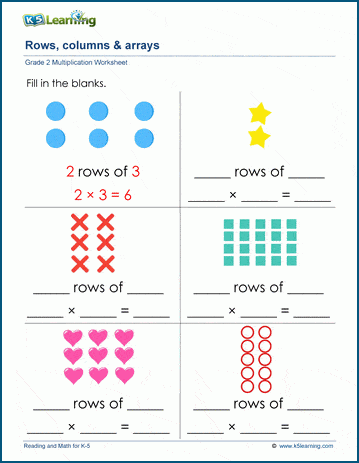
an array with 3 rows of 4
You can practice with everyday objects. Put four buttons in each of three groups and ask:
How many buttons are there altogether?
Can you write an addition sentence?
Can you write a multiplication sentence?
Skip counting by 2s, 5s and 10s also helps children begin to notice multiplication patterns.
Grade 2 multiplication worksheets
Our grade 2 multiplication worksheets introduce equal groups, arrays, multiplication sentences and the 2, 3, 5 and 10 times tables.
In these worksheets, students use rows and columns of objects to write and solve multiplication equations.
Beginning to understand division
Children may have had only an introduction to division before grade 3. They do not need to know a formal division method yet, but they should be beginning to understand the idea of sharing equally.
Give your child 12 counters and ask:
Can you share these equally among three people?
How many does each person get?
They can also make equal groups:
How many groups of three can you make with 12 counters?
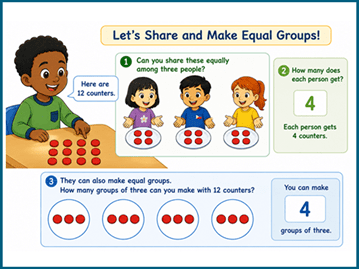
Both activities lead to 12 ÷ 3 = 4, but they approach the problem in slightly different ways.
It is also useful for children to see the connection between multiplication and division:
3 × 4 = 12
12 ÷ 3 = 4
12 ÷ 4 = 3
Hands-on practice with counters, blocks or small toys can make these ideas much easier to understand.
Solving math word problems
Grade 3 math involves more problem solving, so children need to do more than calculate accurately. They also need to decide what a question is asking.
For example:
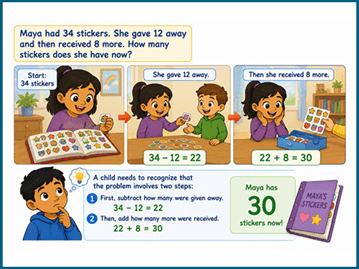
Maya had 34 stickers. She gave 12 away and then received 8 more. How many stickers does she have now?
A child needs to recognize that the problem involves two steps:
34 − 12 = 22
22 + 8 = 30
Encourage your child to:
read the problem carefully
identify what they need to find
decide which operation or operations to use
draw a picture, number line or model if helpful
check whether the answer makes sense
Avoid teaching children to choose an operation from one keyword alone. The word “more,” for example, does not always mean that they should add. Understanding the situation is more reliable.
Grade 2 word problem worksheets
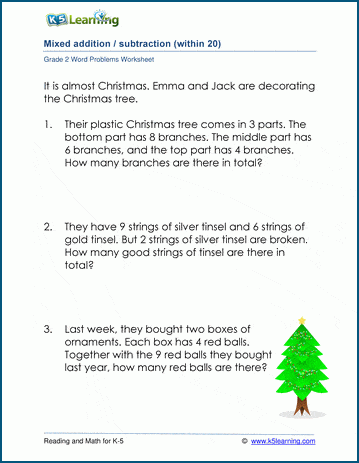
Our grade 2 word problem worksheets cover addition, subtraction, simple multiplication, measurement, time, money and fractions.
Mixed problem sets are especially useful because children have to think about the meaning of each question instead of repeating the same operation.
These worksheets cover addition and subtraction word problems where all the numbers are less than 20.
Telling time
Before grade 3, children should be able to read an analog clock and a digital clock, usually to the nearest five minutes.
They should understand:
the difference between the hour and minute hands
that there are 60 minutes in an hour
the meaning of a.m. and p.m.
simple periods of elapsed time
Ask questions during the day:
It is 3:20 now. What time will it be in 30 minutes?
The movie starts at 6:15 and ends at 7:45. How long is it?
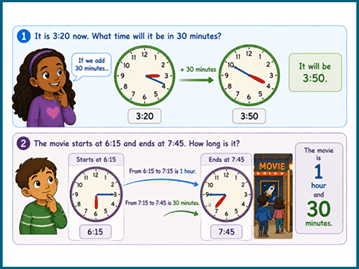
Elapsed time is often harder than simply reading a clock. A child can use a number line or count forward in manageable jumps.
Grade 2 telling time worksheets
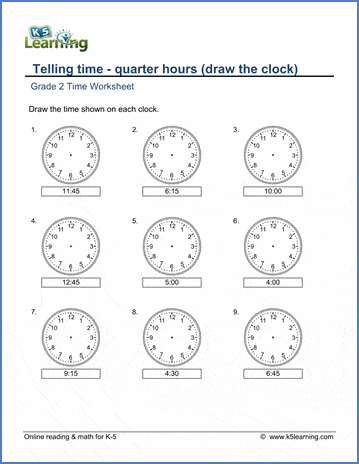
Our grade 2 time worksheets provide practice reading clocks, writing times and working out simple elapsed-time questions.
Students are asked to draw the time by the quarter hour in these worksheets.
Counting money and making change
Children entering grade 3 should be able to identify common coins and bills and combine their values to find a total.
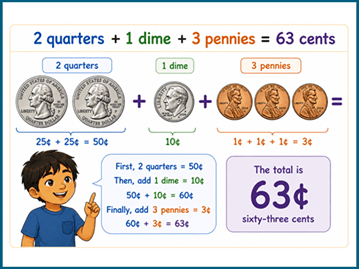
They might count:
2 quarters + 1 dime + 3 pennies = 63 cents
They should also be beginning to solve simple money problems.
An apple costs 45 cents. You pay with $1. How much change should you receive?
Playing store is an easy way to practice. Add prices to a few household items, let your child choose what to buy and ask them to find the total or work out the change.
Grade 2 money worksheets
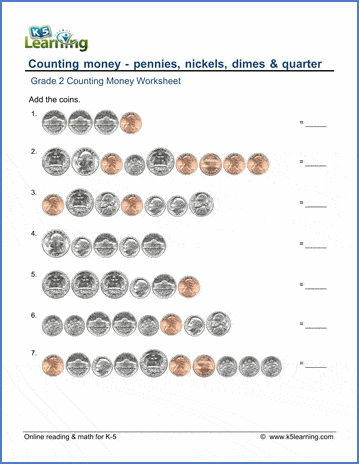
Our grade 2 money worksheets help children recognize coins and bills, count money and solve simple shopping problems. Both U.S. and Canadian currencies are available.
Students count pennies, nickels, dimes and quarters in these worksheets.
Measuring length, weight and capacity
Grade 2 students begin using standard units rather than only comparing objects as longer, shorter, heavier or lighter.
Before grade 3, children should have some experience measuring with rulers and using units such as:
centimeters and meters
inches and feet
grams and kilograms
cups and liters
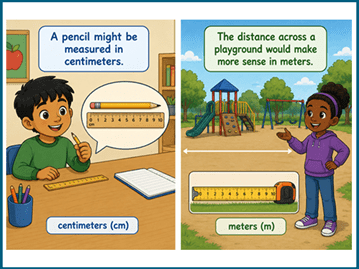
They should understand that the unit needs to match what is being measured. A pencil might be measured in centimeters, while the distance across a playground would make more sense in meters.
Children should also be able to make reasonable estimates. A classroom door is not likely to be 2 centimeters tall, for example.
Grade 2 measurement worksheets
Our grade 2 measurement worksheets cover length, weight, capacity and temperature using metric and customary units.
Whenever possible, combine worksheet practice with real measuring. Ask your child to estimate an object's length, measure it and compare the estimate with the result.
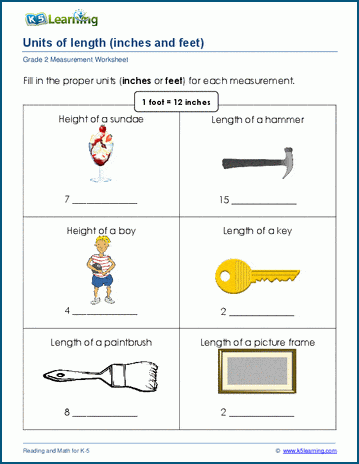
In these worksheets students choose between inches and feet to determine the length of objects.
Recognizing and describing shapes
Children should recognize common two-dimensional and three-dimensional shapes and be able to describe some of their features.
For a two-dimensional shape, they might identify:
the number of sides
the number of corners or vertices
whether sides are equal
whether the shape has a line of symmetry
For a three-dimensional shape, they might discuss faces, edges and vertices.
Ask:
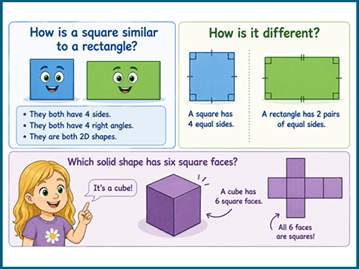
How is a square similar to a rectangle?
How is it different?
Which solid shape has six square faces?
Children may also have been introduced to area and perimeter. They do not need to have mastered these ideas, but they should begin to understand that perimeter is the distance around a shape and area is the space inside it.
Grade 2 geometry worksheets
Our grade 2 geometry worksheets cover the properties of 2D shapes, symmetry, congruency, area, perimeter and 3D shapes.
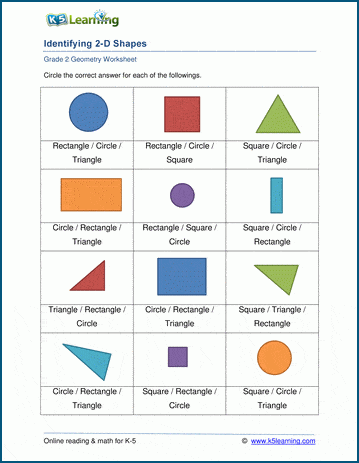
Students work on identifying shapes in these 2D geometry worksheets.
Understanding basic fractions
Before grade 3, children should understand that fractions describe equal parts of a whole or a group.
If a sandwich is cut into four equal pieces, each piece is one fourth. Three pieces are three fourths.
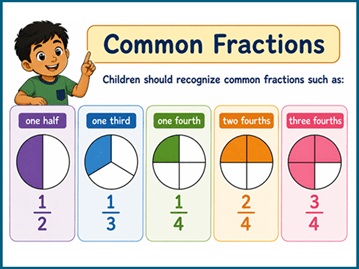
Children should recognize common fractions such as:
one half
one third
one fourth
two fourths
three fourths
The word equal is important. If a shape is divided into four pieces of different sizes, the pieces are not fourths.
Children may also be able to compare simple fractions using pictures. When two same-sized pizzas are involved, one half is greater than one fourth, even though 4 is the larger number.
Grade 2 fraction worksheets
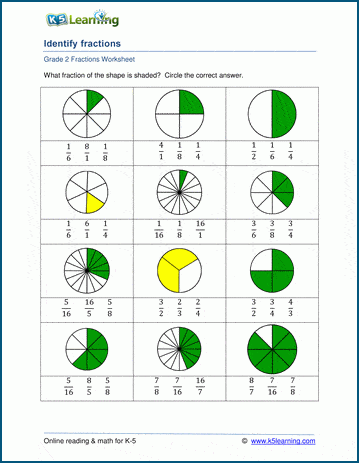
Our grade 2 fraction worksheets help students divide shapes into equal parts, identify and write fractions, compare fractions and solve simple fraction problems.
Visual models are helpful at this stage because they allow children to see what the numerator and denominator represent.
In these worksheets students work on identifying fractions.
Reading graphs and interpreting data
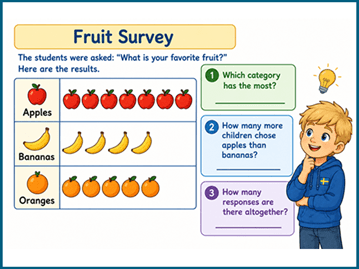
Children entering grade 3 should have some experience reading pictographs, bar graphs, tally charts and simple line plots.
They should be able to use a graph to answer questions such as:
Which category has the most?
How many more children chose apples than bananas?
How many responses are there altogether?
They may also be able to collect their own data and use it to make a graph. Ask family members to choose a favorite fruit, book or season, then help your child record the answers and display the results.
Grade 2 data and graphing worksheets
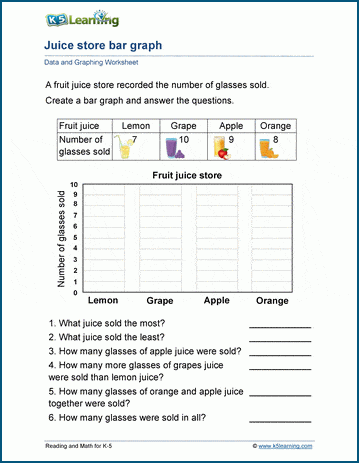
Our grade 2 data worksheets give children practice creating and reading pictographs, bar graphs, line plots and other simple graphs.
These bar graph worksheets ask students to graph a set of data and answer questions about it.
Using math in everyday life
Some of the most useful grade 3 preparation does not look like schoolwork.
Ask your child to total the prices of two groceries. Let them measure ingredients while cooking. Work out how long it is until you need to leave the house. Divide 15 strawberries equally among three people. Look for arrays in egg cartons, muffin trays or rows of chairs.
These small activities help children see that math is useful and give them a reason to think about what numbers mean.
Worksheets can then provide focused practice with the same concepts and help children become more comfortable working independently.
What if my child cannot do all of these things?
Do not treat this as a checklist that every child has to complete before the first day of grade 3.
Children develop at different rates, and grade 3 teachers expect students to arrive with different levels of math knowledge. A child might be confident with addition but still find subtraction with regrouping difficult. Another might understand multiplication with objects but need more practice telling time.
Instead, use the list to identify a few skills that could use some review.
Short, regular practice is usually more useful than trying to cover everything at once. Spend 10 or 15 minutes on one skill, play a math game or use an everyday activity to talk through a problem.
The goal is not to teach all of grade 3 math before grade 3 starts. It is to refresh the grade 2 concepts your child will build on when they get there.
Practice math skills before grade 3
If your child is starting grade 3 soon, reviewing grade 2 math can be a simple way to refresh skills they may not have practiced much over the summer.
K5 Learning's free grade 2 math worksheets cover many of these foundational skills, including place value, addition, subtraction, multiplication, fractions, measurement, time, money, geometry, data and word problems.
Start with skills your child already knows to build confidence, then gradually introduce areas where they could use a little more practice.