
 Halloween W'sheets!

Children spend plenty of time learning math at school, but a little practice at home can help reinforce what they are learning and build confidence.
That doesn't mean children need to spend an hour every evening working through math problems. Short, focused practice is usually more useful than long sessions, especially for younger children.
So, how much math practice is useful, and what should children work on?
Keep math practice short and regular
There is no set amount of math practice that is right for every child. Age, ability and what a child is currently learning all make a difference.
As a general guide, a short practice session might look something like this:
Kindergarten: 5–10 minutes
Grade 1: about 10 minutes
Grade 2: 10–15 minutes
Grade 3: 15–20 minutes
Grade 4: about 20 minutes
Grade 5: 20–30 minutes
These aren't daily requirements. Some children may benefit from a few minutes of practice several times a week, while others may need extra practice with a particular skill.
More isn't necessarily better. If your child is tired, frustrated or no longer concentrating, it is probably time to stop.
Focus on number sense
Number sense is a child's understanding of numbers and how they relate to one another. It is one of the most important foundations for later math.
For younger children, this might mean counting objects, comparing numbers or recognizing that a group of five objects is still five whether the objects are spread out or close together.
As children get older, number sense becomes more sophisticated. They might recognize that 49 + 21 is close to 50 + 20, understand different ways to make 100 or estimate an answer before calculating it.
Simple activities can help build number sense at home. Ask your child questions such as:
Which is greater, 38 or 83?
What number is 10 more than 46?
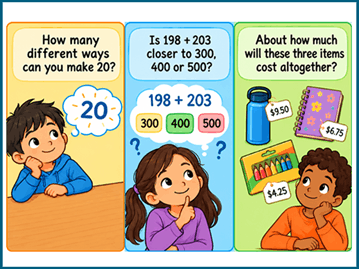
How many different ways can you make 20?
Is 198 + 203 closer to 300, 400 or 500?
About how much will these three items cost altogether?
These quick questions can often be worked into everyday conversations without turning them into a formal math lesson.
Build fluency with math facts
Children also benefit from becoming comfortable with basic math facts.
In the early grades, the focus is mainly on addition and subtraction facts. Later, multiplication and division facts become increasingly important.
Knowing these facts well frees children to concentrate on more complicated parts of a problem.
For example, a child working on a multi-step division problem will find it much harder if they also have to stop and work out basic multiplication facts.
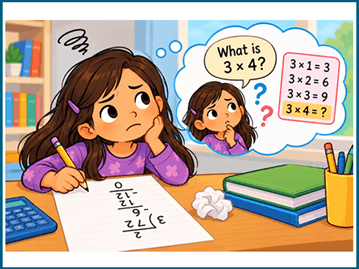
Worksheets provide useful, focused practice with math facts and give children repeated opportunities to build fluency. They can be combined with flash cards, dice, playing cards and quick oral questions to add variety to math practice.
Reinforce what your child is learning at school
Home practice is a good opportunity to strengthen skills your child is currently learning rather than racing ahead to new topics.
Depending on the grade, this might include:
Kindergarten: counting and recognizing numbers, comparing quantities, patterns, shapes, addition and subtraction.
Grade 1: addition and subtraction, place value, measurement and telling time.
Grade 2: addition and subtraction, place value, money, time and early multiplication.
Grade 3: multiplication and division, fractions, place value, measurement and word problems.
Grade 4: multiplication and division, fractions, decimals, measurement and multi-step problems.
Grade 5: fractions and decimals, multiplication and division, measurement and multi-step problems.
If your child is having difficulty with a particular skill, it can also be helpful to go back to an earlier skill that supports it.
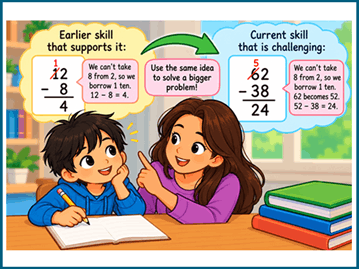
A child struggling with long division, for example, may actually need more practice with multiplication facts rather than more long-division questions.
Don't forget word problems
Being able to calculate an answer is only part of learning math. Children also need to understand when and how to use their math skills.
Math word problems help children practice this.
Instead of immediately looking for numbers and choosing an operation, encourage your child to think about the problem first.
What is the question asking?
What information is important?
Which operation might help?
Does the answer make sense?
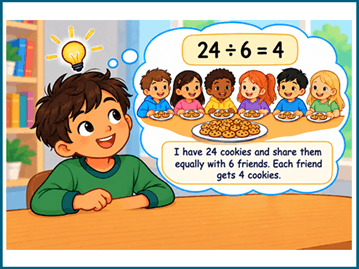
Children can also make up their own word problems. Give them a calculation such as 24 ÷ 6 = 4 and ask them to create a short story that matches it.
Practice math in everyday life
Not all math practice needs to happen with pencil and paper.
Everyday activities provide plenty of opportunities to use math in meaningful ways.
While cooking, children can practice measurement, measure ingredients, double a recipe or compare fractions.
At the grocery store, they can compare prices, estimate the total cost or calculate change.
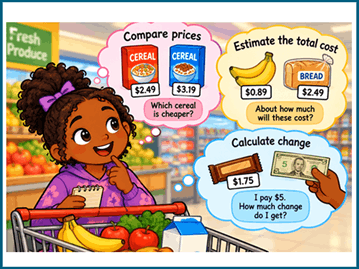
Around the house, they can measure furniture, read clocks, work out how much time is left before an activity or estimate how many objects will fit into a container.
Games can provide math practice too. Card games, dice games, puzzles and board games can involve counting, addition, strategy, probability and logical thinking.
These activities help children see that math is something they use, not just something they do on a worksheet.
Spend more time on weak areas
It can be tempting to practice the math your child already does well. Success feels good, and familiar questions are usually easier to complete.
But home practice is also an opportunity to strengthen weaker skills.
If your child consistently has trouble with fractions, place value or multiplication, include a little extra practice in that area.
Start with problems your child can manage and gradually increase the difficulty. If the work is so difficult that your child doesn't understand what to do, simply completing more questions is unlikely to help.
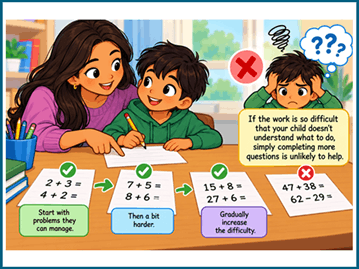
In that situation, go back a step and make sure the underlying concept is understood first.
Include some review
Math skills can become rusty when children don't use them.
A child who is currently learning fractions can still benefit from occasional practice with multiplication. A child working with decimals may need to revisit place value.
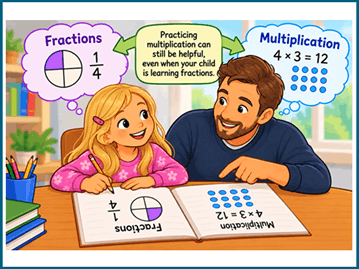
Mixing a few previously learned skills into home practice helps children retain what they have learned and recognize when to use different types of math.
Aim for understanding, not just correct answers
A correct answer doesn't always mean a child understands the math behind it.
Occasionally ask your child to explain how they found an answer.
There may be several ways to solve the same problem. For example:
27 + 15
A child might add 20 + 10 and then 7 + 5.
Another might turn 27 into 30 by taking 3 from 15, then calculate 30 + 12.
Both approaches lead to 42.
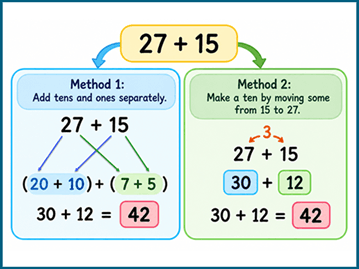
Talking through strategies helps children think about numbers and develop a deeper understanding of how math works.
Keep math practice positive
Home math practice should reinforce learning, not become a nightly battle.
Short, regular sessions that focus on important skills are generally more useful than trying to complete a large amount of work at once.
Focus on number sense, math facts, current grade-level skills, word problems and areas where your child could use a little extra practice. Mix math worksheets with games and everyday activities, and stop when concentration starts to disappear.
The goal isn't simply to do more math. It's to help children become more comfortable, capable and confident using the math they are learning.