


When your child makes equal groups, there may be a few items left over. Those leftovers are the remainder. Start with a small group of objects, then use multiplication facts or long division to find the remainder in larger problems.
What is a remainder?
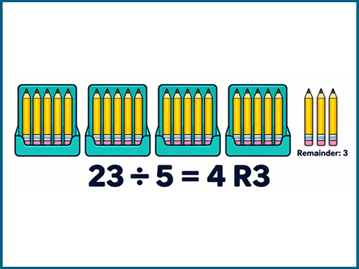
Suppose you have 23 pencils and each box holds 5 pencils. You can fill 4 boxes. That uses 20 pencils and leaves 3 pencils loose.
23 ÷ 5 = 4 R3
The quotient is 4, the number of full boxes. The remainder is 3, the number of pencils left over. The divisor is 5, the number of pencils in each full box.
If your child is still learning to make equal groups, start with our Grade 3 Division guide.
Find the remainder using multiplication
To solve 38 ÷ 6, think of the multiples of 6 near 38.
• 6 × 6 = 36. Six groups fit.
• 6 × 7 = 42. Seven groups would take too many.
• Subtract 38 − 36 = 2 to find what is left.
So 38 ÷ 6 = 6 R2. Ask your child to check by multiplying and adding back the remainder. 6 × 6 + 2 = 38.
Our grade 3 division with remainders worksheets give students practice using division facts with numbers up to 100.

Find the remainder using long division
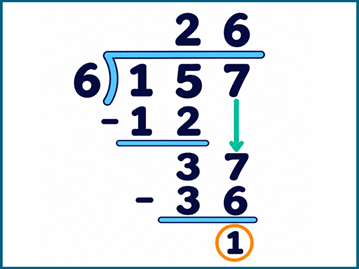
For larger numbers, use long division. Try 157 ÷ 6.
1. Start with 15 tens. Six goes into 15 twice. Write 2 in the tens place above the 5. Multiply 2 × 6 = 12 and subtract 15 − 12 = 3.
2. Bring down the 7. The 3 tens and 7 ones make 37 ones.
3. Six goes into 37 six times. Write 6 in the ones place above the 7. Multiply 6 × 6 = 36 and subtract 37 − 36 = 1.
The answer is 26 R1. Check it with 26 × 6 + 1 = 157.
Try our grade 4 long division worksheets with three-digit dividends.
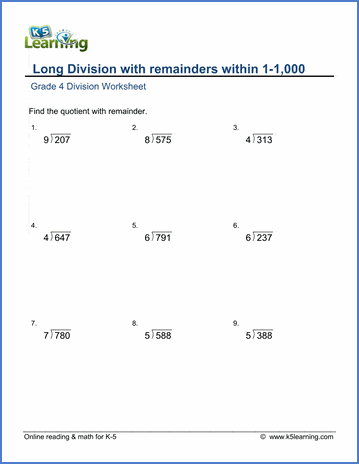
For a challenge, use our grade 5 long division worksheets with two-digit divisors.

What does the remainder mean in a word problem?
The same calculation can answer different questions. Go back to the 23 pencils and the boxes that hold 5 each.
• How many full boxes can you make? Four full boxes.
• How many pencils are left over? Three pencils.
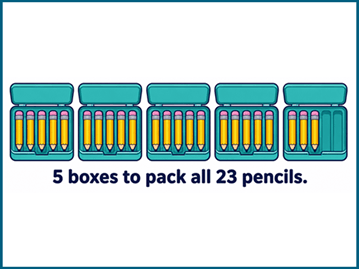
• How many boxes do you need to pack all the pencils? Five boxes. Four are full, and the fifth holds the remaining three pencils.
For another example, see how a remainder tells you when to add an extra bus in What Math Skills Kids Should Know Before Grade 5.
Check for these common mistakes
• The remainder is as large, or larger, as the divisor. If your child writes 23 ÷ 5 = 3 R8, ask whether 8 pencils are enough to fill another box. One more group of 5 leaves 3 pencils, so the answer is 4 R3. The remainder must be smaller than the divisor.
• The answer drops the leftover amount. If your child writes 38 ÷ 6 = 6, have them multiply 6 × 6. They get 36, so they still need to account for 2. When the multiplication gives the original number exactly, the remainder is zero.
Try it together
1. Find the quotient and remainder for 29 ÷ 4.
2. Use long division to solve 173 ÷ 5.
3. A van holds 6 students. How many vans are needed for 31 students?
Answers
1. 7 R1
2. 34 R3
3. 6 vans. Five vans hold 30 students, and one more van is needed for the last student.