


Multiplication word problems ask students to use multiplication to solve everyday questions. Some need just one calculation. Others need two steps to reach the final answer.
For students in grades 3–5, identifying what to find first helps make these problems easier to solve.
One-step multiplication word problems
A one-step problem needs one calculation to answer the question.
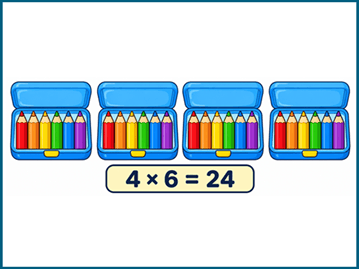
Example: There are 4 boxes with 6 pencils in each box. How many pencils are there altogether?
There are 4 equal groups of 6:
4 × 6 = 24
There are 24 pencils altogether.
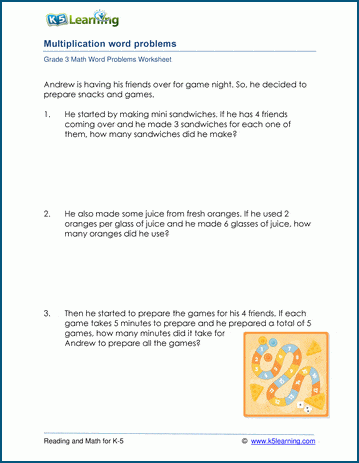
Our grade 3 multiplication word problem worksheets help students turn simple stories into multiplication equations.
Two-step multiplication word problems
A two-step problem needs two calculations. Students use the answer from the first step to complete the second.
Compare this problem with the first example:
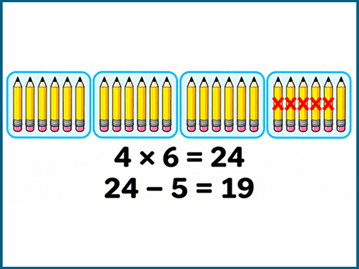
Example: There are 4 boxes with 6 pencils in each box. A teacher gives away 5 pencils. How many pencils are left?
Step 1: Find the total number of pencils.
4 × 6 = 24
Step 2: Subtract the pencils given away.
24 − 5 = 19
There are 19 pencils left.
The first calculation finds how many pencils there were at the start. The second answers the question about how many remain.
Multiply, then add
Some two-step problems combine multiplication and addition.
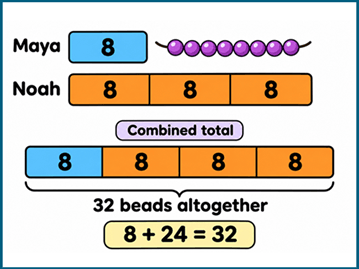
Example: Maya has 8 beads. Noah has 3 times as many beads as Maya. How many beads do they have altogether?
Step 1: Find how many beads Noah has.
3 × 8 = 24
Step 2: Add Maya’s beads.
24 + 8 = 32
They have 32 beads altogether.
Does multiplication always come first?
No. The situation determines which calculation comes first.
Example: A class has 3 trays of seedlings and receives 2 more trays. Each tray holds 6 seedlings. How many seedlings are there now?
First, find the number of trays:
3 + 2 = 5
Then, find the number of seedlings:
5 × 6 = 30
There are 30 seedlings altogether.
Ask your child: “What do you need to know before you can answer the question?”
For more help planning each calculation, follow our simple process for solving math word problems.
/blog/there-is-simple-process-solving-math-word-problems
Common mistakes to watch for
Stopping after the first step. Finding 24 pencils does not answer how many are left after five are given away. Have your child reread the question before finishing.
Choosing an operation from one word. “Altogether” may suggest addition, but four equal groups of six can be found by multiplying. Focus on what is happening in the story. Our guide to identifying the operation in word problems explains how to help children choose the right calculation.
/blog/identify-the-operation-in-word-problems
Confusing “times as many” with “more than.” Three times as many as eight means 3 × 8, not 3 + 8.
Leaving out the units. Write “19 pencils” so the answer clearly connects to the question.
Try these multiplication word problems
Ask your child to decide whether each problem needs one step or two, then write an equation for each step.
1. There are 5 bags with 7 marbles in each bag. How many marbles are there altogether?
2. There are 5 bags with 7 marbles in each bag. Sam removes 9 marbles. How many marbles remain?
3. Ava reads 12 pages each day for 4 days. She reads another 8 pages on Friday. How many pages does she read altogether?
Answers:
1. One step: 5 × 7 = 35 marbles.
2. Two steps: 5 × 7 = 35; 35 − 9 = 26 marbles.
3. Two steps: 12 × 4 = 48; 48 + 8 = 56 pages.
Word problem worksheets for more practice
Once students are comfortable with simple multiplication stories, mixed problems help them practice deciding which operations to use.
Our grade 4 mixed-operation word problem worksheets include questions with more than one step.
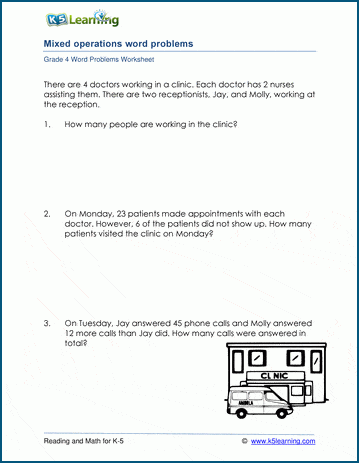
For further practice, explore our grade 5 word problem worksheets, including mixed operations, money and measurement problems.
/free-math-worksheets/fifth-grade-5/word-problems
/worksheets/math/grade-5-word-problems-mixed-operations-a.gif
Start with a few questions and ask your child to explain what each calculation finds. This helps you check their understanding as well as their arithmetic.