
 Thanksgiving WS's!


After reading a story together, ask your child, “What happened first?” Then ask what happened next and how the story ended. Putting the main events in order helps your child follow what the characters do and retell the story in their own words.
A child might remember the funniest part or jump straight to the ending. If that happens, ask them to go back to the beginning and tell you what led up to the part they remember. A few questions can help them connect the events into a retelling that makes sense to someone hearing the story for the first time.
What is the sequence of events in a story?
The sequence of events is the order in which things happen. Start with three main events and use first, next, and last to retell them.
An event is something that happens in the story. A red sail describes the boat. The wind blowing the boat away is an event. When your child chooses what to include, ask which actions help explain what happens by the end.
Example 1 — Maya’s toy sailboat
First, Maya set her toy sailboat in a puddle. Next, the wind blew the boat toward the reeds. Finally, Maya used a stick to guide it back to the edge.
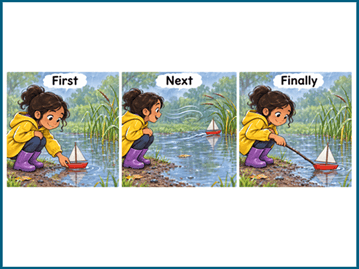
Ask your child why Maya needed the stick. The wind had already blown the boat away from the edge. That connection helps your child remember which event came before Maya used the stick.
Look at the three pictures together. Ask your child to point to the picture where Maya puts the boat in the water, then find the picture where she brings it back. What happened between those two moments? Have your child retell the story from the pictures, using a complete sentence for each event.
For more three-event practice, try our grade 1 sequencing worksheets.

Look for clues that tell you when things happened
Words such as before, after, and later can help your child work out the order. Sometimes the event that happened first is mentioned later in the sentence.
Example 2 — The library book
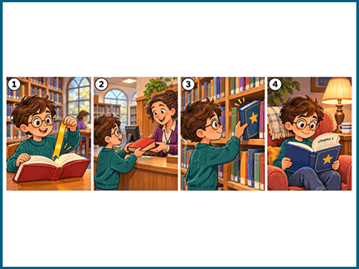
Before Leo returned his book, he took his bookmark out. After he dropped the book in the return slot, he picked out a new one. Later that afternoon, he read the first chapter at home.
1. Leo took out his bookmark.
2. He returned his book.
3. He picked out a new book.
4. He read the first chapter at home.
Ask your child to underline before in the first sentence. Which happened first, taking out the bookmark or returning the book? Have them point to the words that helped them decide.
Try saying the first sentence another way. “Leo took out his bookmark before he returned his book.” The sentences mention the actions in a different order, but both tell us that Leo took out the bookmark first. You can do the same with after. “Leo picked out a new book after he returned his old one.” Ask your child to say which action happened earlier and explain how they know.
For more practice using time clues in a passage, try our grade 3 sequencing worksheets.

Put more events in order
For a longer story, ask your child to jot down the main events as they read. If the order is unclear, have them find the sentence that connects two events. In Maya’s story, the boat has to drift away before she needs the stick to bring it back.
Example 3 — The class garden
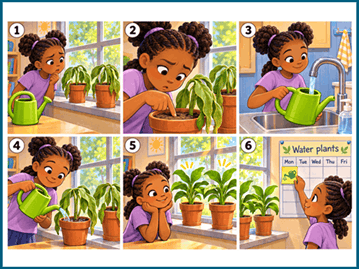
At recess, Amina noticed that the bean plants were drooping. She pressed a finger into the soil. It felt dry, so she filled a watering can at the outdoor tap. She watered the plants around their roots. By the end of the school day, the leaves had perked up. Amina added a reminder to the class chart so someone would check the soil the next morning.
Have your child use a few words for each event. A timeline for this story might look like this.
1. Amina noticed the drooping plants.
2. She checked the soil.
3. She filled the watering can.
4. She watered the plants.
5. The leaves perked up.
6. She added a reminder to the chart.
Ask what Amina did just before she filled the watering can. Then ask what happened after she watered the plants. Have your child find the words by the end of the school day and explain where that event belongs on the timeline.
Try our grade 4 sequencing worksheets to practice identifying and ordering events in longer texts.

Try it together
Read these events aloud and ask your child to put them in order.
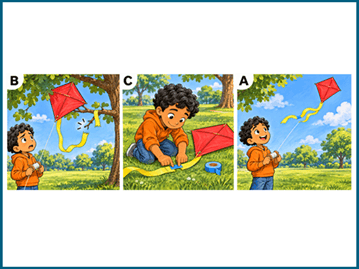
• A. Sam put the repaired kite back in the air.
• B. The kite’s tail tore on a low branch.
• C. Sam taped the torn tail.
Answer — B, C, A. The tail tore first. Sam fixed it next. Last, Sam flew the kite again.
After your next read-aloud, have your child draw three boxes and sketch one main event in each. Ask them to use the pictures to retell the story. If two events get swapped, go back to the page where they happened and look for a clue together.
For a second round, write four or more events from a familiar story on slips of paper and mix them up. Have your child arrange the slips, then choose two neighboring events and explain why one comes before the other. If their explanation is “That’s how I remember it,” ask them to find a time clue or an action in the text that supports their answer.
Browse our sequencing worksheets by grade for more practice.