
 Halloween W'sheets!


Your child has written a story, but every animal is big, every character is happy and every adventure is nice. How can you help them explore other words without turning writing into a search for the longest word in the dictionary?
Synonyms give children choices. A big footprint might be enormous, while a big backpack might simply be large. Choosing between those words helps a writer think about the picture they want the reader to see.
Use the 100 synonyms below as a writing word bank. Start with a few familiar words, talk about their meanings and try them in sentences together.
What are synonyms?
Synonyms are words with the same or similar meanings. For example, small and little are synonyms in a sentence about a small kitten.
However, synonyms do not work as replacements in every sentence. A little kitten sounds natural, but a little brother usually means a younger brother, even if he is tall!
Explain it this way: “Synonyms have meanings that are close. We still need to check which word fits.”
How can synonyms improve writing?
Synonyms can help children avoid distracting repetition, describe something more precisely and show differences in feelings or actions.
Compare these sentences:
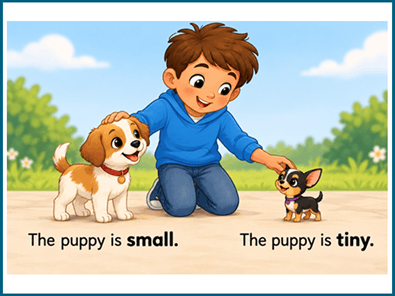
• The puppy was small.
• The puppy was tiny.
Both describe size, but tiny emphasizes how small the puppy was.
Now compare:
• Ava looked at the mysterious footprints.
• Ava examined the mysterious footprints.
Examined tells us that Ava looked carefully. It adds information about her action.
The aim is to choose a word that expresses the intended meaning. Familiar words such as said, good and big can still be the right choices.
100 synonyms to use as a writing word bank
This list gives 25 familiar words with four alternatives each: 100 synonym choices in total. The alternatives include close synonyms and words with more specific meanings. They are not interchangeable in every sentence.
Some choices will be familiar to younger children; others can be introduced with adult support. Choose a small group rather than asking your child to learn the whole list at once.
Words for size and appearance
1. Big: large, huge, enormous, gigantic.
2. Small: little, tiny, miniature, minuscule.
3. Beautiful: pretty, lovely, attractive, gorgeous.
4. Clean: spotless, tidy, neat, immaculate.
5. Dirty: muddy, dusty, grimy, filthy.
Try the words in a sentence:
The dog left dirty paw prints on the floor.
The dog left muddy paw prints on the floor.
Muddy tells us what made the prints dirty. Dusty would suggest a different kind of dirt. Similarly, a tidy room is orderly, while a spotless room has no visible dirt. Ask which meaning your child intends.
Words for feelings
6. Happy: glad, cheerful, delighted, joyful.
7. Sad: unhappy, sorrowful, miserable, gloomy.
8. Angry: cross, annoyed, irritated, furious.
9. Scared: afraid, frightened, fearful, terrified.
10. Surprised: amazed, astonished, startled, stunned.
Try the words in a sentence:
Leo was angry when his tower fell over.
Leo was annoyed when his tower fell over.
Leo was furious when his tower fell over.
Annoyed suggests a milder reaction than furious. Discuss which word matches what happened and how Leo behaved.
Words for actions
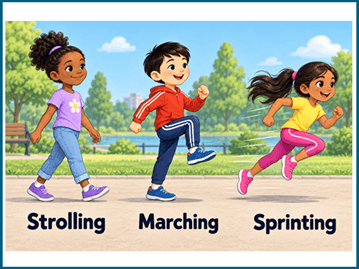
11. Walk: stroll, wander, march, stride.
12. Run: jog, sprint, dash, race.
13. Look: glance, gaze, peek, examine.
14. Say: state, remark, mention, declare.
15. Make: create, build, construct, produce.
Try the words in a sentence:
Mia walked through the garden.
Mia strolled through the garden.
Strolled suggests a relaxed walk. Marched would suggest more purposeful, regular steps. Both relate to walking, but they create different pictures.
The same care applies to make. You can build a tower and produce a report, but you would not usually build a sandwich or construct a noise.
Words for sounds and speed
16. Loud: noisy, booming, thunderous, deafening.
17. Quiet: soft, hushed, muted, faint.
18. Fast: quick, speedy, rapid, swift.
19. Slow: unhurried, leisurely, sluggish, gradual.
20. Sudden: unexpected, abrupt, unforeseen, unanticipated.
Try the words in a sentence:
We heard a loud crash.
We heard a deafening crash.
Deafening suggests an extremely loud sound. It may fit a dramatic story, but it could exaggerate the noise made by a dropped pencil.
Check the noun, too. Gradual can describe a slow change, while sluggish can describe slow movement. “A gradual turtle” does not express the same idea as “a sluggish turtle.”
Words for everyday descriptions
21. Good: excellent, fine, great, superb.
22. Bad: poor, awful, terrible, dreadful.
23. Easy: simple, straightforward, effortless, uncomplicated.
24. Hard: difficult, challenging, tough, demanding.
25. Important: significant, essential, major, crucial.
Try the words in a sentence:
The puzzle was hard.
The puzzle was challenging.
Here, hard means difficult. In “The rock was hard,” it describes firmness instead. Challenging would change the meaning rather than provide a suitable synonym.
For children who would benefit from matching practice, K5 Learning's grade 2 synonym worksheets and grade 3 synonym worksheets offer word-bank activities. After matching a pair, ask your child to use the words in a sentence.


How to help your child choose the right synonym
1. Work out what the original word means
Read the whole sentence before looking for alternatives.
In “We had a bright idea,” bright means clever or promising. In “The lamp was bright,” it describes light. A synonym that fits one sentence may not fit the other.
Ask, “What does this word tell us here?”
2. Think about the picture or feeling
Try two possible words and discuss the difference.
• The rabbit dashed across the grass.
• The rabbit jogged across the grass.
Dashed better suggests a quick burst of movement. Jogged would create a different, possibly humorous picture.
Ask, “What do you want the reader to imagine?”
3. Check the grammar
The replacement must fit the sentence structure. Children may need to change a word's ending.
• Yesterday, we walked to the pond.
• Yesterday, we strolled to the pond.
“Yesterday, we stroll to the pond” does not preserve the past tense.
4. Read the sentence aloud
Ask your child to read the revised sentence. Does it sound natural? Does it still say what they meant?
If they cannot explain the new word, discuss its meaning before using it. A dictionary or child-friendly thesaurus can offer possibilities, but the writer makes the final choice.
Simple synonym activities to try at home
Choose the word that fits
Read each sentence and choose the better word for the situation.
1. The baby was sleeping, so we spoke in hushed / thunderous voices.
2. When the starting whistle blew, the runners sprinted / strolled toward the finish line.
3. After losing her favorite toy, Isla felt miserable / delighted.
4. The instructions were clear and straightforward / demanding, so I followed them easily.
Answers: 1. Hushed. 2. Sprinted. 3. Miserable. 4. Straightforward.
Ask your child to explain one choice. The explanation reveals whether they understand the word in context.
Build a word-strength scale
Write these words on separate cards:
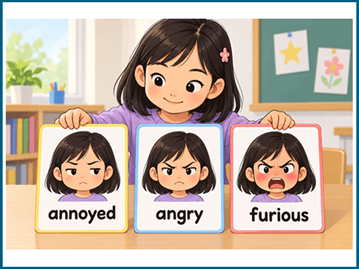
Annoyed — angry — furious
Ask your child to arrange them from a milder feeling to a stronger one. Then invent a situation for each word.
For example, a child might be annoyed by a squeaky chair but furious when someone deliberately destroys their project. Discuss their reasoning; reactions can differ between people and situations.
For more examples of differences between related words, explore our article on shades of meaning.
Revise a short paragraph
Read this paragraph together:
A big dog walked into the garden. It looked at a small hole beside the fence. Then it made a loud noise.
Ask your child to change two or three words using a word bank. Here is one possible revision:
A huge dog wandered into the garden. It examined a tiny hole beside the fence. Then it made a thunderous noise.
Talk about what changed. Wandered suggests the dog was moving without a fixed direction. Examined suggests careful attention. Thunderous makes the final noise seem powerful.
There is no single correct revision. Your child might choose a different mood or decide that some original words already work well.
For a further challenge, replace “made a loud noise” with a specific action, such as barked. This goes beyond finding a synonym: it revises the phrase to communicate more precisely. Our guide to adding details to writing offers related practice.
Keep a personal word bank
Choose a word your child uses often, such as happy or look. Write two useful alternatives beneath it, each with a short example sentence.
Add words from books or conversations as your child encounters them. A small collection they understand will be easier to use than a long list of unfamiliar words.
Adapting synonym practice for Grades 2–5
Grade 2: Begin with familiar pairs such as big/large and happy/glad. Say sentences aloud together before asking your child to write them.
Grade 3: Compare two or three related words. Discuss how tiny differs from small, or how stroll differs from march. Revise one sentence at a time.
Grade 4: Explore words with more than one meaning, such as hard and bright. Ask your child to explain why an alternative works in one sentence but fails in another.
Grade 5: Discuss tone, precision and intensity. Encourage children to justify their choices while revising a paragraph. K5 Learning's grade 4 synonym worksheets and grade 5 synonym worksheets can support word-meaning practice before children apply words in their own writing.
These are flexible starting points. Choose the level of support that suits your child's vocabulary and writing confidence.
Common mistakes when using synonyms
Replacing every familiar word. A sentence does not improve simply because its words become longer. Keep a familiar word when it communicates the idea clearly.
Choosing a word that is too strong. Terrified means much more than a little worried. Ask whether the event supports that level of emotion.
Ignoring the sentence's meaning. A fine day and a fine thread use different meanings of fine. Check the whole sentence before replacing it.
Treating related words as exact matches. A dusty shelf and a muddy shelf are both dirty, but they describe different conditions.
Avoiding all repetition. Repeating a character's name, a key science term or said in dialogue can help readers follow the text. Revise repetition when it distracts from the message.
Questions parents ask about synonyms
Does my child need to memorize all 100 synonyms?
No. Use the list as a reference. Choose a few useful words, explain their meanings and revisit them in reading and writing.
Are synonyms always interchangeable?
No. Words with similar meanings may differ in strength, tone, grammar or the situations in which people use them. Always test the replacement in the complete sentence.
Should my child replace said in stories?
Sometimes, if another word adds useful information. Declared can suggest a firm announcement, while mentioned suggests bringing something up. Said is also useful because it lets readers focus on the dialogue.
What is the difference between a synonym and an antonym?
A synonym has the same or a similar meaning: big and large. An antonym has an opposite meaning: big and small.
Help your child make one thoughtful word choice
The next time your child finishes a short piece of writing, choose one sentence to revisit. Find a word worth discussing, try an alternative and read both versions aloud.
Ask, “Which word says what you mean?” With regular opportunities to compare and experiment, your child can build a word bank they understand and use with confidence.