 Halloween W'sheets!

Many students think better writing means adding more sentences.
Strong writers know it means adding better details.
The best way to do that is by using RARE details.
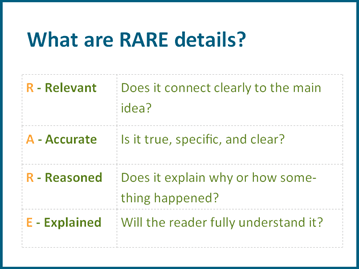
What are RARE details?
Before adding a detail, ask if it is:
R – Relevant
Does it connect clearly to the main idea?
A – Accurate
Is it true, specific, and clear?
R – Reasoned
Does it explain why or how something happened?
E – Explained
Will the reader fully understand it?
If a detail does not meet all four parts of RARE, it weakens the writing instead of improving it.
Why details matter in writing
Details help your reader:
understand your ideas without guessing
picture what is happening
follow your thinking
stay interested
Without details, writing sounds vague or rushed.
With strong details, writing sounds thoughtful and complete.
6 smart ways to add RARE details
Replace vague words with precise language
Vague words don’t explain much on their own.
Vague words to watch for:
good, bad, nice, fun, big, stuff, things
For example:
The book was good.
The book was exciting because every chapter ended with a cliffhanger.
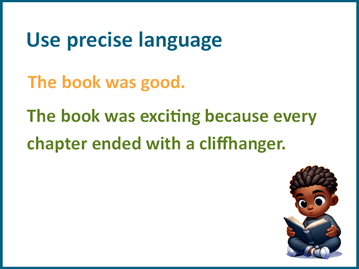
Specific words make details more accurate and explained.
Explain your ideas
If a sentence sounds finished but feels unclear, ask:
“What do I mean by that?”
For example:
I felt nervous.
I felt nervous because I was about to speak in front of the entire class.
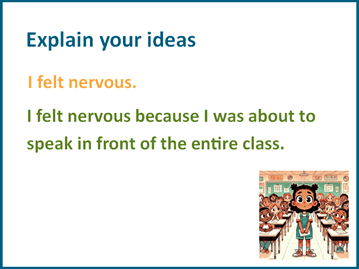
This adds reasoning, which is one of the most important parts of RARE writing.
Use examples to support your point
Examples help the reader see what you mean.
For example:
The cafeteria is noisy.
The cafeteria is noisy, with chairs scraping, trays clattering, and students calling out to friends.
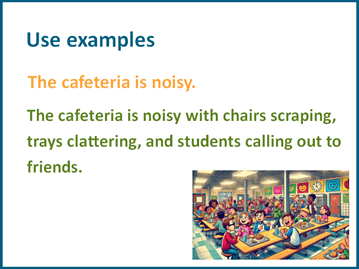
Examples make details more relevant and clear.
Show feelings through actions
Instead of telling the reader how someone feels, show it through behavior.
For example:
He was disappointed.
After the game, he stared at the floor and slowly shook his opponent’s hand. He felt sad about losing.
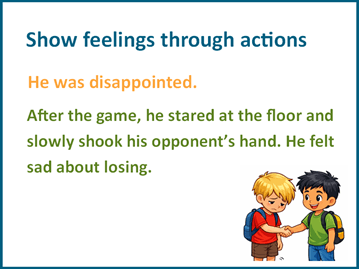
This technique makes writing more engaging and mature.
Add thoughts and reflections
Strong writing often includes what the writer is thinking, not just what is happening.
For example:
I lost the game.
I lost the game, and although I was upset at first, I realized how much I had improved.
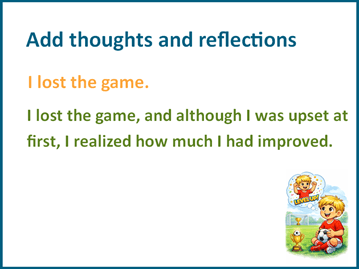
Thoughts and reflections help explain why the event matters.
Stay focused on the main idea
More details are not always better.
Every detail should support the topic.
Ask yourself:
Does this detail help prove or explain my point?
Does it add new information?
If the answer is no, remove or revise it.
RARE before-and-after examples
Before:
Homework is hard.
After:
Homework can be hard because it often takes a long time to finish after a full school day.
Before:
The field trip was fun.
After:
The field trip was exciting because we explored exhibits, asked questions, and worked in small groups.
Common mistakes when adding details
Repeating the same idea in different words
Adding off-topic information
Using too many weak adjectives instead of explanations
Adding details that confuse the main point
Good writers revise to fix these problems.
RARE revision checklist
Before turning in your writing, ask:
Does it connect clearly to the main idea? (Relevant)
Is it true, specific, and clear? (Accurate)
Does it explain why or how something happened? (Reasoned)
Will the reader fully understand it? (Explained)
Practice activity
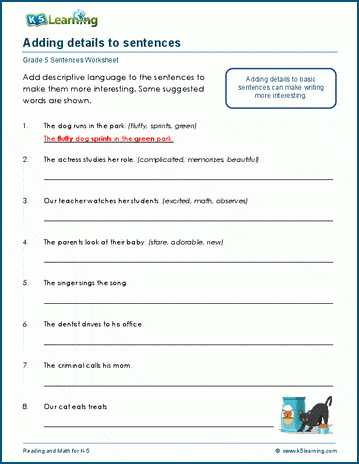
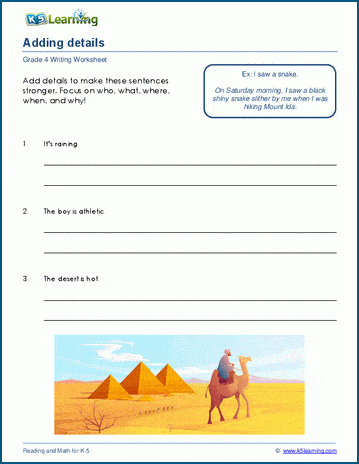
In our later grades, we have worksheets for students to practice adding details to sentences.
Grade 4 adding details practice
Students are presented with simple sentences and asked to add details to make the sentences stronger in these worksheets.
Grade 5 adding details worksheets
Students are asked to make dull sentences into more interesting sentences in these worksheets.