
 Thanksgiving WS's!


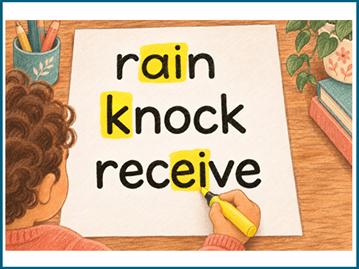
When your child writes ran for rain or recieve for receive, have them compare their spelling with the printed word. Which letter did they leave out or put in a different place? Once they find it, give them another word from the same group to practice.
The examples below come from our K5 Learning spelling lists. Each grade highlights a few groups, from silent-e words in grade 1 to prefixes and suffixes in grade 5. Start with a group that matches a mistake you’ve noticed in your child’s writing.
Grade 1 — Sight words, silent e and vowel teams
K5 spelling group - Words to practice
Sight words — one, two, have, was
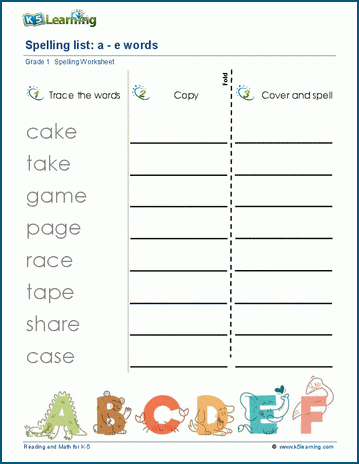
Silent e words — cake, tape, bike, cube
ai words — rain, main, sail
ay words — pay, stay, play
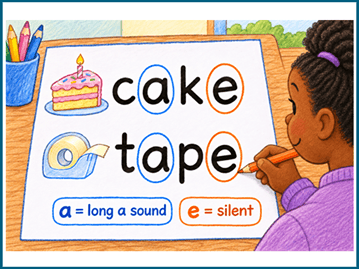
Look at the end of the word. In cake and tape, the a spells a long vowel sound and the final e is silent. Have your child circle the a and e in each word. Then ask them to find the same pattern with i in bike. In have, the e is also silent, and the a has a short sound. Practice have with the sight words so your child can learn its spelling as a whole.
Try a two-column sort. Write rain, main, sail, pay, stay and play on slips of paper. Have your child read each word and sort it under ai or ay. In these examples, both spellings represent the long a sound. The ai comes before another letter, and the ay comes at the end. Dictate “We can play in the rain” and have your child check both spellings.
Find these groups in our grade 1 spelling lists.
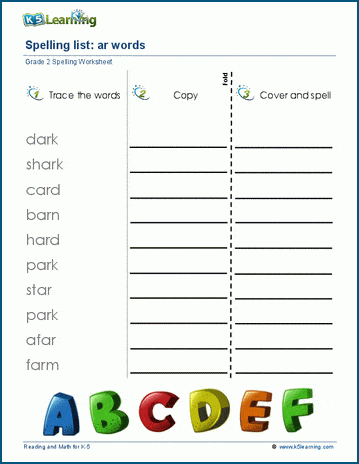
Grade 2 — R-controlled vowels and the endings -er and -est
K5 spelling group - Words to practice
er words - fern, herd, germ
ir words - bird, girl, shirt
ur words - burn, turn, hurt
-er and -est words - taller, tallest, bigger, biggest, easier, easiest
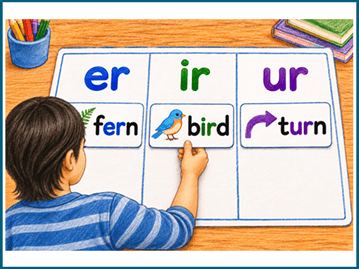
Listen for the sound and look for the letters. Say fern, bird and turn. The middle sound can be spelled er, ir or ur. Give your child three headings and have them place each word under its spelling. Dictate “The bird sat near the fern.” When your child checks the two words, ask them to say which letters spell the sound in each one.
Build a pair of words. Start with big and ask your child to make bigger and biggest. Point out the extra g in both. Then start with easy and make easier and easiest. Here, the y changes to i before the ending is added. Finish with tall, taller and tallest. The base word already ends in ll, and those letters stay in both forms.
For more r-controlled vowels and words with endings, browse our grade 2 spelling lists.
Grade 3 — Silent letters and soft c and g
K5 spelling group - Words to practice
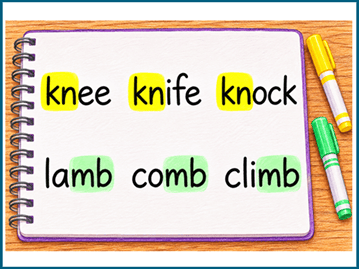
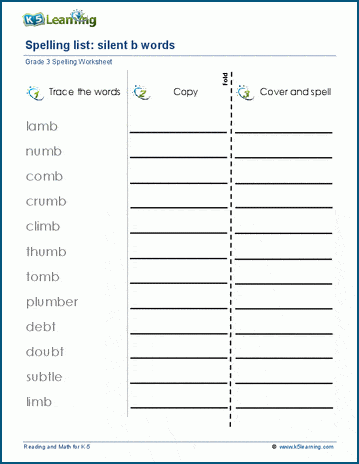
Silent b - lamb, comb, climb
Silent k - knee, knife, knock
Soft c - fence, pencil, price
Soft g - giant, gentle, engine
Find the letter you can’t hear. Say comb and ask your child to write it. If the final b is missing, show them comb beside lamb and climb. Underline mb in each word. For knee, knife and knock, underline kn at the beginning. Dictate “I heard a knock at the door” and have your child check the first two letters.
Compare the two soft sounds. In pencil, c sounds like s. In giant, g sounds like j. Have your child underline the c in fence and price, then circle the g in gentle and engine. Ask them to read each word aloud and say which sound the marked letter represents. Then dictate “The giant leaned over the fence.”
Choose from the silent-letter and soft c and g groups in our grade 3 spelling lists.
Grade 4 — Letter order in ie and ei words, plus double c
K5 spelling group - Words to practice
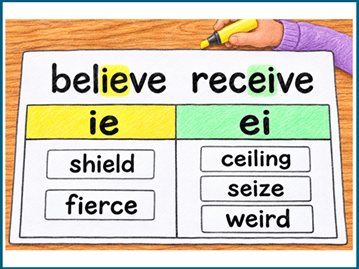
ie words - believe, shield, fierce
ei words - receive, ceiling, seize, weird
cc words - accept, accident, success
Check the order of the vowels. Write believe and receive side by side. The long e sound is spelled ie in believe and ei in receive. Have your child highlight the letters in each word, then sort shield, fierce, ceiling and seize under ie or ei. Include weird as another ei example so your child gets used to checking each word’s letter order.
Listen to the double c. In accept, accident and success, the first c sounds like k and the second sounds like s. Have your child underline both letters in success. Read the word together, then say “The school fair was a success” and ask them to write it. Check the middle cc and the final ss separately.
Find the ie, ei and cc groups in our grade 4 spelling lists.
Grade 5 — Prefixes and suffixes in longer words
K5 spelling group - Words to practice
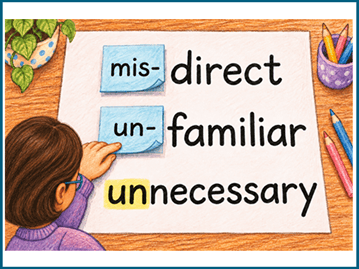
mis- words - miscalculate, misdirect, mismatched
un- words - unfamiliar, unnecessary, unacceptable
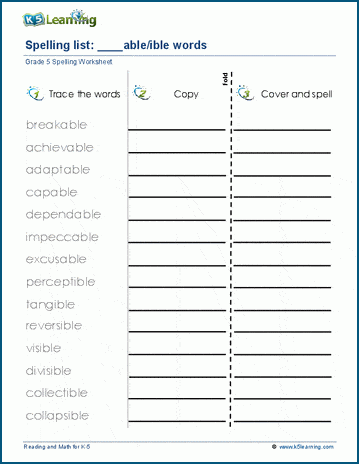
-able and -ible words - breakable, dependable, visible, divisible
-tion and -sion words - protection, connection, discussion, expansion
Find the prefix and base word. Cover mis- in misdirect and ask your child to read direct. Do the same with un- in unfamiliar. Then look at unnecessary together. Once your child identifies un-, have them check that necessary has one c and two s’s. Say “The extra trip was unnecessary” and ask them to write the word in two parts before reading it back.
Compare endings. Put breakable and dependable together under -able, then put visible and divisible under -ible. Have your child underline the vowel at the start of each ending. Try the same activity with protection and discussion. Both end with a “shun” sound in these words, so have your child mark -tion in protection and -sion in discussion before writing each from memory.
For more words organized by prefix and suffix, see our grade 5 spelling lists.
Try a short proofreading exercise
Read one sentence at a time. Ask your child to find the spelling to fix, then name the K5 word group that can help them check it.
Sentence to edit - Answer and what to check
We can play in the rane. rain belongs in the ai group.
The berd sat on a branch. bird uses ir for the r-controlled vowel sound.
I heard a nock at the door. knock starts with a silent k.
Did you recieve the letter? receive has ei after c.
Our class had a discusion about the story. discussion has ss before ion.
Pick the right group for the mistake
A spelling error can tell you where to start. If your child writes berd, they’ve heard the right sound. Show bird beside girl and shirt so they can see how the grade 2 list spells that sound in several words. If they write clim, start with the grade 3 silent b group and ask what climb shares with comb.
Letter order needs a different kind of check. For recieve, put the student’s spelling next to receive. Have your child point to where the e and i switched places. Then ask them to find that same ei order in ceiling. When a longer word such as unnecessary causes trouble, cover the prefix and work on the base word before putting the two parts back together.
Move from the list to a sentence
Some children can spell knife correctly on a list and leave out the k when they’re writing a story. Give them a chance to use each word with their attention on the meaning of the sentence. For example, dictate “I used a knife to cut the apple.” When they’ve finished, ask them to reread the sentence and check kn. The next day, invite them to write a sentence of their own using knife or knock.
You can also practice two words from different groups in the same sentence. Try “The bird landed on the fence.” Ask your child to check ir in bird and c in fence. If one word is still tricky, return to its list and practice a few words that share the same letters.
Use the printable lists for five minutes of practice
Pick a group. If your child writes nock, print the grade 3 list and choose a few silent k words.
Mark the tricky letters. Underline kn in knock, knee and knife. Read the words together.
Cover, write and check. Dictate one of the words in a sentence. Uncover the list and have your child check the marked letters.
Revisit it the next day. Use the same word in a new sentence, then try another word from the group.
If a word keeps coming up in your child’s writing, add it to a personal spelling list. Keep one example sentence with each word so you can practice it again in context. For more printable activities, browse our K5 Learning spelling worksheets for grades 1–5.