


Children often rely on the same familiar words when they speak and write. Something is big or nice. Someone is happy or sad. A character went somewhere or said something.
There is nothing wrong with these words. They are useful words that children need to know and use. But as children's vocabularies grow, they can begin to discover that there are often other words that express an idea more precisely.
A dog might not just be big. It could be huge, enormous or gigantic.
A child might not simply walk across the room. They might stroll, march, wander or tiptoe.
And someone who said something might actually have whispered, shouted, asked or replied.
Learning to choose more precise words helps children express themselves more clearly. It can also make their writing more descriptive and interesting and help them understand a wider range of vocabulary when they read.
It's not about using "fancy" words
Encouraging children to develop a stronger vocabulary doesn't mean replacing every simple word with a longer or more complicated one.
In fact, sometimes the simplest word is the best word.
The goal is to help children understand that words have slightly different meanings and that choosing the right word can help a reader understand exactly what is happening.
Consider these sentences:
The boy walked into the room.
The boy marched into the room.
The boy tiptoed into the room.
The boy wandered into the room.
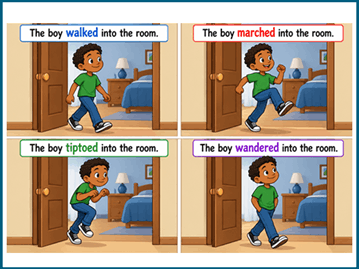
All four sentences describe a boy moving into a room, but they don't describe exactly the same action.
Marched might suggest that he walked purposefully. Tiptoed tells us that he was trying to move quietly. Wandered suggests that he wasn't in much of a hurry and perhaps didn't have a particular destination in mind.
That is what makes a larger vocabulary so useful. Children aren't simply learning more words. They are gaining more ways to communicate what they mean.
Start with words children already use
One easy way to build vocabulary is to start with common words children already know and explore other words that have related meanings.
Here are some examples.
Instead of "big"
Children might use:
huge, enormous, gigantic, massive, large
Try comparing the words in sentences:
We saw a big whale.
We saw an enormous whale.
We saw a gigantic whale.
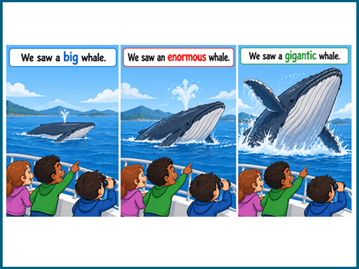
Ask your child whether the sentences create exactly the same picture in their mind.
You can also talk about which words work best in different situations. A large sandwich sounds natural. A massive sandwich suggests something unusually big. A gigantic sandwich sounds even more dramatic.
Children begin to see that words that have similar meanings aren't always interchangeable.
Instead of "small"
Try:
tiny, little, miniature, narrow, short
Again, the words aren't identical.
A mouse might be tiny. A toy version of a real car might be miniature. A path might be narrow. A child might be short.
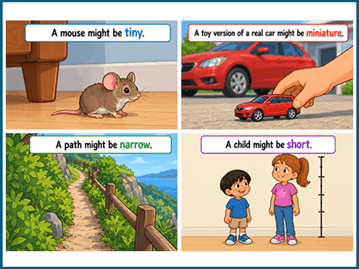
Talking about these differences helps children develop a more precise understanding of vocabulary.
Instead of "nice"
Nice is an especially useful word to explore because children often use it to describe many different things.
Instead of saying:
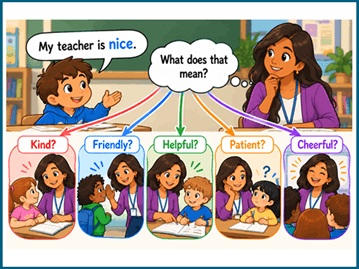
My teacher is nice.
Ask what the child actually means.
Is the teacher kind, friendly, helpful, patient or cheerful?
Instead of:
We had a nice day.
Was the day relaxing, exciting, fun, peaceful or enjoyable?
The more specific word often tells us much more.
Find stronger words for feelings
Feelings provide another good opportunity to expand children's vocabulary.
Young children often describe themselves and others as happy, sad, mad or scared. As they learn more words, they can begin to describe different kinds and degrees of emotion.
Instead of "happy"
Try:
cheerful, pleased, delighted, excited, joyful, proud
These words don't all mean exactly the same thing.
A child might be pleased with a drawing, excited about a birthday party, proud of learning to ride a bicycle and delighted by an unexpected present.
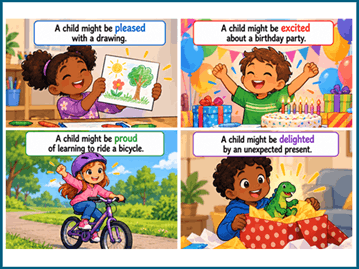
Ask children to think about which word fits each situation best.
Instead of "sad"
Try:
unhappy, disappointed, lonely, miserable, upset, gloomy
A child whose soccer game was cancelled might be disappointed.
Someone missing a friend might feel lonely.
A character having a terrible day might feel miserable.
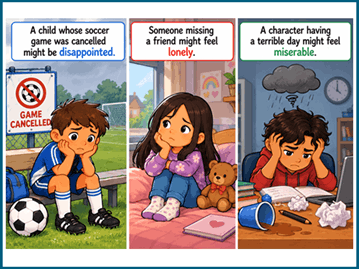
Understanding these differences doesn't just improve writing. It helps children understand the vocabulary they encounter in stories and conversations.
Instead of "scared"
Try:
afraid, nervous, worried, frightened, terrified
These words can introduce the idea of intensity.
Someone waiting to perform in a school concert might feel nervous.
Someone who hears a strange noise downstairs might be frightened.
A dog might be terrified by loud thunder and lightning.
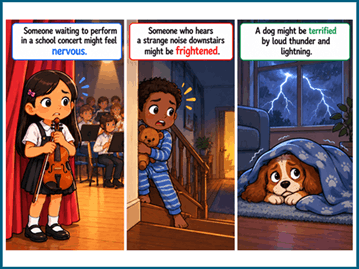
Ask your child to put the words in order from the least frightened to the most frightened. There isn't always one perfect answer, which makes this a good opportunity to talk about shades of meaning.
Use more precise action words
Verbs are particularly useful for showing children how choosing a different word can completely change a sentence.
Instead of “walk”
A person can:
stroll, march, wander, tiptoe, hike, shuffle, stomp
Now imagine:
Grandpa walked through the garden.
Grandpa strolled through the garden.
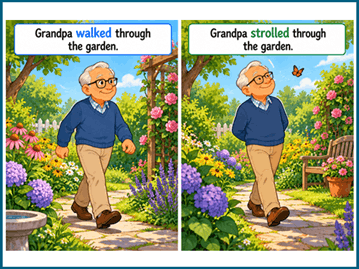
The second sentence gives us a little more information. We can imagine Grandpa walking slowly and comfortably, perhaps enjoying the flowers as he goes.
Or compare:
The girl walked upstairs.
The girl stomped upstairs.
Suddenly, we might suspect that the girl is angry.
Instead of "run"
Try:
race, sprint, dash, jog, hurry
Compare:
Ben ran to the bus.
Ben dashed to the bus.
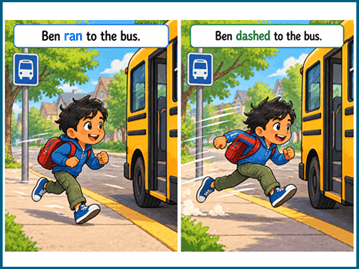
The second sentence suggests urgency.
But:
Ben jogged to the bus.
creates a different picture.
Instead of "look"
Try:
glance, stare, peek, gaze, watch, examine
A child might glance at the clock but stare at an enormous spider on the wall.
A scientist might examine a rock closely.
A child might peek inside a birthday present.
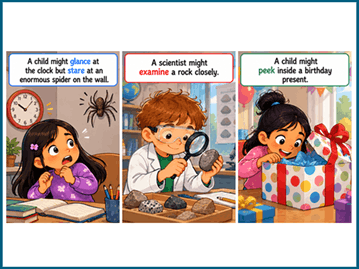
The basic action involves looking, but each verb tells us more about how the person is looking.
What can children use instead of "said"?
Children are sometimes encouraged to replace said whenever they write dialogue. There's no need to eliminate it. Said is a perfectly good word, and repeating it is often less distracting than constantly searching for unusual alternatives.
However, other words can be useful when they provide information that said doesn't.
For example:
asked, replied, whispered, shouted, yelled, cried, explained
Compare:
"I know where it is," Maya said.
"I know where it is," Maya whispered.
"I know where it is!" Maya shouted.
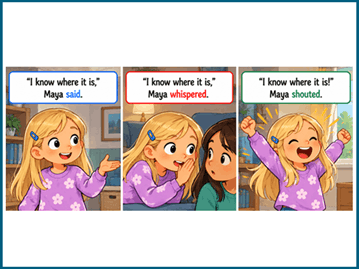
The words whispered and shouted tell the reader how Maya spoke, so they add useful information.
Encourage children to think about meaning rather than simply replacing said with a different word.
Explore degrees of meaning
One of the most useful vocabulary skills children can develop is recognizing that related words can have different strengths.
Consider:
warm → hot → scorching
Or:
cool → cold → freezing
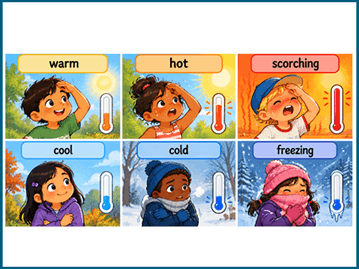
You can turn this into a simple word activity.
Give your child three or four related words and ask them to arrange the words from weakest to strongest.
For example:
giggle – laugh – roar with laughter
annoyed – angry – furious
drizzle – rain – downpour
breeze – wind – gale
Children may disagree about exactly where some words belong. That's okay. The conversation about why they chose a particular order is part of the vocabulary learning.
Use pictures to find better words
Pictures are an easy way to practice vocabulary without making the activity feel like a vocabulary lesson.
Choose a picture from a book, magazine or family photo and ask your child to describe what they see.
If they say:
"The dog is big."
ask:
"What other word could describe how big it is?"
If they say:
"The girl is walking."
look more closely.
Is she strolling, marching, hurrying, wandering or tiptoeing?
You can do the same thing with objects.
Instead of simply describing an apple as red, perhaps it is shiny, round, smooth, crisp or ripe.
One object can generate many different words because children can describe its size, color, shape, texture, condition and other characteristics.
Play "Which word fits best?"
Give children a sentence with a common word and several possible replacements.
For example:
The kitten was very small.
Which word works best?
massive – tiny – furious – noisy
Or:
Ella walked quietly past the sleeping baby.
Which word could replace walked?
stomped – raced – tiptoed – shouted
For older children, make the choices more similar:
The children _____ around the museum, stopping whenever something caught their attention.
marched – wandered – sprinted – stomped
Children have to think about meaning and context rather than simply recognizing a synonym.
Make a "better words" collection
Children can keep a notebook or word bank of interesting words they encounter.
You could organize the words under common headings such as:
Instead of BIG
huge
enormous
gigantic
massive
Instead of HAPPY
cheerful
delighted
excited
joyful
pleased
Instead of WALK
stroll
march
wander
tiptoe
stomp
Add new words whenever children encounter them while reading, talking or doing vocabulary activities.
The goal isn't to memorize a long list at once. A few useful words learned well are more valuable than dozens of words a child doesn't really understand.
Notice interesting words while reading
Reading is one of the best opportunities for children to encounter vocabulary in context.
When an interesting word appears in a story, you don't necessarily need to stop and turn it into a lesson. But occasionally drawing attention to a particularly useful word can help.
For example:
"The book says the rabbit scurried into its burrow. What do you think scurried means?"
After discussing the meaning, compare it with words the child already knows.
Could the author have written ran?
Yes.
Why might scurried be a better choice?
Perhaps it helps us picture a small animal moving quickly with short steps.
This kind of discussion helps children understand why authors choose particular words.
Encourage children to use new words
Recognizing a word while reading is different from being able to use it independently.
Children need opportunities to hear, say and write new vocabulary.
If your child recently learned the word enormous, try using it naturally during the week:
"That's an enormous pumpkin."
Later, ask:
"What was enormous at the pumpkin patch?"
Or challenge your child to make up a sentence using the word.
The more often children encounter and use a word in meaningful situations, the more likely it is to become part of their vocabulary.
Don't correct every simple word
If a child says:
"We saw a big dog today."
there is no need to respond:
"You should say enormous."
Instead, vocabulary building can be conversational:
"It was enormous, wasn't it? It was almost as tall as you!"
The child hears the new word connected to something they already understand.
Similarly, when reviewing a child's writing, don't try to replace every simple word. Choose one or two places where a more precise word would genuinely improve the sentence.
A page filled with corrections can make writing frustrating. Vocabulary development should give children more choices, not make them afraid of choosing the wrong word.
Ask "What do you really mean?"
One simple question can encourage children to think more carefully about vocabulary:
What do you really mean?
If a child writes:
"The movie was good."
ask what made it good.
Was it funny, exciting, interesting, surprising or moving?
If they write:
"The food was bad."
Was it burnt, bitter, soggy, stale or simply something they didn't like?
If they write:
"The room was messy."
Was it cluttered, dirty, untidy or crowded?
This shifts the focus away from finding a "bigger" word and toward finding a more accurate one.
Build vocabulary a little at a time
Children don't need to learn hundreds of new words at once.
Vocabulary grows gradually through reading, conversation, schoolwork and everyday experiences. Parents can help by noticing interesting words, explaining unfamiliar ones and encouraging children to experiment with new vocabulary.
Start with the words your child already uses.
A big pumpkin can become an enormous pumpkin.
A child who walked into the kitchen might have rushed, wandered or tiptoed.
Someone who is happy might actually be excited, proud or delighted.
Each new word gives children another way to describe what they see, think and feel.
And that's the real goal of building a stronger vocabulary: not to use the longest or fanciest word, but to have enough words to choose the right one.