


When children begin writing in the early grades, their stories are full of imagination, but sometimes their sentences fall flat. A common reason is weak verbs: simple, overused action words that don’t clearly show what’s happening. By teaching students to choose strong verbs, we help them paint clearer pictures in the reader’s mind and build confidence as writers.
What are weak verbs?
Weak verbs are common, vague, or general action words. They tell that something happened, but not how it happened.
For example:
went
said
walked
got
made
did
These words are useful, especially for early writers, but when used too often the writing becomes repetitive and dull.
Weak verb example:
The dog went to the door.
The sentence tells us the action, but not much else.
What are strong verbs?
Strong verbs are specific, vivid action words that help the reader see or feel the action more clearly.
For example:
raced
marched
dashed
whispered
bellowed
snatched
constructed
Strong verb example:
The dog raced to the door.
Now the reader can picture the excitement and speed.
Why strong verbs matter
Strong verbs help children:
Build more descriptive and engaging writing
Communicate emotions and actions more clearly
Reduce reliance on adverbs (like quickly, loudly, suddenly)
Add voice and personality to stories
Improve reading comprehension and vocabulary simultaneously
Spot the difference

Ask your kids: How does the meaning or feeling change?
Simple classroom and at-home activities
1. Strong verb substitution game
Write a weak verb on the board (e.g. went, said).
Students list as many stronger verbs as they can:
went → sprinted, marched, tiptoed, zoomed, wandered, trudged
Turn it into a race to see who can write the most words.
2. Sentence makeover challenge
Give students plain sentences and ask them to improve them:
The girl went to the park.
The dog took the ball.
The baby cried.
Compare before and after versions. Celebrate creativity.
3. Verb word wall
Create a wall or printable list organized by categories of movement:
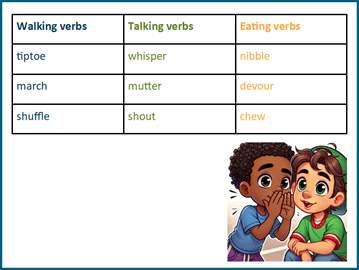
Kids love choosing words from a menu.
4. Acting out strong verbs
Have children act out verbs like stomp, glide, crawl, tiptoe and others guess the word.
Movement helps memory.
5. Replace weak verbs in their own writing
Use a highlighter color code:
Yellow = weak verb
Blue = strong verb replacement
Writers learn to revise thoughtfully rather than rewrite everything at once.
When weak verbs are OK
Strong verbs are wonderful, but balance matters.
Weak verbs are appropriate when:
The action is simple or not important.
You need to avoid interrupting the flow.
Too many fancy verbs may sound unnatural or forced.
The goal is intentional word choice, not fancy writing all the time.