
 Halloween W'sheets!


Your child can read cap, but adding one letter turns it into cape. The final e does not make a sound of its own, yet it changes how we read the word.
Learning the silent-e pattern helps children move beyond short-vowel words and recognize familiar patterns in longer words. This guide explains the main rule, provides word lists by vowel sound and shares simple ways to practice at home.
What is silent e?
Silent e is an e at the end of a word that is not pronounced as a separate sound. In many words, it helps show that an earlier vowel has a long sound.
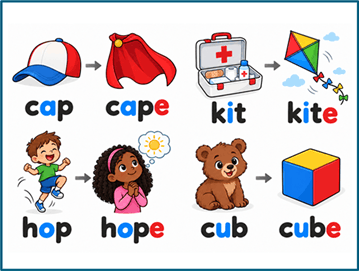
A long vowel usually sounds like the name of its letter. Compare these pairs:
• cap → cape: Short a changes to long a.
• kit → kite: Short i changes to long i.
• hop → hope: Short o changes to long o.
• cub → cube: Short u changes to long u.
Children may hear this pattern called magic e, bossy e or vowel-consonant-e. These names describe the same common spelling pattern.
The main silent-e spelling rule
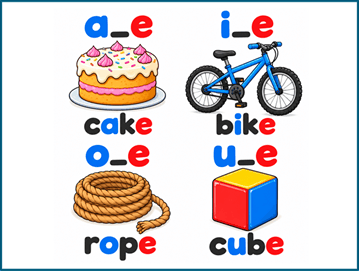
When a word ends in a vowel, a consonant and a silent e, the first vowel often has a long sound.
In cake, the pattern is a–k–e. The a has its long sound, the k keeps its sound and the final e is silent.
You may also see the label CVCe, which stands for consonant-vowel-consonant-e. Words such as make, bike and home follow this pattern.
The same vowel-consonant-e ending can appear after a consonant blend, as in plate, slide and smile. Once children can read simpler words, these make useful next steps.
Use the word often when explaining the rule. A final e does not make the earlier vowel long in every word.
How to teach silent e step by step
Start with a short-vowel word your child already knows, such as tap.
1. Read the original word. Ask your child to say the sounds in tap and blend them together.
2. Add an e. Write tape beside tap or add an e with a letter tile.
3. Point out the pattern. Show the a, the consonant p and the final e.
4. Read the new word. Explain that the a now says its name. Blend the sounds to read tape without adding a sound for the e.
5. Compare the meanings. A tap and a roll of tape are different things. Ask your child to explain or draw each word.
6. Spell the new word. Cover tape, say it aloud and ask your child to write it. Then check that the silent e is included.
Try just three or four pairs at first. When your child understands the change, mix short-vowel and silent-e words so they must look carefully before reading.
Short-vowel and silent-e word pairs
These pairs help children see how adding e can change both pronunciation and meaning.
Short-vowel word → Silent-e word
cap → cape
tap → tape
can → cane
mad → made
kit → kite
pin → pine
fin → fine
rip → ripe
hop → hope
not → note
rob → robe
cub → cube
tub → tube
cut → cute
Read across each row, then ask: “Which letter changed? Which vowel sound changed?” Explain unfamiliar words before asking your child to use them in a sentence.
Silent-e word lists by vowel sound
Choose one group at a time. Children do not need to memorize the whole list in one sitting; the aim is to use the spelling pattern to read and write new words.
Long a: a–consonant–e
cake, bake, lake, make, take, name, same, game, gate, late, date, safe, save, wave, cave, tape
Once these are comfortable, try words with consonant blends:
brave, flame, plane, plate, skate, snake
Practice sentence: We can bake a cake.
Long i: i–consonant–e
bike, hike, like, kite, bite, five, nine, line, mine, pine, time, dime, ride, side, hide, wide
For additional practice with consonant blends, try:
bride, drive, slide, smile, spine, stripe
Practice sentence: I like to ride my bike.
Long o: o–consonant–e
bone, cone, home, hope, rope, rose, nose, note, vote, hole, pole, mole, joke, woke, robe, code
For additional practice with consonant blends, try:
globe, slope, smoke, stone, stove, drove
Practice sentence: The rose is close to the stone.
Long u: u–consonant–e
cube, cute, huge, mule, tube, tune, use, dune, duke, fume
For additional practice with consonant blends, try:
flute, prune
In words such as cube and cute, the u sounds like “yoo.” In words such as flute and prune, it sounds like “oo.” Pronunciation also varies by accent in words such as tube and tune. Both sounds occur in this spelling pattern.
Practice sentence: The cute mule is huge.
What about long e?
The e–consonant–e pattern appears in words such as these and theme, but it is less common in beginner word lists. Introduce these words after your child is comfortable with the more frequent a, i, o and u patterns.
Does silent e always make a vowel long?
No. Silent e has other jobs, and some common words do not follow the long-vowel pattern.
Familiar words that do not follow the pattern
Words such as have, give, love, come, some and done end in silent e, but their earlier vowels do not say their names.
Introduce a few of these after children have practiced regular examples. Read each word together, identify the unexpected vowel sound and practice using the word in a short sentence.
For example, compare gave and have. They share the same ending, but the a sounds different.
Silent e can help show a soft c or g
In race and ice, the c has an /s/ sound. In page and huge, the g has a /j/ sound. The final e helps signal those consonant sounds.
Some words have more than one pattern working at once. In race, for example, a has its long sound and c has its soft sound.
Words ending in v usually need a final e
Common English words generally do not end in a bare v. Words such as have, give and love include a final e even though the earlier vowel is not long.
For beginners, focus first on the long-vowel pattern. These other jobs can be introduced gradually as children encounter relevant words.
What happens to silent e when we add an ending?
Once your child reads and spells silent-e words confidently, introduce a few examples with endings.
A final silent e is usually dropped before an ending that begins with a vowel:
• make + ing = making
• ride + ing = riding
• hope + ing = hoping
It is usually kept before an ending that begins with a consonant:
• hope + ful = hopeful
• safe + ly = safely
• late + ly = lately
There are exceptions, so teach this as a useful general pattern. Keep early practice focused on familiar examples rather than introducing every suffix rule at once.
Five ways to practice silent-e words at home
1. Add it, read it, remove it
Write pin with letter tiles. Ask your child to read it, add an e and read pine. Remove the e and read pin again.
Repeat with cap/cape, hop/hope and tub/tube. Each time, ask your child to explain what happened to the vowel sound.
2. Sort short-vowel and long-vowel words
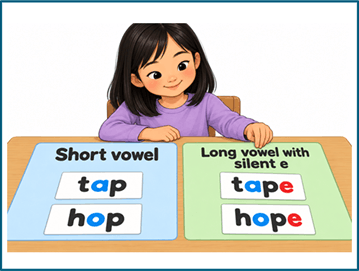
Write these words on small pieces of paper:
tap, tape, kit, kite, hop, hope, cub, cube
Make two groups: short vowel and long vowel with silent e. Have your child read each word aloud before sorting it. When the sort is complete, ask them to match the word pairs.
3. Choose the word that fits
Ask your child to read each sentence and choose the correct word. This checks meaning as well as decoding.
1. I wear a cap / cape on my head.
2. We fly a kit / kite in the park.
3. The rabbit can hop / hope.
4. Please write a not / note.
5. The bear has a cub / cube.
Answers: 1. cap; 2. kite; 3. hop; 4. note; 5. cub.
4. Read, cover, write and check
Choose four or five words with the same vowel pattern, such as cake, lake, name, game and gate.
Have your child read a word, cover it, write it from memory and check the spelling. If the final e is missing, return to the pattern: “What helps show that the a has its long sound?”
Finish by dictating one short sentence using a practiced word.
5. Hunt for the pattern in a book
Choose a page from a familiar book and look for words such as make, like, time or home.
Ask your child to point to the vowel-consonant-e pattern and read the word in its sentence. If you find have or come, explain that these are familiar words with a different vowel sound. Looking for the pattern in reading helps children apply what they have practiced.
Common silent-e mistakes and how to help
Reading every word as if it has a short vowel. If your child reads hope as hop, point to the final e and ask them to check the vowel sound. Then reread the whole sentence.
Adding an extra sound for e. Model how to read cake as one syllable. The final e is written, but it does not add another spoken sound.
Leaving e out when spelling. Compare a pair such as pin and pine. Ask your child which spelling matches the word you said and why the final e matters.
Assuming every final e makes the earlier vowel long. Practice regular words first, then introduce common exceptions in small groups. Avoid asking children to force words such as have and give to fit the rule.
Managing simple words but struggling with blends. Return to familiar examples such as ride before moving to slide or stripe. Your child may need more practice blending the consonants as well as recognizing the vowel pattern.
Silent-e practice for Grades 1–3
Choose practice according to your child’s current skills rather than grade alone.
Grade 1: Begin with familiar short-vowel words and simple pairs such as cap/cape and kit/kite. Use pictures and letter tiles, then practice reading and spelling a few words.
Grade 2: Mix vowel patterns and introduce words with blends, such as plane, smile and stone. Add sentence reading, dictation and common exceptions.
Grade 3: Review any uncertain patterns, build more complex words and introduce familiar suffix examples such as making and hopeful. Encourage children to check silent-e spellings in their own writing.
K5 Learning’s phonics worksheets include CVC and CVCe practice, short and long vowels, and word-building activities across these grades. Choose a task that matches the pattern your child is learning.

For a broader look at letters we write but do not always pronounce, explore Learning Silent Letter Words.
A quick silent-e check
Try these three questions after practice:
1. What happens when you add e to cap?
2. Which word has a long i sound: kit or kite?
3. Why does have need to be learned separately from words such as gave?
Answers: Cap becomes cape, and the a changes to its long sound. Kite has a long i sound. Have ends in silent e, but its a does not have the long sound heard in gave.
Keep practice short and focused. Moving from reading a word to spelling it and using it in a sentence gives your child several ways to apply the silent-e pattern.