
 Halloween W'sheets!

When children first learn about relative clauses, they are often introduced to lots of new grammar vocabulary. Words like relative pronoun, subordinate clause, and antecedent can make a simple idea seem much harder than it really is.
The good news is that relative clauses are actually quite easy to understand when we focus on what they do instead of what they are called.
What is a relative clause?
A relative clause gives extra information about a person, place, animal, or thing in a sentence.
Look at this sentence:
The boy is my brother.
Now let's add more information:
The boy who is wearing a red hat is my brother.
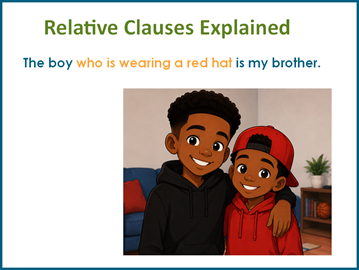
The words who is wearing a red hat tell us more about the boy. That extra piece of information is a relative clause.
Think of relative clauses as "information add-ons"
A relative clause works like a label that helps identify something more clearly.
For example:
The dog that chased the ball is tired.
The teacher who helped us was kind.
The book that I borrowed was exciting.
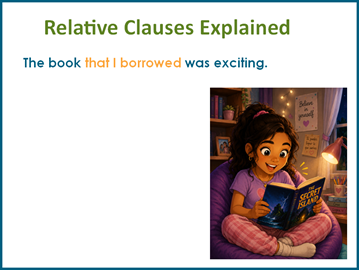
In each sentence, the part in bold adds useful information.
Without the extra information, we still have a complete sentence:
The dog is tired.
The teacher was kind.
The book was exciting.
The relative clause simply helps us understand exactly which dog, teacher, or book the writer means.
Words that often start relative clauses
Children do not need to memorize complicated grammar definitions. They simply need to recognize some common words that often introduce extra information.
These include:
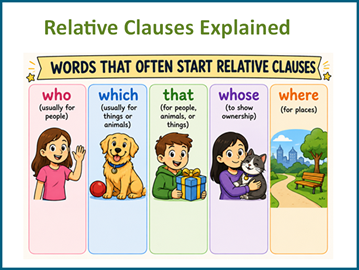
who (usually for people)
which (usually for things or animals)
that (for people, animals, or things)
whose (to show ownership)
where (for places)
Examples
Who
The girl who won the race smiled proudly.
Which
The bicycle which has a basket belongs to Mia.
That
The sandwich that I made was delicious.
Whose
The boy whose backpack was missing looked worried.
Where
The park where we play soccer is nearby.
Why Writers Use Relative Clauses
Relative clauses make writing more interesting and precise.
Instead of writing:
I saw a dog. The dog was muddy.
A writer can combine the ideas:
I saw a dog that was muddy.
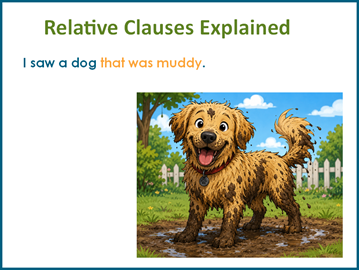
This sounds smoother and helps ideas flow together naturally.
A simple trick for finding relative clauses
Ask:
"Is this part giving extra information about a person, place, animal, or thing?"
For example:
The rabbit that lives under our deck likes carrots.
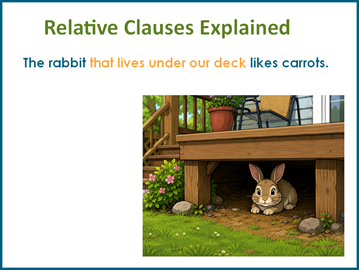
The word that lives under our deck tell us more about the rabbit.
That's the relative clause.
Practice together
Can you spot the relative clause in each sentence?
The girl who plays the violin is my friend.
The castle that stands on the hill is very old.
The teacher whose class won the contest was excited.
The beach where we collected shells was beautiful.
Answers
who plays the violin
that stands on the hill
whose class won the contest
where we collected shells
A common mistake
Children sometimes think every sentence containing who, which, or that has a relative clause.
Not always!
For example:
I know that you are tired.
Here, that is not adding information about a noun. It is doing a different job, so this is not a relative clause.
The key question remains:
Is it giving extra information about a person, place, animal, or thing?
If yes, it's probably a relative clause.
Helping your child at home
Try these simple activities:
Read a story together and look for sentences containing who, which, that, whose, or where.
Ask your child to add extra information to simple sentences.
Play a describing game:
"The cat..."
"The cat that sleeps on the sofa..."
"The cat that sleeps on the sofa loves tuna."
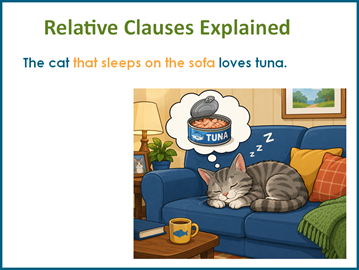
These quick exercises help children recognize how relative clauses work in real writing.
Final thoughts
Relative clauses are simply pieces of a sentence that add extra information. Once children understand that they are really just "information add-ons," the concept becomes much less intimidating.
Instead of memorizing complicated grammar terms, focus on helping children answer one simple question:
"Which words are telling me more about a person, place, animal, or thing?"
When they can do that confidently, they are already well on their way to mastering relative clauses.