
 Halloween W'sheets!

Living things have needs
All living things must meet certain needs to survive, grow, and reproduce. Plants and animals share some basic needs, such as air and water, but they meet those needs in very different ways.
What plants need
Plants are producers, meaning they make their own food through photosynthesis.
Sunlight – provides energy for photosynthesis
Water – used to make food and transport nutrients
Air – plants take in carbon dioxide
Nutrients – minerals such as nitrogen and potassium (usually from soil)
Space – room for roots to spread and leaves to reach sunlight
Because plants make their own food, they do not need to eat other organisms.
What animals need
Animals are consumers, meaning they must eat plants or other animals to get energy.
Food – plants, animals, or both
Water – essential for body functions
Air – oxygen for respiration
Shelter – protection from weather and predators
Space – room to move, hunt, and find resources
Animals depend on plants either directly or indirectly for food.
How plants and animals are connected
Plants and animals are part of the same ecosystems.
Plants provide food and oxygen
Animals provide carbon dioxide, which plants use
Many animals help plants by spreading seeds or pollinating flowers
This interdependence helps keep ecosystems balanced.
Key similarities and differences
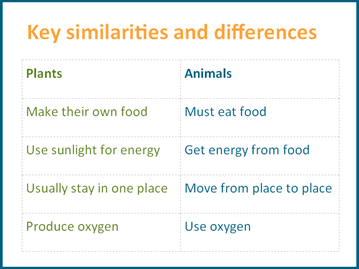
Plants and animals have different needs, but they depend on each other to survive. Changes to one part of an ecosystem can affect many living things.