


If your child has started learning multi-step math problems, you may have heard them talk about something called PEMDAS or say the phrase:
“Please Excuse My Dear Aunt Sally.”
PEMDAS is a memory trick that helps students remember the correct order for solving math problems with more than one operation.
Understanding PEMDAS helps children solve problems accurately and avoid common mistakes as math becomes more advanced in the upper elementary years.
What does PEMDAS stand for?
PEMDAS stands for:
P – Parentheses
E – Exponents
M – Multiply
D – Divide
A – Add
S – Subtract
The phrase:
“Please Excuse My Dear Aunt Sally”
is simply a mnemonic device to help students remember the order.
Why does math need an order?
Imagine solving this problem:
8 + 2 × 5
Should you:
add first?
multiply first?
If students do the addition first:
(8 + 2) × 5 = 50
But the correct answer is:
8 + (2 × 5) = 18
Without agreed-upon rules, everyone could get different answers for the same problem.
PEMDAS gives mathematicians, teachers, and students a consistent order to follow.
Step 1: Parentheses (Please)
Students solve anything inside parentheses first.
Example:
(4 + 3) × 2
First solve:
4 + 3 = 7
Then:
7 × 2 = 14
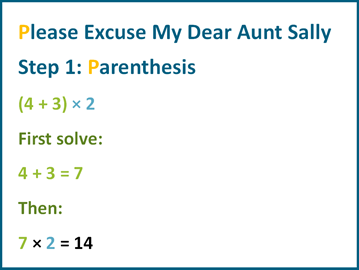
Parentheses tell us which part of the problem is most important.
Step 2: Exponents (Excuse)
Exponents show repeated multiplication.
Example:
3²
means:
3 × 3 = 9
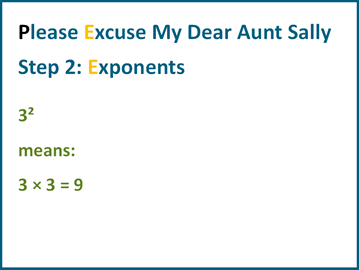
Elementary students may only briefly encounter exponents at first, but PEMDAS introduces the concept early.
Step 3: Multiplication and Division (My Dear)
This is where many children become confused.
A common misunderstanding is thinking multiplication must always happen before division because the M comes before the D.
But multiplication and division are actually equal in priority.
Students solve them:
from left to right
Example:
20 ÷ 5 × 2
First:
20 ÷ 5 = 4
Then:
4 × 2 = 8
Not:
20 ÷ 10 = 2
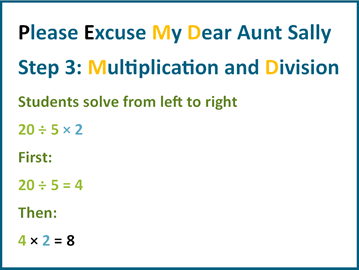
The same rule applies to addition and subtraction later.
Step 4: Addition and Subtraction (Aunt Sally)
Addition and subtraction are also solved from left to right.
Example:
12 − 4 + 3
First:
12 − 4 = 8
Then:
8 + 3 = 11
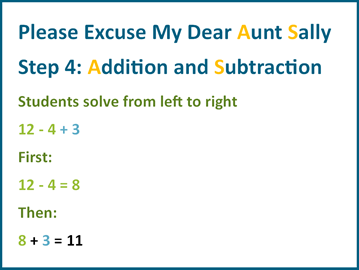
Many children initially think they should always add before subtracting because A comes before S in PEMDAS, but that is not how the rule works.
Common PEMDAS mistakes
Forgetting left to right
Children often memorize the letters without understanding that:
multiplication and division are partners
addition and subtraction are partners
Rushing through steps
Students sometimes skip parentheses or accidentally solve operations in the wrong order.
Treating PEMDAS like six separate levels
In reality, it is better to think of it as:
Parentheses
Exponents
Multiplication and Division (left to right)
Addition and Subtraction (left to right)
Why PEMDAS can feel difficult
PEMDAS combines several math skills at once:
multiplication facts
division understanding
number sense
careful reading
working memory
A child may understand the rule but still make mistakes when solving longer problems.
This is very common.
Many students need repeated practice with smaller examples before they feel confident with more complicated expressions.
Ways parents can help at home
Ask your child to explain each step
Instead of only checking the final answer, ask:
“Why did you do that part first?”
“What operation comes next?”
Explaining builds understanding.
Cover parts of the problem
Some children feel overwhelmed by long expressions. Covering parts with a finger or paper can help them focus step-by-step.
Practice with simple examples
Short problems are often better than very long ones when first learning PEMDAS.
Focus on understanding, not memorization alone
Memory tricks are helpful, but children learn best when they understand why the order matters.
PEMDAS Is about organization
At its core, PEMDAS teaches children that math follows a logical structure.
The goal is not just remembering “Please Excuse My Dear Aunt Sally.” The real goal is helping students learn how mathematicians organize and solve problems carefully and consistently.
Once children become comfortable with the order of operations, they often feel much more confident tackling larger and more complex math problems.