


Patterns are everywhere.
We see them in the changing seasons, the petals on flowers, the rhythm of music, the design of a quilt, and even in our daily routines. Every morning follows a familiar pattern; we wake up, get dressed, eat breakfast, and head off to school and work.
Mathematics is built on patterns too.
In fact, one of the most important things children learn in elementary school isn't simply how to add, subtract, multiply, or divide; it's how to recognize patterns. The ability to spot patterns helps children understand how numbers work, solve problems more efficiently, and develop the logical thinking skills they'll use throughout their lives.
Rather than seeing mathematics as a long list of rules to memorize, children who understand patterns begin to see that math is connected, predictable, and full of relationships.
Why are patterns so important?
Patterns help children make sense of the world.
When children notice that something repeats or changes in a predictable way, they begin asking questions:
What happens next?
Why does it change this way?
Is there a rule?
Can I predict what comes next?
These questions are at the heart of mathematical thinking.
Instead of simply remembering an answer, children learn to look for relationships and understand why something works. This deeper understanding makes new math concepts easier to learn because each new idea builds on something they already know.
Learning to recognize patterns begins early
Even very young children naturally notice patterns.
A toddler might clap twice, stomp twice, and repeat the sequence over and over.
Preschoolers enjoy creating bead necklaces with repeating colors such as:
Red, blue, red, blue, red, blue...
They might also arrange toys by size or notice that every traffic light follows the same order.
These simple activities may seem like play, but they are helping children develop early mathematical thinking.
As children enter elementary school, patterns become more sophisticated. They begin exploring:
Number patterns
Shape patterns
Growing patterns
Repeating patterns
Patterns in measurement and time
Patterns in multiplication tables
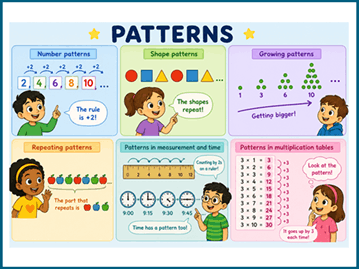
Each new pattern helps children understand how mathematics is organized.
Patterns strengthen number sense
One of the biggest benefits of studying patterns is that children develop stronger number sense.
Number sense is the ability to understand numbers, how they relate to one another, and how they behave.
Instead of viewing each number as completely separate, children begin to see connections.
For example, they might notice that:
Even numbers always end in 0, 2, 4, 6, or 8.
Odd numbers always end in 1, 3, 5, 7, or 9.
Every time you add 10, only the tens digit changes.
Counting by fives always ends in 5 or 0.
Multiples of 3 appear in a regular sequence.
Every multiplication table follows its own pattern.
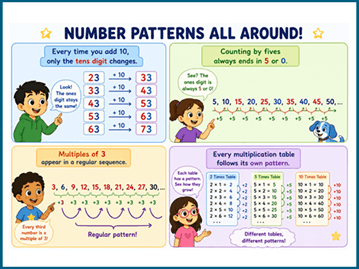
These discoveries help children predict answers and make mental calculations much more easily.
Instead of memorizing isolated facts, they begin understanding how numbers are connected.
Patterns make mental math easier
Children who recognize patterns often become stronger mental mathematicians.
Imagine adding:
27 + 10
Rather than counting on ten individual numbers, children who understand place value patterns immediately recognize that adding ten simply increases the tens digit.
The answer becomes obvious:
27 → 37
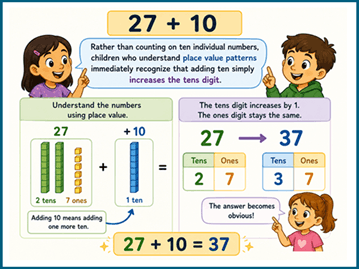
The same idea works when adding hundreds or thousands.
Recognizing these predictable changes makes calculations faster and builds confidence.
Patterns help children solve problems
Many math problems become much easier once children learn to look for patterns.
For example, consider the sequence:
3, 6, 9, 12, 15...
Instead of memorizing every number individually, children notice that each number increases by 3.
Now they can easily predict that the next number is 18.
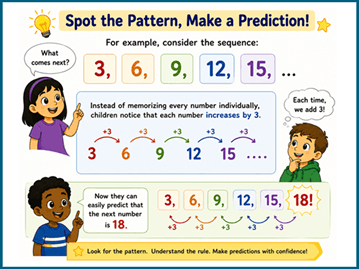
The same thinking helps with much more complicated problems later in school.
Whenever children ask themselves:
What changed?
What stayed the same?
Can I find a rule?
Does this remind me of another problem?
they are developing the reasoning skills mathematicians use every day.
Patterns appear throughout elementary math
Patterns aren't taught in just one unit. They appear in almost every area of mathematics.
Addition and subtraction
Children notice that:
Adding 1 gives the next number.
Adding 0 leaves a number unchanged.
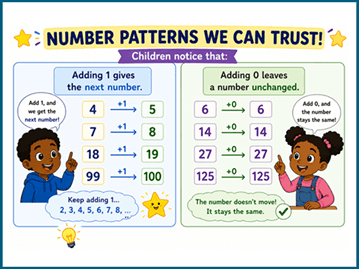
Numbers can often be broken apart in different ways to make calculations easier.
Multiplication
The multiplication tables are filled with patterns.
For example:
Multiples of 2 are always even.
Multiples of 5 end in 5 or 0.
The digits in multiples of 9 add up to 9, 18, 27, and so on.
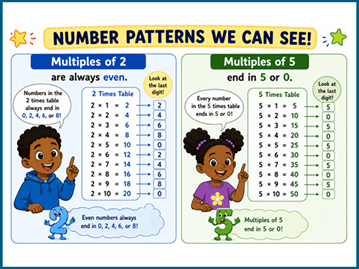
Recognizing these patterns makes multiplication facts much easier to learn.
Fractions
Children begin noticing relationships such as:
Two quarters equal one half.
Four quarters equal one whole.
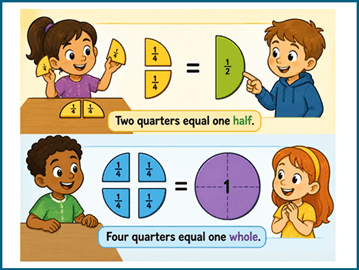
As the denominator gets larger, each piece becomes smaller.
Patterns help fractions make sense instead of feeling like random numbers.
Geometry
Shapes also follow patterns.
Children learn to recognize:
Lines of symmetry
Repeating designs
Rotations
Tessellations
Angles and side relationships
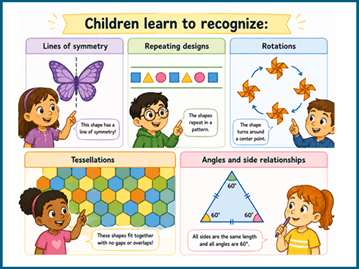
These visual patterns strengthen spatial reasoning and problem-solving skills.
Patterns prepare children for algebra
Many parents are surprised to learn that algebra begins long before students ever see letters like x or y.
Algebra is really about recognizing relationships and finding rules.
Consider these addition facts:
3 + 5 = 8
4 + 5 = 9
5 + 5 = 10
6 + 5 = 11
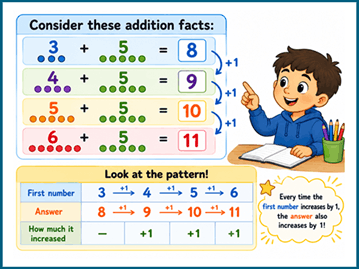
Children soon notice that every time the first number increases by 1, the answer also increases by 1.
They are discovering a mathematical rule.
This kind of thinking is exactly what prepares children for algebra in later grades.
Instead of memorizing equations, they learn to understand how numbers change and relate to one another.
Looking for patterns builds confidence
One reason some children struggle with math is that they believe every problem is completely different.
Children who look for patterns realize that many problems are actually connected.
They begin thinking:
"I've seen something like this before."
That confidence makes new learning much less intimidating.
Rather than guessing, children develop strategies based on reasoning and observation.
Finding patterns at home
Parents can help children develop pattern recognition without using worksheets.
Try activities like these:
Count by 2s, 5s, or 10s while walking.
Look for repeating patterns in floor tiles, fences, or wallpaper.
Build growing towers with blocks or LEGO® bricks.
Find patterns on calendars.
Look for symmetry in flowers, butterflies, and leaves.
Notice number patterns on clocks, license plates, and house numbers.
Create repeating bead or bracelet designs.
Bake together and notice measurement patterns in recipes.
The goal isn't to test children; it's simply to encourage them to notice the mathematical world around them.
The takeaway
Patterns are one of the foundations of mathematics.
They help children recognize relationships, make predictions, solve problems, and understand numbers more deeply. Pattern recognition strengthens number sense, improves mental math, supports multiplication and fractions, and lays the foundation for algebra and higher-level mathematics.
The more opportunities children have to explore patterns (in school and in everyday life) the more confident and capable they become as mathematical thinkers.
Helping children notice patterns today gives them skills that will support their learning for years to come.