
 Halloween W'sheets!

If your child is using partial quotients, you're not alone.
Many parents are surprised when they see division done in a completely different way from the long division they learned in school. But partial quotients aren't a trick or a shortcut. They're a strategy that helps children understand what division really means.
The good news? Once you see how it works, it's surprisingly simple.
What are partial quotients?
Partial quotients are a way of solving division problems by breaking them into smaller, easier steps.
Instead of trying to find the whole answer at once, children repeatedly subtract groups of the divisor from the dividend and keep track of how many groups they removed.
The "partial quotients" are those groups.
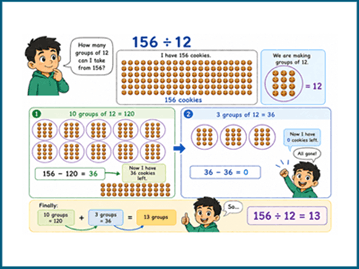
Example: 156 ÷ 12
Ask:
How many groups of 12 can I take from 156?
A child might think:
10 groups of 12 = 120
156 − 120 = 36
Then:
3 groups of 12 = 36
36 − 36 = 0
Finally:
10 groups + 3 groups = 13 groups
So:
156 ÷ 12 = 13
Why do schools teach partial quotients?
Partial quotients help children:
Understand division as making groups
Use multiplication facts they already know
Develop number sense
Solve problems flexibly
See why long division works instead of just memorizing steps
In other words, children learn the reasoning behind division before learning the traditional algorithm.
How is partial quotients different from long division?
Long division:
Uses a fixed set of steps
Requires remembering where to write each number
Often becomes a procedure to memorize
Partial quotients:
Allows different approaches
Encourages mental math
Focuses on understanding
Helps students estimate and reason
Eventually, many students move from partial quotients to traditional long division because they understand the ideas behind it.
Another Example: 245 ÷ 7
Start by asking:
How many groups of 7 can I remove?
A child might choose:
20 groups of 7 = 140
245 − 140 = 105
Then:
10 groups of 7 = 70
105 − 70 = 35
Then:
5 groups of 7 = 35
35 − 35 = 0
Add the groups:
20 + 10 + 5 = 35
So:
245 ÷ 7 = 35
Notice that another child might subtract:
30 groups of 7
Then 5 groups of 7
They would still get the correct answer.
That's one of the strengths of partial quotients: there is often more than one right path.
Common questions parents ask
Is partial quotients harder than long division?
At first, it can seem unfamiliar. But many children find it easier because they can use multiplication facts they already know instead of memorizing a sequence of steps.
Will my child still learn long division?
Usually, yes.
Many elementary schools teach partial quotients first and then introduce traditional long division later. The goal is for students to understand division deeply before learning the standard algorithm.
Why does my child subtract big numbers like 70 or 140?
Because they are removing large groups all at once.
This makes the calculation faster and helps children think about the size of numbers rather than following a set procedure.
Tips for helping your child at home
If your child is learning partial quotients:
Ask, "How many groups can we remove?"
Encourage estimation.
Let them choose friendly numbers like 10 groups or 20 groups.
Use multiplication facts to check their work.
Focus on understanding rather than speed.
The goal is to help children become flexible, confident mathematicians who understand what division means.
The bottom line
Partial quotients are a division strategy that breaks a large problem into smaller, manageable pieces.
It may look different from the long division you learned in school, but it builds number sense, strengthens multiplication skills, and helps children understand the reasoning behind division.
And once students understand partial quotients, traditional long division often makes a lot more sense.