


Below are the major shifts in how children are learning math today, which could also be great topics for your elementary math blog.
Conceptual understanding before memorization
Modern math teaching focuses on understanding why math works.
Instead of memorizing:
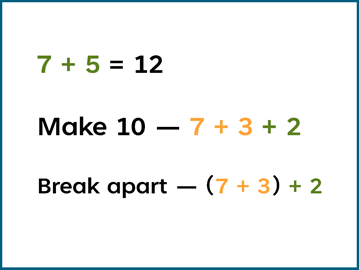
7 + 5 = 12
Students learn strategies such as:
Make 10 → 7 + 3 + 2
Break apart numbers → (7 + 3) + 2
Children build number sense, which helps them solve unfamiliar problems later.
Visual math models
Children are now taught math through visual representations before abstract numbers.
Common models include:
Number lines
show addition, subtraction, and fractions
Ten frames
help understand place value and combinations to 10
Bar models
visualize word problems and relationships between numbers
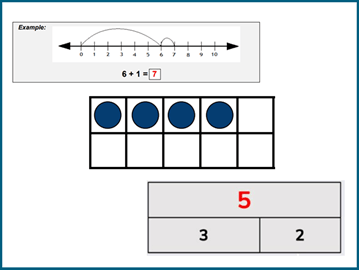
These visuals help children see how numbers relate to each other.
Multiple ways to solve a problem
Instead of a single correct method, students learn several strategies.
Example:
15 + 27 could be solved by:
- Standard algorithm
- Compensation: 15 + 25 + 2
- Break apart: (10 + 20) + (5 + 7)
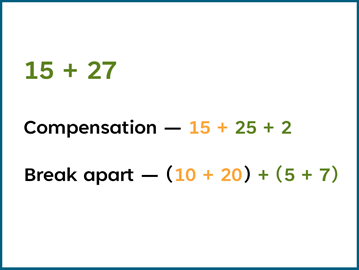
Teachers encourage students to explain their thinking, which strengthens reasoning.
Math talks and discussion
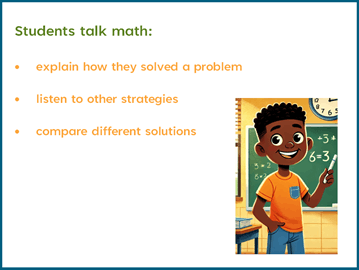
Many classrooms now use math talks.
Students:
- explain how they solved a problem
- listen to other strategies
- compare different solutions
This helps children:
- develop mathematical language
- build confidence
- understand deeper strategies
Real-world problem solving
Math is increasingly taught through real-life scenarios.
Examples:
- budgeting money
- measuring ingredients in cooking
- planning travel distances
- interpreting graphs and data

Children learn that math is useful, not just a school subject.
Growth mindset in math
Teachers emphasize that math ability can improve with practice.
Students are encouraged to:
- try different strategies
- learn from mistakes
- explain their thinking
This reduces the fear that many students used to feel toward math.
Early focus on problem solving
Even young students now encounter multi-step thinking problems.
Example:
"There are 12 apples. Mia eats 3 and buys 5 more. How many apples does she have now?"
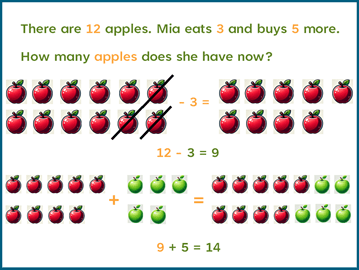
Children learn to:
- understand the story
- decide what operations to use
- represent the problem visually
Why this matters for parents
Many parents say “This isn’t how I learned math.”
But these new methods aim to build:
- stronger number sense
- flexible thinking
- deeper understanding
Students who learn math conceptually are better prepared for algebra and advanced math later.
Understanding how children learn math today: parent questions answered
What is number sense?
Number sense is a child’s ability to understand how numbers work and relate to each other.
Instead of just memorizing math facts, children with strong number sense can:
- break numbers apart and put them back together
- estimate answers
- solve problems in flexible ways
For example, a child with number sense may solve 8 + 7 by thinking:
8 + 2 = 10
10 + 5 = 15
This shows they understand how numbers combine, not just the final answer.
Number sense helps children become confident and flexible problem solvers in math.
Why do teachers use number lines and ten frames?
Teachers use visual tools because they help children see how numbers behave.
A number line helps students:
- understand counting forward and backward
- visualize addition and subtraction
- see the distance between numbers
A ten frame helps children:
- understand numbers up to ten quickly
- see combinations that make ten
- build early place value understanding
These tools make math visible and concrete, which is especially helpful for younger learners.
What Is the “new math” parents see in homework?
Many parents notice that math homework today looks very different from what they learned in school.
Instead of only teaching the standard algorithm, modern math education encourages children to:
- understand why a method works
- explore multiple strategies
- explain their thinking
For example, to solve 27 + 15, a child might write:
20 + 10 = 30
7 + 5 = 12
30 + 12 = 42
This approach helps children build deep understanding, which supports learning more advanced math later.
How do children learn mental math strategies?
Mental math helps children solve problems without writing everything down.
Teachers introduce strategies such as:
Making ten
Example:
9 + 6 → (9 + 1) + 5
Breaking numbers apart
Example:
14 + 23 → (10 + 20) + (4 + 3)
Compensation
Example:
19 + 7 → 20 + 7 − 1
These strategies help children calculate quickly and flexibly in their heads.
Why does explaining math out loud help children learn?
When children explain their thinking, they organize their ideas and make their reasoning clearer.
Talking about math helps students:
- strengthen understanding
- discover mistakes
- learn different strategies from classmates
For example, one child might solve a problem by breaking numbers apart, while another might use a number line.
Hearing different approaches helps students realize there are many ways to solve a problem correctly.
Why do children learn several ways to solve the same problem?
Teachers encourage multiple strategies because it helps children understand how numbers work, not just memorize a method.
When students learn several approaches, they:
- see patterns between numbers
- choose the most efficient strategy
- adapt when problems become more complex
Learning flexible strategies builds stronger long-term problem-solving skills.
Why do teachers focus so much on number sense?
Number sense is a child’s general understanding of numbers and how they relate to each other.
Children with strong number sense can:
- estimate answers
- break numbers apart
- choose efficient strategies
Research shows these skills help students succeed in later math learning and problem solving.
Why do children learn “making ten” and other number tricks?
Strategies like making ten help children calculate mentally.
Example:
8 + 6 → (8 + 2) + 4
These strategies help children:
- simplify calculations
- build mental math skills
- recognize number relationships.
Why does math homework sometimes include pictures or diagrams?
Pictures help children visualize mathematical relationships.
Students may draw:
- number lines
- groups of objects
- bar models
diagrams showing parts and wholes
Visual thinking makes abstract math concepts easier to understand.
Why are estimation and “about” answers important?
Estimation teaches children to judge whether an answer makes sense.
Example:
52 + 29 is about 50 + 30 = 80
Estimation helps children:
- check their work
- develop number sense
- build confidence with large numbers.
Why do students use manipulatives like blocks or counters?
Manipulatives help children touch and see math concepts.
Examples include:
- base-ten blocks
- linking cubes
- fraction circles
Concrete tools make abstract ideas easier to understand, especially for younger learners. Digital versions of these tools are now also used in many classrooms.
Why do teachers ask “how do you know"?
Explaining reasoning shows whether a child truly understands the concept.
When students explain their thinking, they:
- clarify their ideas
- detect mistakes
- deepen their understanding.
This skill becomes essential in later math and science learning.
Why do children sometimes learn math through games?
Games help students practice math skills in a low-stress, engaging way.
Research shows play-based activities can support the development of number sense and mental math skills, especially in younger learners.
Why do some problems look harder than when I was in school?
Modern math often focuses on conceptual understanding before shortcuts.
Students still learn traditional algorithms, but only after they understand why they work. This approach reduces mistakes and improves long-term retention.
Why do teachers encourage children to talk about math?
Talking about math helps children:
- organize their thinking
- learn new strategies from classmates
- build confidence in problem solving.
Studies show that “math talk” between adults and children can help develop mathematical understanding and engagement.