


Measuring angles helps students describe how far two rays open from a shared endpoint. Our measuring angles worksheets give students practice using a protractor, recording measurements in degrees and classifying angles.
What is an angle?
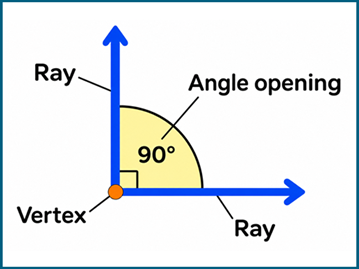
An angle is formed by two rays that share an endpoint, called the vertex. We measure the opening between the rays in degrees, using the symbol °.
For example, a right angle measures 90°. Making the rays longer does not change the angle’s measurement.
How to measure an angle with a protractor
A protractor is a tool used to measure and draw angles. To measure an angle:
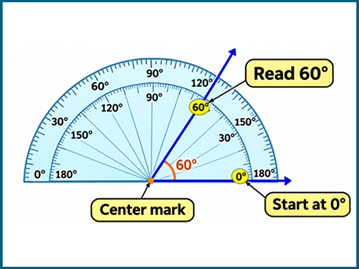
1. Place the protractor’s center mark on the angle’s vertex.
2. Line up one ray with the protractor’s zero line.
3. Find where the other ray crosses the numbered scale.
4. Read the scale that starts at 0° on the ray you lined up.
For example, if one ray lines up with 0° and the other crosses 60° on that scale, the angle measures 60°.
Many protractors have two scales. Before reading the measurement, check whether the angle is smaller or larger than a right angle. This helps students avoid reading 120° when the angle measures 60°.
Practice reading a protractor
Students can begin by reading angles shown on a printed protractor. This helps them learn which scale to follow and how to read the degree markings.
Our using a protractor worksheets include exercises for measuring and drawing angles.

Measure angles with a real protractor
Once students understand the markings, they can position a protractor themselves and measure angles facing different directions.
In these measuring angles worksheets, students use a real protractor to find each measurement. Some exercises also ask them to classify the angles.

Measure and classify angles
Students can use their measurements to identify the type of angle:
• An acute angle measures more than 0° and less than 90°.
• A right angle measures exactly 90°.
• An obtuse angle measures more than 90° and less than 180°.
For example, a 45° angle is acute, while a 130° angle is obtuse. Our guide to different types of angles explains these categories.
Our grade 5 measure and classify angles worksheets bring both skills together.

For a quick check, ask your child to draw a 40° angle and a 120° angle, then name each type. The first is acute; the second is obtuse.