
 Halloween W'sheets!


Your child finishes reading a paragraph about a school garden. They can tell you about the tomatoes, the watering cans and the worms in the soil. But when you ask what the paragraph is mostly about, they are not quite sure.
Remembering details and understanding how those details fit together are different skills. Learning to identify the main idea helps children move from recalling separate facts to understanding the point of what they read.
These main idea and supporting details examples show how to introduce the skill, practice it together and gradually work toward longer passages. Start with the example that best matches your child’s reading confidence, whether they are in grade 2, 3, 4 or 5.
What are the main idea and supporting details?
The main idea is the most important point a writer makes about a topic. Supporting details are the facts, examples, reasons or descriptions that explain and develop that point.
For a child, you can explain it this way:
- Main idea: What does the writer most want me to understand?
- Supporting details: What information helps me understand that idea?
Read this short example together:
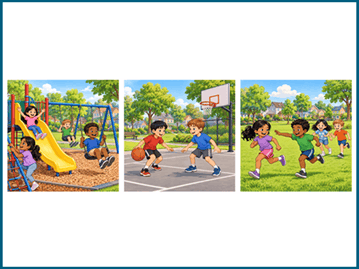
Our neighborhood park has several places for children to play. Younger children can use the swings and slide. Older children can play basketball on the court. There is also a large grassy area for running and playing tag.
Main idea: The neighborhood park has several places for children to play.
Supporting details:
- There are swings and a slide for younger children.
- Older children can use the basketball court.
- The grassy area provides space for running and playing tag.
Each detail explains a different way the park provides places to play. Together, the details support one clear main idea.
What is the difference between a topic and a main idea?
A topic names the subject of a text. A main idea explains what the writer says about that subject.
In the park example:
Topic: The neighborhood park.
Main idea: The neighborhood park has several places for children to play.
“The neighborhood park” tells us the subject, but it does not tell us the writer’s point. Another paragraph about the same park might explain why it needs cleaning or how it changes in autumn.
Try a second comparison:
Topic: School lunches.
Possible main idea: Packing a school lunch the night before can make mornings easier.
Another possible main idea: Students can reduce lunch waste by using reusable containers.
The topic stays the same, but the main idea changes. If your child answers with just one or two words, ask, “What does the writer tell us about that?” Help them turn the topic into a complete thought.
How to find the main idea in five steps
Children often need to hear the thinking behind an answer. Work through a short paragraph aloud before asking your child to try independently.
1. Read the whole paragraph
Encourage your child to read to the end before choosing an answer. The first sentence may introduce the main idea, but later sentences can change or clarify what the paragraph is about.
If reading the words takes most of your child’s attention, read the passage aloud. They can practice identifying the main idea through listening while continuing to build their independent reading skills.
2. Identify the topic
Ask, “Who or what is this paragraph about?” Look for people, places, objects or ideas that appear throughout the passage.
Repeated words can offer clues, but counting repeated words is not enough. Writers may use different words for the same subject, and the main idea includes more than the subject’s name.
3. Ask what the details have in common
Return to the park example. The swings, basketball court and grassy area are different things. What connects them? They all provide places for children to play.
Useful questions include:
- What do these details help explain?
- Why has the writer included these examples together?
- What point connects most of the important information?
4. State the main idea in a complete sentence
A helpful sentence frame is:
“This paragraph is mostly about ___, and it explains that ___.”
For the park example, your child might say, “This paragraph is mostly about our neighborhood park, and it explains that children have several places to play.”
Once they understand the idea, help them make the sentence shorter: “Our neighborhood park has several places for children to play.”
5. Check the answer against the text
Ask your child to find two or three details that support their answer. Then ask, “Does this main idea explain why these details belong together?”
If their answer only covers the basketball court, it is too narrow. If their answer is “Parks are important,” it is too broad for this paragraph. A strong answer matches the passage closely without adding ideas the writer has not supported.
Grade 2 example: finding a clearly stated main idea
For an accessible starting point, choose a short paragraph with familiar vocabulary and a main idea stated directly in the text.
Read the paragraph
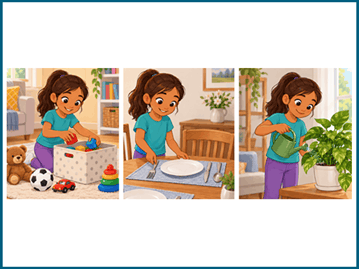
Mia helps at home in several ways. She puts her toys in a basket after playing. Before dinner, she sets the forks and knives on the table. She also waters the plant beside the window.
Find the main idea
Main idea: Mia helps at home in several ways.
The first sentence states the main idea. The other sentences give examples of how Mia helps.
Identify the supporting details
- Mia puts away her toys.
- She sets the forks and knives on the table.
- She waters a plant.
Explain that “Mia waters a plant” is a detail because it tells us about just one of her helpful jobs. The main idea includes all three jobs.
Try a multiple-choice question
Which sentence best tells what the paragraph is mostly about?
A. Mia has a plant beside the window.
B. Mia helps with different jobs at home.
C. Everyone should have a toy basket.
Answer: B. It covers all the examples in the paragraph. A is only one detail, and C is an opinion that the paragraph does not discuss.
Parent prompt: “Can you point to two sentences that show how Mia helps?”
Grade 3 example: finding a main idea at the end
Once your child can find a main idea at the beginning, show that it can appear elsewhere. In this example, the writer gives the details first.
Read the paragraph
At the library, children can borrow books to enjoy at home. They can use computers to look up information for school projects. Some libraries also offer story times and craft activities. Libraries give children several ways to read, learn and create.
Find the main idea
Main idea: Libraries give children several ways to read, learn and create.
Here, the last sentence brings the earlier details together. Your child should check the entire paragraph rather than automatically choosing the opening sentence.
Identify the supporting details
- Children can borrow books.
- They can use computers to research school projects.
- Some libraries offer story times and craft activities.
Explain why another answer is too narrow
“Children can borrow books from the library” is true, but it does not include the computer research or activities. It describes only part of the paragraph.
“Libraries give children several ways to read, learn and create” covers the full set of examples.
Parent prompt: “Which sentence connects all three things children can do?”
Grade 4 example: finding an implied main idea
Sometimes the writer does not state the main idea in one sentence. Readers must work it out from the details. This is called an implied main idea.
Read the paragraph
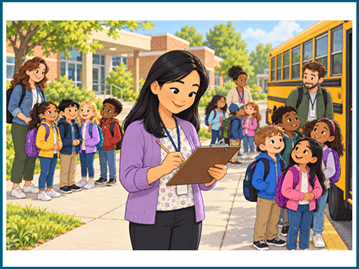
Before the class trip, Mrs. Chen checked that every student had returned a permission form. She made a list of the students in each group and shared it with the adult helpers. She packed the emergency contact information and reviewed the day’s schedule. Before the bus left, she counted the students and reminded them of the safety rules.
Find the main idea
Main idea: Mrs. Chen prepared carefully to keep the class trip organized and safe.
No sentence states that exact idea. Instead, the permission forms, group lists, emergency information, schedule and safety reminders all point toward it.
Identify the supporting details
- She checked permission forms.
- She organized groups and informed the adult helpers.
- She brought emergency contact information.
- She reviewed the schedule and safety rules and counted the students.
Compare possible answers
Too broad: Teachers have many responsibilities.
This could apply to a whole article about teaching, but the paragraph focuses on preparing for one trip.
Too narrow: Mrs. Chen checked permission forms.
This leaves out most of her preparations.
Unsupported: Mrs. Chen was worried that the students would misbehave.
The paragraph describes her actions, but it does not tell us she felt worried or expected poor behavior.
Best fit: Mrs. Chen prepared carefully to keep the class trip organized and safe.
Parent prompt: “What do all these preparations help Mrs. Chen do?”
Grade 5 example: finding the main idea across paragraphs
Longer texts can contain a main idea for each paragraph and an overall main idea connecting the whole passage. Help your child identify the smaller ideas before combining them.
Read the passage
At Oak Street School, students noticed that many reusable items were being thrown away. The student council placed a tray beside the classroom scrap-paper bin so children could collect sheets with a blank side. Teachers encouraged students to use this paper for planning stories and solving math problems.
The school also held a supply swap. Families donated spare rulers, unused notebooks and pencil cases they no longer needed. Students chose supplies they could use instead of buying everything new.
At lunchtime, classes began collecting unopened food items permitted by the school’s food-sharing rules. These items were placed on a supervised sharing table where students could take something they wanted. The school checked its food-safety procedures before starting the project.
Find each paragraph’s main idea
Paragraph 1: The school helped students reuse paper.
Paragraph 2: A supply swap helped students reuse school supplies.
Paragraph 3: A supervised sharing table helped students share unopened food instead of discarding it.
Find the overall main idea
Overall main idea: Oak Street School introduced several practical ways to reduce waste.
This sentence connects paper reuse, the supply swap and the sharing table. An answer about saving paper alone would miss two-thirds of the passage.
Select evidence from across the text
To support the overall main idea, your child could choose:
- Students used the blank sides of scrap paper.
- Families donated supplies for other students to use.
- Students shared permitted unopened food through a supervised table.
Choosing evidence from different paragraphs shows how the overall idea connects the text. Three details from the first paragraph would only explain one part of the school’s work.
Parent prompt: “What larger idea includes all three projects?”
These grade labels offer starting points for practice. A Grade 5 student may benefit from short, clearly stated examples before moving to longer texts, while a confident younger reader may be ready to discuss an implied main idea.
Main idea, topic sentence, summary and theme: what is the difference?
These terms are related, so children can easily confuse them.
A topic names the subject. For example: “Reusing school supplies.”
A main idea states the writer’s central point about the subject. For example: “A school supply swap helps students reuse items instead of buying everything new.”
A topic sentence is a sentence in the paragraph that states its main idea. It often appears near the beginning, but it can appear elsewhere. When the main idea is implied, there may be no sentence that states it directly.
A summary briefly retells the main idea and the most important information. It gives more information than a main idea sentence alone. For the Oak Street passage, a summary could be: “Oak Street School introduced several ways to reduce waste. Students reused scrap paper, exchanged school supplies and shared permitted unopened food.”
A theme is a broader message explored in a story. If a story describes two friends solving a difficult problem together, its main idea might explain what the friends do. A possible theme might be that cooperation helps people overcome challenges. The theme must still be supported by the story.
For initial practice, use short informational paragraphs. They make it easier to focus on the relationship between a central point and its supporting information before discussing the additional demands of stories.
Common mistakes when finding the main idea
Choosing an interesting detail
A surprising fact can feel more important than the rest of a passage. Your child may remember that a character carried a purple umbrella while missing the paragraph’s focus on getting ready for a rainy walk.
Ask, “Does that answer explain most of the paragraph, or just one small part?” Then look for the idea that connects several details.
Giving only the topic
If your child says “Libraries,” they have identified the subject. Help them take the next step: “What does this paragraph tell us about libraries?”
Encourage a complete sentence, such as “Libraries offer children several ways to read, learn and create.”
Always choosing the first sentence
The first sentence is a useful place to look, but it is not a rule. Compare the Grade 2 and Grade 3 examples to show how the main idea can appear at the beginning or the end. Then use the Grade 4 example to show that readers sometimes need to put the idea into their own words.
Adding personal knowledge
Your child may know many facts about a topic. However, an answer about the main idea must fit the passage they have read.
If a paragraph explains how a library helps children learn, “Libraries should stay open later” is not its main idea, even if your child agrees with that opinion.
Ask, “Where does the text support that answer?”
Naming details without explaining their connection
A child may correctly list paper, notebooks and food but still struggle to identify the overall main idea of the school passage.
Help them complete this thought: “These examples all show ways the school is ___.” The missing phrase, “reducing waste,” connects the details.
Four main idea practice activities to try at home
1. Match the details to an idea
Write these details on separate slips of paper:
- We can play a board game.
- We can build a blanket fort.
- We can make pictures with crayons.
Ask your child to choose between these main ideas:
A. Board games have many small pieces.
B. There are several fun activities to do indoors.
C. Rain falls from clouds.
Answer: B. All three details are examples of indoor activities. Ask your child to explain why the other choices do not fit the whole group.
For an extra challenge, remove the choices and ask your child to write their own main idea.
2. Find the detail that does not belong
Give your child this main idea:
Our class takes care of its reading corner.
Then offer four details:
- We return books to the correct baskets.
- We put the cushions back after reading.
- Our school has a large soccer field.
- We tell the teacher when a book needs repairing.
Answer: The soccer field detail does not support the main idea. It is about the school, but it does not explain how the class cares for its reading corner.
This distinction matters: a detail can relate to the general topic without supporting the specific main idea.
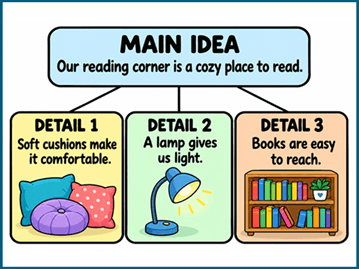
3. Build a main idea organizer
Draw one large box above three smaller boxes. Write the main idea in the large box and one supporting detail in each smaller box.
Use this sentence frame to connect them:
“The detail ___ supports the main idea because ___.”
For example: “The detail about returning books supports the main idea because it shows one way the class keeps its reading corner organized.”
Three detail boxes are a convenient practice format. A real paragraph may include fewer or more supporting details.
4. Choose the best main idea, then improve it
Read this paragraph:
The class made signs to advertise its book sale. Students sorted donated books into groups and placed price stickers on the covers. On the morning of the sale, they arranged the books on tables and set up a place to collect payments.
Which main idea fits best?
A. Students put stickers on books.
B. The class worked together to prepare for a book sale.
C. Books are better than movies.
Answer: B. A is one detail, and C is unrelated to the paragraph’s point.
Now ask your child to state the main idea without looking at the choices. An answer such as “The students completed different jobs to get their book sale ready” also works. Children do not need to copy one exact sentence when their wording accurately expresses the same idea.
Independent practice: find the main idea and details
Read the paragraph, then answer the questions before checking the suggested answers.
When the school started a walking club, students found different ways to take part. Some walked a short loop around the playground before class. Others joined a lunchtime walk with a teacher. On Fridays, families could join a longer walk through the neighborhood. The club offered walking opportunities at different times so more people could participate.
1. What is the topic?
2. What is the main idea?
3. Which three details support the main idea?
4. Is the main idea stated directly or implied?
Suggested answers
Topic: The school walking club.
Main idea: The club offered walks at different times so more people could participate.
Supporting details: Students could walk before class, join a lunchtime walk or take part in a longer Friday walk with families.
Stated or implied? Stated directly in the final sentence.
Accept sensible answers in your child’s own words. If they write “The walking club gave people several opportunities to join in,” ask them to show how the passage supports that interpretation.
Main idea and supporting details worksheets for Grades 2–5
After working through an example together, choose a worksheet that lets your child try the same skill with a new passage.
Grade 2 main idea worksheets
Identify and discuss the main idea and supporting details.

Grade 3 main idea and supporting details worksheets
Practice with fiction and nonfiction texts.

Grade 4 main idea and summarizing worksheets
Identify main ideas and supporting details, with additional summarizing practice.

Grade 5 main idea, details and summary worksheets
Continue practicing main ideas, supporting information and summaries.
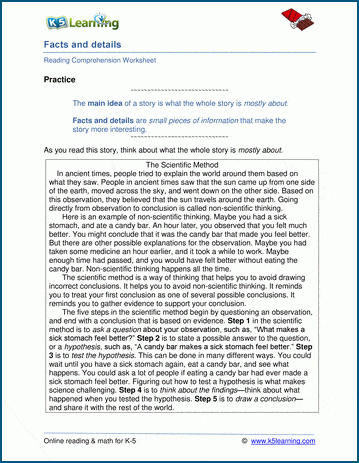
Start with one passage and discuss the answer. Ask your child to explain how a supporting detail connects to the main idea before moving to another worksheet.
For a connection to writing, try Grade 4 supporting details worksheets. Children can use the same relationship in reverse: begin with a main idea and write details that explain it.
Frequently asked questions about main ideas
Is the main idea always the first sentence?
No. It may appear at the beginning, in the middle or at the end of a paragraph. It may also be implied, meaning readers need to work it out from the details.
Can a main idea be more than one sentence?
A child can usually express the main idea of a short paragraph in one clear sentence. A complex text may require a fuller explanation, and a longer passage can contain several main ideas. Follow the question’s instructions and focus on the amount of text being discussed.
How many supporting details should a child find?
Follow the task’s directions. Two or three details are useful for guided practice, but there is no fixed number that every paragraph must contain. The details should explain the chosen main idea and come from the text.
What if my child’s answer is different from the answer key?
Compare the meaning rather than expecting identical wording. Ask whether the answer covers the passage’s important information, stays focused and has clear support in the text. A correctly paraphrased answer can be just as accurate as the suggested answer.
How can I help without giving the answer away?
Ask your child to name the topic, select two important details and explain what those details have in common. If they are still stuck, offer two possible main ideas and discuss which one fits better. Then try a fresh example with less help.
Help your child connect the details to the bigger idea
When you read together, occasionally pause after a paragraph and ask, “What is the writer telling us here?” Follow with, “Which details helped you decide?”
Keep the discussion brief enough that reading still feels enjoyable. One clear explanation supported by evidence can be more useful than rushing through several passages. As your child gains confidence, move from finding a stated main idea to explaining implied ideas and connecting information across paragraphs.