
 Halloween W'sheets!

The answers to all of these questions involve light and sound.
Light and sound are forms of energy that help us experience the world around us. Light allows us to see colors, shapes, and objects. Sound allows us to hear music, voices, and all the noises around us.
Even though we use light and sound every day, they are full of amazing science.
Let's discover how they work.
What Is light?
Light is a form of energy that travels in waves. It moves incredibly fast and allows us to see everything around us.
Without light, the world would be completely dark. We wouldn't be able to see our friends, read books, play sports, or enjoy beautiful sunsets.
Where does light come from?
Some objects make their own light. These are called light sources.
Examples of light sources include:
The Sun
Stars
Light bulbs
Flashlights
Candles
Fireflies
Television and computer screens
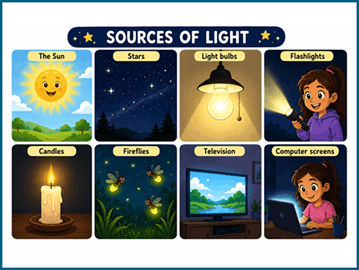
The Sun is the biggest and most important source of light for Earth. It provides the light and heat that make life possible.
Other objects do not make their own light. Instead, they reflect light from another source.
For example:
The Moon shines because it reflects light from the Sun.
A mirror reflects light so you can see yourself.
A white shirt reflects most of the light that hits it.
How does light travel?
Light travels in straight lines called rays.
It travels incredibly fast, about 300,000 kilometers (186,000 miles) every second.
That means light can travel around Earth more than seven times in just one second.
Because light travels so quickly, sunlight only takes about eight minutes to reach Earth, even though the Sun is about 150 million kilometers away.
Reflection: when light bounces
When light hits a smooth surface, it can bounce off. This is called reflection.
You see reflection every day:
Looking into a mirror
Seeing your face in a calm lake
Watching sunlight sparkle on water
Seeing reflections in windows
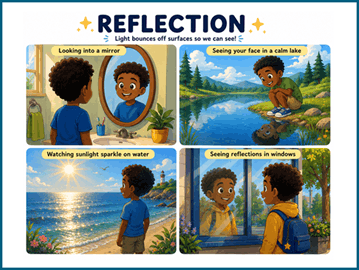
Mirrors are made to reflect almost all of the light that hits them, which is why they create clear images.
Try this:
Shine a flashlight at a mirror.
What happens?
The light bounces off the mirror and shines somewhere else. That's reflection in action!
Refraction: when light bends
Sometimes light doesn't bounce; it bends.
This bending is called refraction.
Refraction happens when light travels from one material to another, such as:
Air to water
Air to glass
Water to air
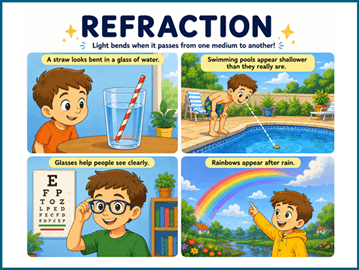
You can see refraction when:
A straw looks bent in a glass of water.
Swimming pools appear shallower than they really are.
Glasses help people see clearly.
Rainbows appear after rain.
How are rainbows made?
Rainbows form when sunlight enters tiny raindrops in the air.
Inside each raindrop:
The light bends.
The light separates into different colors.
The light reflects inside the drop.
It bends again as it leaves.
This creates the beautiful colors of the rainbow:
Red
Orange
Yellow
Green
Blue
Indigo
Violet
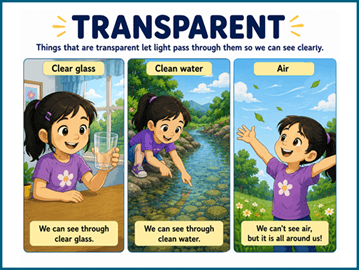
Transparent, translucent, and opaque objects
Different materials let different amounts of light pass through.
Transparent
Transparent materials let almost all light pass through.
Examples:
Clear glass
Clean water
Air
You can see clearly through them.
Translucent
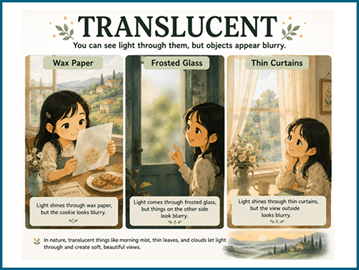
Translucent materials let some light pass through.
Examples:
Wax paper
Frosted glass
Thin curtains
You can see light through them, but objects appear blurry.
Opaque
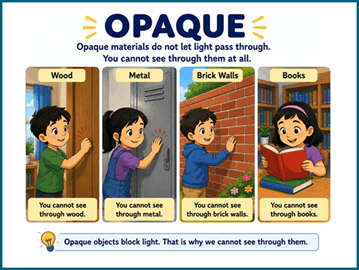
Opaque materials block light completely.
Examples:
Wood
Metal
Brick walls
Books
You cannot see through opaque objects.
What is sound?
Sound is another form of energy.
Unlike light, sound is created by vibrations.
A vibration is a quick back-and-forth movement.
When something vibrates, it pushes the air around it. These pushes travel as sound waves.
When the sound waves reach your ears, your brain interprets them as sounds.
How Is sound made?
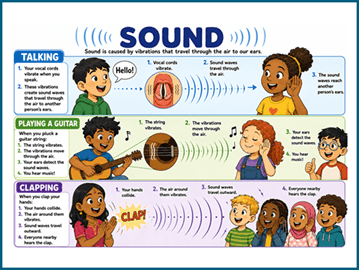
Almost every sound you hear comes from something vibrating.
For example:
Talking
Your vocal cords vibrate when you speak.
These vibrations create sound waves that travel through the air to another person's ears.
Playing a guitar
When you pluck a guitar string:
The string vibrates.
The vibrations move through the air.
Your ears detect the sound waves.
You hear music!
Clapping
When you clap your hands:
Your hands collide.
The air around them vibrates.
Sound waves travel outward.
Everyone nearby hears the clap.
Does sound need air?
Yes, and this is one of the biggest differences between light and sound.
Sound needs matter to travel.
It can travel through:
Air
Water
Wood
Metal
Glass
But sound cannot travel through empty space.
That's why space is silent.
Astronauts on spacewalks cannot hear each other directly because there is no air between them. Instead, they use radios to send signals.
Light, however, can travel through space.
That's why we can see the Sun and stars even though space is mostly empty.
How fast does sound travel?
Sound travels much slower than light.
In air, sound travels about:
343 meters per second
Light travels about:
300,000,000 meters per second
That's why you often:
See lightning first.
Hear thunder a few seconds later.
The lightning and thunder happen at the same time.
You see the lightning first because light travels much faster than sound.
Loud and soft sounds
Some sounds are loud.
Some sounds are quiet.
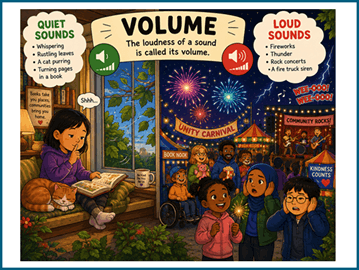
The loudness of a sound is called its volume.
Quiet Sounds
Whispering
Rustling leaves
A cat purring
Turning pages in a book
Loud Sounds
Fireworks
Thunder
Rock concerts
A fire truck siren
Sounds that are too loud can damage your hearing.
That's why people sometimes wear ear protection at concerts, construction sites, or sporting events.
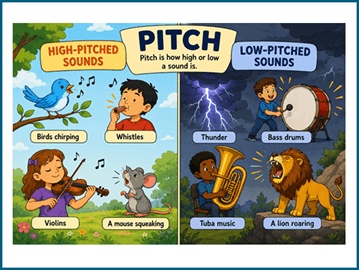
High and low sounds
Have you noticed that some sounds are high and squeaky, while others are deep and booming?
This is called pitch.
High-Pitched Sounds
Birds chirping
Whistles
Violins
A mouse squeaking
Low-Pitched Sounds
Thunder
Bass drums
Tuba music
A lion roaring
Generally:
Small objects vibrate quickly and make high-pitched sounds.
Large objects vibrate more slowly and make low-pitched sounds.
Animals that use sound in amazing ways
Humans use sound to communicate, but some animals use sound in incredible ways.
Bats
Bats fly at night when it's dark.
They make high-pitched sounds that bounce off objects.
By listening to the echoes, bats can tell:
Where insects are
How far away objects are
Which direction to fly
This is called echolocation.
Dolphins
Dolphins also use echolocation underwater.
They send out clicks and listen for echoes to:
Find fish
Avoid obstacles
Navigate through the ocean
Light and sound in everyday life
Think about your day.
You use light and sound constantly!
Light Helps You:
Read books
Watch television
Draw and paint
Play sports
Cross the street safely
See colors and faces
Sound Helps You:
Listen to music
Hear your teacher
Talk to friends
Hear alarms and doorbells
Enjoy birds singing
Watch movies
It's hard to imagine life without either one.
Fun facts about light and sound
Light from the Sun takes about 8 minutes to reach Earth.
Sound travels about one million times slower than light.
The fastest sound ever recorded was made by the eruption of the volcano Krakatoa in 1883. It was heard thousands of kilometers away!
Fireflies create light through a chemical reaction inside their bodies.
The deepest part of the ocean is so dark that animals there must create their own light. This is called bioluminescence.
Some whales can communicate with each other from hundreds of kilometers away using low-frequency sounds.
Try these simple experiments
Experiment 1: Reflection
You will need:
A flashlight
A mirror
Shine the flashlight at the mirror.
Can you make the light bounce onto the wall?
You are observing reflection!
Experiment 2: Make sound with a rubber band
You will need:
A tissue box or small container
Rubber bands of different sizes
Stretch the rubber bands around the box and pluck them.
What do you notice?
The rubber bands vibrate to make sound.
Thin rubber bands usually make higher sounds.
Thicker rubber bands usually make lower sounds.
Key vocabulary
Word Meaning
Light A form of energy that lets us see
Sound Energy created by vibrations
Vibration A rapid back-and-forth movement
Reflection When light bounces off a surface
Refraction When light bends as it passes through a material
Transparent Lets most light pass through
Translucent Lets some light pass through
Opaque Blocks light
Volume How loud or quiet a sound is
Pitch How high or low a sound is
Wave A repeating movement that carries energy
Echolocation Using echoes to locate objects
What did you learn?
Light and sound are amazing forms of energy that help us experience the world.
Light lets us see colors, objects, and stars in the night sky. Sound lets us hear music, laughter, and the voices of people we love.
The next time you see a rainbow, hear thunder, or listen to your favorite song, remember:
You are experiencing the fascinating science of light and sound.