


A sentence fragment is an unfinished sentence. It may be missing a subject, a complete verb or information needed to finish the thought. Learning to spot and repair fragments helps students in grades 2–4 make their writing clearer.
For a refresher on what makes a sentence complete, read our explanation of when sentences are not complete. Then use the examples below to practice fixing them.
Add who or what
Some fragments tell us what happened without naming who or what did it. They are missing a subject.
Fragment: Ran across the playground.
Ask: Who ran across the playground?
Complete sentence: The children ran across the playground.
Different subjects can complete the same fragment:
• My brother ran across the playground.
• Two friends ran across the playground.
• The excited puppy ran across the playground.
Each answer works because it names who performed the action.
Try another example:
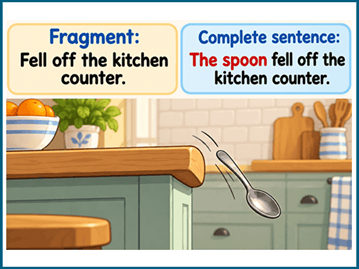
Fragment: Fell off the kitchen counter.
Complete sentence: The spoon fell off the kitchen counter.
Tell what happened
Other fragments name a person, place or thing but do not tell us anything about it. They are missing a predicate: the part of a sentence that includes the verb and tells something about the subject.
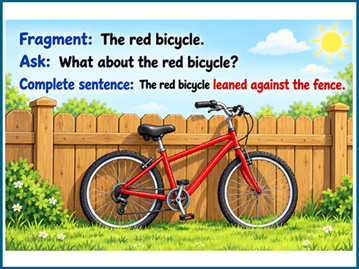
Fragment: The red bicycle.
Ask: What about the red bicycle?
Complete sentence: The red bicycle leaned against the fence.
Your child could also write:
• The red bicycle has a flat tire.
• The red bicycle belongs to my sister.
Adding more describing words does not solve the problem. The shiny red bicycle with a silver bell is still a fragment. We still need to say something about the bicycle.
Complete the verb
Sometimes the subject is present, but the verb is incomplete.
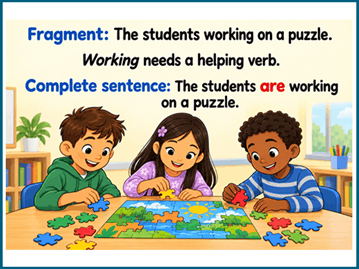
Fragment: The students working on a puzzle.
The words tell us who is involved and suggest an action, but working needs a helping verb here.
Complete sentence: The students are working on a puzzle.
Other helping verbs can change when the action happens:
• The students were working on a puzzle.
• The students have been working on a puzzle.
Another way to fix the fragment is to change the verb:
The students worked on a puzzle.
Compare these examples:
Fragment: The dog barking at the gate.
Complete sentence: The dog is barking at the gate.
Fragment: My cousins waiting outside.
Complete sentence: My cousins were waiting outside.
Fragment: The leaves blowing across the yard.
Complete sentence: The leaves blew across the yard.
Finish the thought
A group of words can have a subject and a verb and still leave the reader waiting for more information.
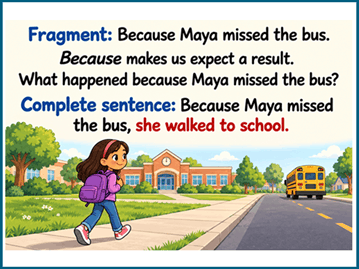
Fragment: Because Maya missed the bus.
We know who the sentence is about and what happened. However, because makes us expect a result.
Ask: What happened because Maya missed the bus?
Complete sentence: Because Maya missed the bus, she walked to school.
Words such as when, although, if and after can also introduce unfinished thoughts.
Fragment: When the rain stopped.
Complete sentence: When the rain stopped, we went outside.
Fragment: Although the bag was heavy.
Complete sentence: Although the bag was heavy, Ben carried it upstairs.
Fragment: If we finish early.
Complete sentence: If we finish early, we can play a game.
These opening groups of words need a main part that can stand on its own. For example, We went outside is a complete sentence.
Join a fragment to a related sentence
Sometimes the missing information is already in the sentence beside the fragment. Joining the two can fix the problem.
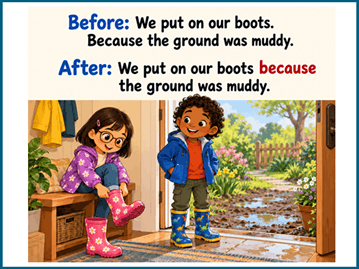
Before: We put on our boots. Because the ground was muddy.
After: We put on our boots because the ground was muddy.
Another example:
Before: After we finished lunch. We played a board game.
After: After we finished lunch, we played a board game.
When the after, when or because group comes first, use a comma to separate it from the main part of the sentence.
Avoid two common mistakes
Adding punctuation without completing the thought
A capital letter and a period do not turn an unfinished thought into a complete sentence.
The little brown rabbit. is still a fragment.
The little brown rabbit hopped away. is complete.
Assuming every short sentence is a fragment
A sentence can be very short and still express a complete thought.
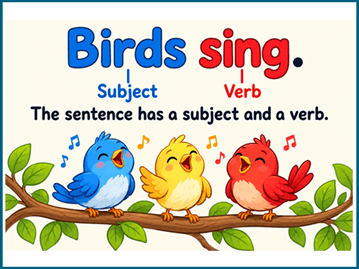
Birds sing. has a subject and a verb.
Commands can also be complete sentences. In Close the door, the subject you is understood: “You close the door.”
Try a sentence repair activity
Ask your child to explain what is missing, then rewrite each fragment as a complete sentence.
1. The sleepy kitten.
2. Carried the books to the classroom.
3. The birds sitting on the fence.
4. After we finished our homework.
5. Beside the garden gate.
6. Although Sam was tired.
Possible answers:
1. The sleepy kitten curled up on the sofa.
2. Our teacher carried the books to the classroom.
3. The birds were sitting on the fence.
4. After we finished our homework, we played outside.
5. A sunflower grew beside the garden gate.
6. Although Sam was tired, he finished the puzzle.
Answers will vary. Ask your child to check that each answer has a subject, a complete verb and a finished thought.
Practice with sentence fragment worksheets
Choose a starting point based on the support your child needs:
• Grade 2 fragments into sentences: Use a word bank to turn fragments into complete sentences.

• Grade 3 sentence fragments: Identify fragments and full sentences.

• Grade 4 fragments to full sentences: Practice adding missing information.

Then apply the same skills to your child’s writing. Read a short paragraph together and pause after each sentence. Ask: Does this thought stand on its own, or is something missing?