


Every year in elementary school builds on the one before it, and grade 4 is where addition becomes a much more powerful mathematical tool.
Students are no longer simply adding two- or three-digit numbers. Instead, they learn to work with larger numbers, solve increasingly challenging word problems, use mental math strategies, and explain how they arrived at an answer. These skills prepare children for more advanced topics such as decimals, fractions, multi-step problem solving, and algebraic thinking in later grades.
Whether you're a parent looking to support learning at home or a teacher searching for extra practice, understanding the goals of Grade 4 addition can help children develop confidence with numbers.
What do grade 4 students learn?
Grade 4 students expand their addition skills in several important ways. They learn to:
mentally add numbers using efficient strategies
add three or more numbers
add numbers with up to six digits
use the standard column addition algorithm
solve problems with missing addends
apply addition to real-world situations and word problems
Rather than memorizing one procedure, students are encouraged to think flexibly and choose strategies that make sense for different problems.
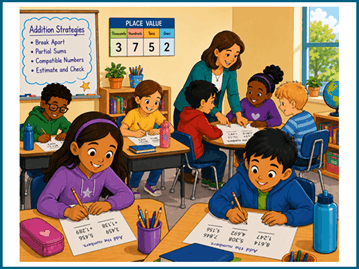
Mental addition builds number sense
Mental math helps children recognize number relationships instead of relying on pencil and paper for every calculation.
For example:
36 + 24
A student might think:
36 + 20 = 56
56 + 4 = 60
Or consider:
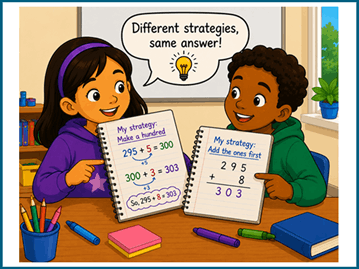
295 + 8
Instead of writing the problem vertically, many students learn to think:
295 + 5 = 300
300 + 3 = 303
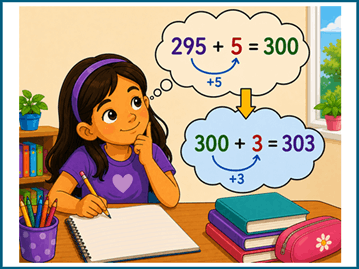
These flexible strategies improve both speed and number sense.
Many Grade 4 worksheets provide practice with:
adding two-digit numbers mentally
adding whole tens, hundreds, and thousands
adding three numbers mentally
finding missing addends
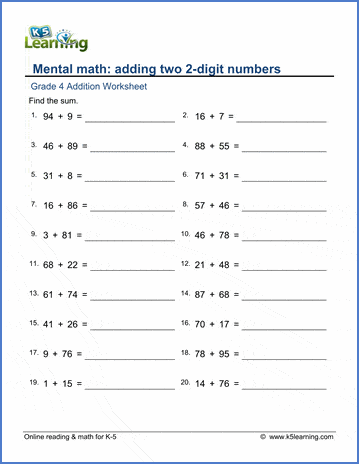
Grade 4 mental addition worksheets
On our grade 4 addition page, we have dozens of worksheets to students to practice mental math.
For example, these worksheets covering adding two-digit numbers.
Adding larger numbers
Students also learn to add much larger numbers using the standard algorithm.
Example:
4,378
+ 2,945
-------
7,323
As numbers become larger, careful place value becomes increasingly important.
Students must line up:
ones
tens
hundreds
thousands
before they begin adding.
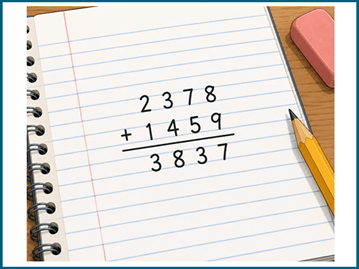
Many mistakes happen simply because digits are not aligned correctly.
Adding large numbers worksheets
On our grade 4 addition page, we have a dedicated section to adding large numbers.
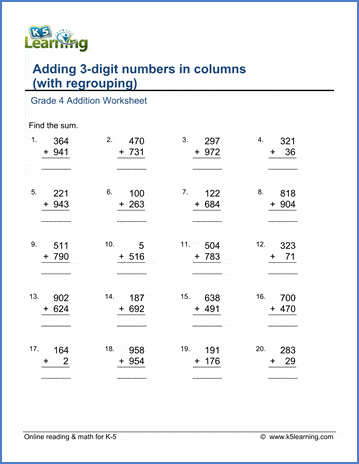
For example, this set of worksheets covering adding three-digit numbers.
Adding more than two numbers
Grade 4 students also learn to add several numbers together.
Example:
345
678
789
+ 890
------
Working with multiple addends strengthens organization and accuracy while giving students additional regrouping practice.
Later, worksheets often include four- and five-digit numbers as well.
Adding multiple large numbers worksheets
On our grade 4 addition page, we also cover working with multiple large addends.
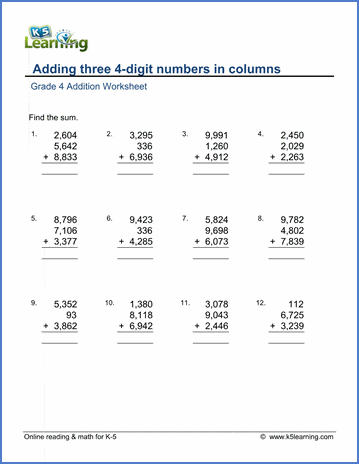
For example, this set of worksheets covering adding three four-digit numbers.
Understanding regrouping
Regrouping (sometimes called carrying) becomes more challenging as numbers grow larger.
For example:
5,987
+ 7,856
--------
Students may need to regroup in several columns before reaching the final answer.
Encourage children to slow down, complete one column at a time, and double-check each regrouping step.
Grade 4 addition with regrouping worksheets
On our grade 4 addition page we offer worksheets that cover carrying numbers.
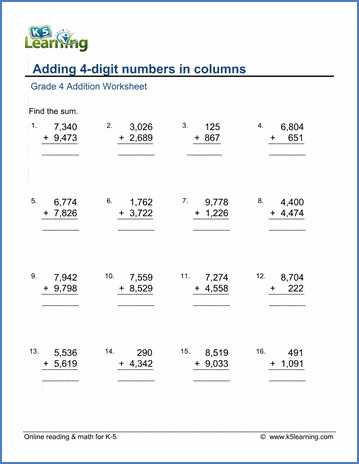
For example, this set of worksheets that ask students to add four-digit numbers.
Missing addends
Not every addition question asks students to find the total.
Sometimes one number is missing.
Examples:
_____ + 606 = 900
400 + _____ = 2,300
These problems help children understand the relationship between addition and subtraction while strengthening logical thinking.
Grade 4 missing addends worksheets
On our grade 4 addition page we have several sets of worksheets that cover missing addends.
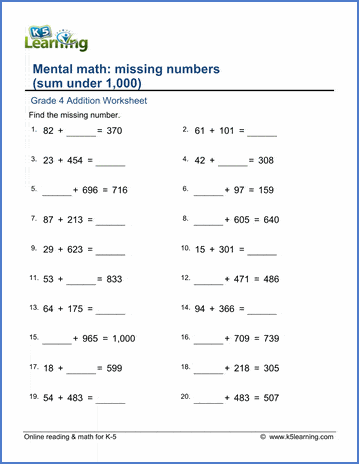
For example, this set of worksheets that cover missing addends with sums under 1.000.
Addition word problems
Addition becomes much more meaningful when students apply it to everyday situations.
For example:
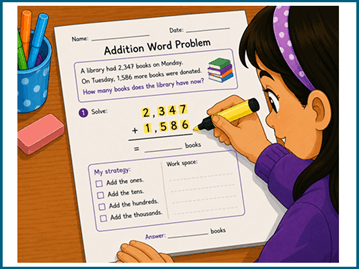
A school collected 2,845 cans in September and 3,176 cans in October. How many cans were collected altogether?
Students must first recognize that the situation requires addition before solving the problem.
Many Grade 4 worksheets combine addition with subtraction and other operations, helping children decide which mathematical operation fits each situation.
Grade 4 addition word problems
On our grade 4 addition page we have two sets of worksheets covering addition and subtraction, as well as the four operations.
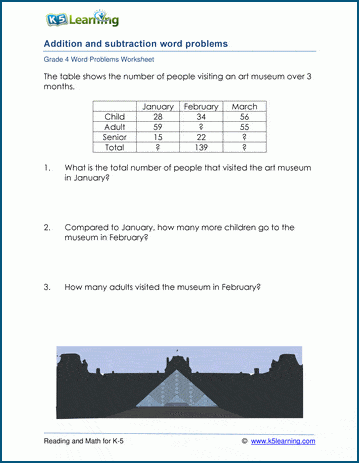
This set of worksheets ask students to identify addition and subtraction operations in solving the word problems.
How parents can help at home
Addition practice doesn't need to be limited to homework.
Try asking questions during everyday activities:
"If these groceries cost $34 and $58, about how much will we spend?"

"We've driven 245 km today and 178 km yesterday. What's our total?"
"Can you add these four prices together?"
"Is there a faster way to solve this?"
These short conversations help children understand that math is useful every day.
Accuracy matters more than speed
Many children worry about finishing first.
Instead, encourage them to:
line up digits carefully
check each column
estimate whether an answer makes sense
reread word problems before solving
Suggested image: A child completing a Grade 4 math worksheet at the kitchen table.
Students who build strong habits now naturally become faster as they gain experience.
Final thoughts
Grade 4 addition is about much more than finding the correct answer. Students learn to work confidently with larger numbers, recognize number patterns, choose efficient mental strategies, and solve increasingly complex real-world problems.
With regular practice and a variety of worksheet types, children develop the confidence they'll need for more advanced math topics in Grade 5 and beyond.
Free printable Grade 4 addition worksheets that include mental math, multi-digit addition, missing addends, regrouping, and word problems are an excellent way to reinforce these important classroom skills.