


If your child has come home talking about fronted adverbials, you’re not alone in wondering what on earth that means. It sounds technical, but the idea is actually quite simple once you break it down.
What is a fronted adverbial?
A fronted adverbial is a word or phrase placed at the beginning of a sentence that tells us more about the action.
It usually gives information about:
When something happens
Where it happens
How it happens
Why it happens
The key idea: it comes before the main part of the sentence.
Simple examples
Yesterday, we went to the park. (when)
In the garden, the cat was sleeping. (where)
Quickly, she finished her homework. (how)
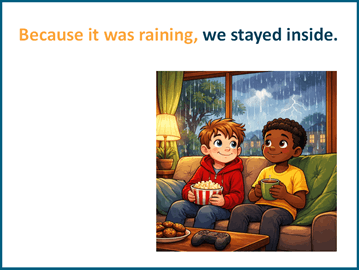
Because it was raining, we stayed inside. (why)
In each example, the sentence would still make sense without the fronted adverbial:
We went to the park yesterday.
The cat was sleeping in the garden.
But moving the phrase to the front adds emphasis and variety.
Why do schools teach fronted adverbials?
You might be wondering, why focus on this at all?
Fronted adverbials help children:
Write more interesting sentences
Avoid repeating the same sentence structure
Add detail and clarity to their writing
Improve storytelling and descriptive skills
Instead of writing:
The boy ran down the road.
A child might write:
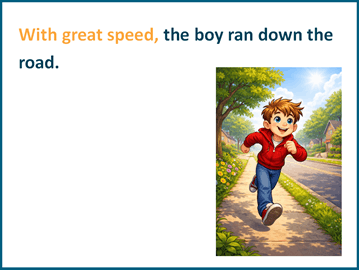
With great speed, the boy ran down the road.
It’s a small change that makes writing more vivid.
The comma rule
When a fronted adverbial starts a sentence, it is usually followed by a comma.
After lunch, we went outside.
On the hill, stood a tall tree.

Teachers often emphasise this rule, so don’t be surprised if your child is reminded about commas often.
How you can help at home
You don’t need worksheets or grammar drills to support your child. Try these simple ideas:
Play “Sentence Switch”
Take a normal sentence and move the ending to the front:
We played football after school →
After school, we played football.
Ask prompt questions
Encourage your child to expand sentences:
When did it happen?
Where did it happen?
How did it happen?
Story upgrade game
Turn a simple sentence into a richer one:
The dog barked →
In the middle of the night, the dog barked loudly.
Common mistakes
Children often:
Forget the comma
Use very short adverbials repeatedly (“Then,” “Then,” “Then…”)
Place them awkwardly at first
This is all part of learning. Practice helps them develop a natural feel for sentence flow.
Final thought
Fronted adverbials may sound like complicated grammar, but they’re really just a way of helping children say more, more clearly, and more creatively.
With a little encouragement at home, your child will start using them naturally, and their writing will become more engaging.