
 Halloween W'sheets!

Fractions can be difficult for elementary students because they represent parts of a whole rather than whole numbers. Visual models help make fractions concrete and easier to understand. When students can see and manipulate fractions, they build a stronger conceptual foundation before moving to abstract calculations.
Using visual models allows students to explore fractions in a meaningful way and develop deeper mathematical understanding.
Why visual models help students understand fractions
Visual representations make fractions easier to grasp because they allow students to:
See how a whole can be divided into equal parts
Compare the size of different fractions
Understand equivalent fractions
Connect fractions to real-world examples
When students rely only on symbols like 1/2 or 3/4, they may memorize procedures without truly understanding what the numbers represent. Visual models bridge the gap between concept and symbol.
Common visual models for teaching fractions
Teachers and parents can introduce fractions using several different visual tools.
Area models
Area models show fractions by dividing a shape into equal parts.
Examples include:
Circles divided like a pie
Rectangles split into equal sections
Fraction bars
Students shade or color parts of the shape to represent fractions.
For example:
If a rectangle is divided into four equal parts and two are shaded, the fraction is 2/4.
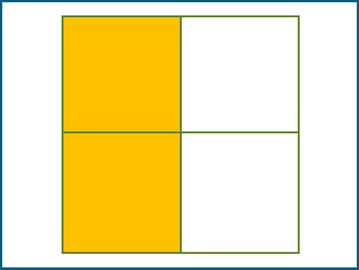
Area models are particularly helpful when introducing:
Basic fractions
Equivalent fractions
Adding fractions with the same denominator
Number lines
A number line helps students see fractions as numbers that exist between whole numbers.
Students mark fractions such as:
1/2
1/4
3/4
For example:
Which fraction is halfway between 0 and 1?
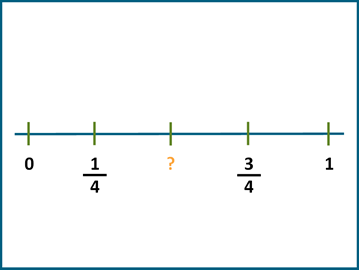
This model helps students understand that fractions represent quantities and positions, not just pieces of shapes.
Number lines are useful for teaching:
Fraction magnitude
Comparing fractions
Ordering fractions
Set models
Set models show fractions as part of a group of objects.
For example:
A set of 8 apples where 4 are red and 4 are green.
Students can identify:
4/8 of the apples are red
4/8 of the apples are green
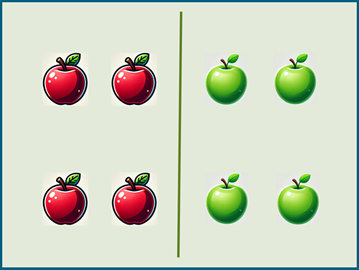
This model connects fractions to counting and real-world objects.
Classroom activities using visual fraction models
Teachers can reinforce fraction concepts through hands-on activities.
Fraction coloring
Give students shapes divided into equal parts and ask them to shade specific fractions.
For example:
Shade 3/6 of the rectangle.
Fraction bars
Students create fraction bars by folding strips of paper into equal sections such as:
halves
thirds
fourths
This activity helps students visually compare fractions.
Build fractions with objects
Use everyday items such as:
counters
buttons
blocks
Ask students to show fractions like 2/5 or 3/8 using a group of objects.
Moving from visual models to abstract fractions
Visual models should be the starting point, not the final step. Once students understand fractions visually, teachers can gradually introduce symbolic notation.
A typical progression is:
Concrete: Use objects or manipulatives
Visual: Draw or view models
Abstract: Write and calculate fractions
This approach helps students build lasting understanding instead of memorizing rules.
Final thoughts
Visual models are one of the most effective ways to teach fractions in elementary school. By using area models, number lines, and set models, teachers help students develop a deeper understanding of how fractions work.
When students can see fractions and interact with them, they are more likely to grasp key concepts and apply them confidently in later math learning.