
 Halloween W'sheets!

Have you ever watched an owl gliding silently through the night sky or seen a mouse scurrying across the ground looking for food? These animals may seem very different, but they are connected through something called a food chain.
Food chains help us understand how plants and animals depend on one another for survival. They show how energy moves through nature and how every living thing plays an important role in an ecosystem.
Once you learn about food chains, you'll start noticing them everywhere, in forests, parks, ponds, fields, and even your own backyard.
What Is a food chain?
A food chain is a diagram that shows how energy passes from one living thing to another.
Living things need energy to grow, move, stay healthy, and survive. A food chain helps us see where that energy comes from.
For example:
Oak tree → Acorn → Mouse → Owl
This food chain tells us:
The oak tree uses energy from the Sun to grow.
The tree produces acorns.
The mouse eats the acorn.
The owl eats the mouse.
The arrows show the direction that energy is moving.
A helpful way to remember this is:
The arrow means "is eaten by."
So:
Acorn → Mouse means the acorn is eaten by the mouse.
Mouse → Owl means the mouse is eaten by the owl.
Where does the energy come from?
Almost every food chain on Earth begins with the Sun.
Sun → Oak Tree → Acorn → Mouse → Owl
The oak tree captures energy from sunlight through a process called photosynthesis. It uses that energy to grow leaves, branches, and acorns.
When a mouse eats an acorn, it gets some of the energy stored inside the acorn. When an owl eats the mouse, it receives that energy too.
This means that the energy in the owl originally came from the Sun.
Following the energy step by step
Let's take a closer look at each part of our food chain.
Step 1: The oak tree
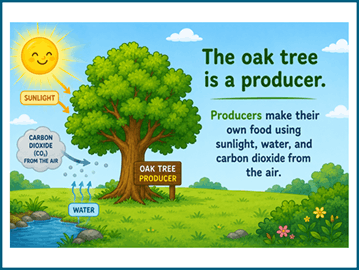
The oak tree is a producer.
Producers make their own food using sunlight, water, and carbon dioxide from the air.
Because producers create the energy-rich food that other living things depend on, every food chain starts with a producer.
Step 2: The acorn
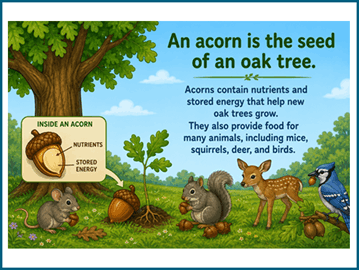
An acorn is the seed of an oak tree.
Acorns contain nutrients and stored energy that help new oak trees grow. They also provide food for many animals, including mice, squirrels, deer, and birds.
Step 3: The mouse
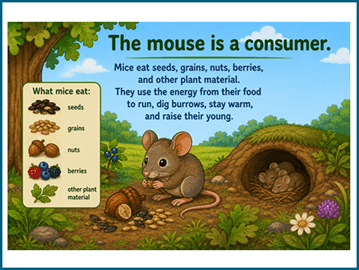
The mouse is a consumer.
Mice eat seeds, grains, nuts, berries, and other plant material. They use the energy from their food to run, dig burrows, stay warm, and raise their young.
Mice are an important source of food for many predators.
Step 4: The owl
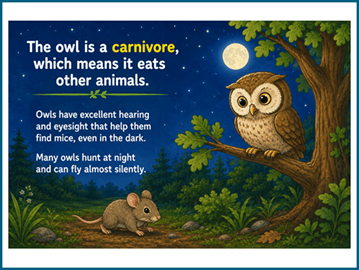
The owl is a carnivore, which means it eats other animals.
Owls have excellent hearing and eyesight that help them find mice, even in the dark. Many owls hunt at night and can fly almost silently.
When an owl catches and eats a mouse, it receives the energy that has moved through the entire food chain.
Why are food chains important?
Food chains help us understand how ecosystems stay balanced.
Every plant and animal has a role to play. If one part of the chain changes, the other parts may be affected.
Imagine that there are fewer mice in a forest.
Oak Tree → Acorn → Mouse → Owl
What might happen?
Owls may have less food to eat.
Some owls may move elsewhere to hunt.
More acorns may remain on the forest floor because fewer mice are eating them.
This shows that every link in a food chain is important.
Food chains and food webs
In nature, animals rarely eat just one type of food.
A mouse might eat:
Acorns
Seeds
Berries
Grains
An owl might eat:
Mice
Voles
Small birds
Insects
Because living things are connected in many different ways, scientists often use food webs instead of simple food chains.
A food web is made up of many food chains linked together.
You can think of a food chain as a single path, while a food web is a whole network of connected paths.
Amazing food chain facts for kids
Every food chain starts with a producer.
The Sun is the main source of energy for almost all life on Earth.
Owls can turn their heads much farther than humans can.
A single owl may eat hundreds of mice in a year.
Acorns provide food for dozens of different forest animals.
Decomposers help recycle nutrients back into the soil so new plants can grow.
Food chains exist in forests, deserts, oceans, ponds, and grasslands all around the world.
Key takeaway
A food chain shows how energy moves through nature. The journey begins with the Sun, continues through plants, and passes from one living thing to another. In our example, energy moves from the Sun to an oak tree, then to an acorn, then to a mouse, and finally to an owl.
By learning about food chains, children can better understand how all living things are connected and why every plant and animal is important to a healthy ecosystem.