


Fall is a wonderful season for children to explore the natural world. Leaves change color, seeds scatter, birds gather and animals prepare for colder weather. Even familiar places can look, sound and feel different from one week to the next.
A fall nature walk does not require a trip to a forest or nature reserve. You can explore a backyard, neighbourhood, park, trail or schoolyard. The goal is simply to slow down and encourage your children to notice details they might ordinarily pass by.
Bring a notebook, pencil and perhaps a magnifying glass. Children can draw or write about their discoveries, but there is no need to turn the entire walk into a formal lesson. Give them time to look, listen, wonder and ask questions.
Here are 10 things children can observe, along with activities that extend the learning.
Leaves changing color
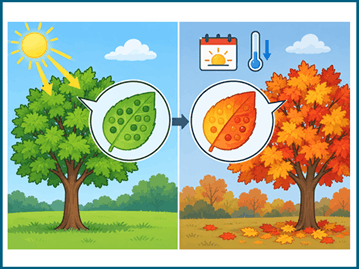
One of the most noticeable signs of fall is the changing color of leaves. Look for green, yellow, orange, red, purple and brown leaves.
Ask your child to study an individual tree. Are all its leaves the same color? Are some branches changing before others? Do leaves near the top of the tree look different from those closer to the ground?
Explain that leaves contain a green substance called chlorophyll. It helps plants use sunlight to make food. As the days become shorter and temperatures fall, many trees stop producing as much chlorophyll. The green color fades, revealing other colors that were already in the leaves.
Try these activities:
Collect one fallen leaf of each color you can find.
Arrange the leaves from greenest to brownest.
Create a leaf-color tally chart.
Choose one tree and photograph it once a week to record how it changes.
Make leaf rubbings by placing leaves under paper and rubbing over them with the side of a crayon.
Different leaf shapes
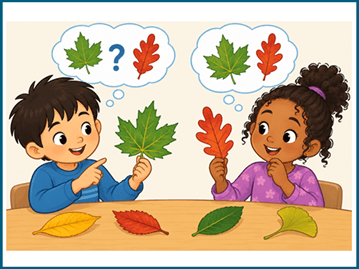
Leaves come in many shapes and sizes. Some are long and narrow, while others are round, heart-shaped or divided into several points.
Look closely at the edges of each leaf. Are they smooth, wavy or jagged? Examine the pattern of veins running through the leaf. The veins transport water, minerals and food through the plant.
Ask children to compare leaves rather than simply naming them. For example: “How is this leaf different from that one?” or “What features do these two leaves share?”
Try these activities:
Sort fallen leaves by shape, size, color or type of edge.
Measure leaves with a ruler and arrange them from shortest to longest.
Trace several leaves and compare their outlines.
Fold a leaf gently along its central vein to explore symmetry.
Create a “mystery leaf” description and have someone identify the correct leaf.
Seeds and seed pods
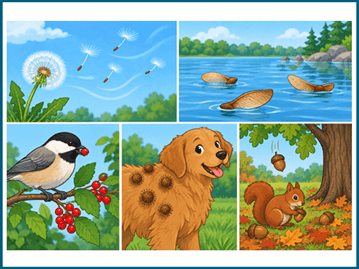
Many plants release their seeds during fall. Children might discover acorns, chestnuts, pine cones, berries, winged maple seeds or dried seed pods.
Encourage children to examine each seed carefully. Is it light or heavy? Smooth or rough? Does it have wings, hooks, fluff or a hard shell? These features provide clues about how the seed travels.
Some seeds float through the air. Others are carried by water, eaten by animals or caught in an animal’s fur. Heavy seeds such as acorns often fall close to the parent tree, although squirrels may carry them farther away.
Try these activities:
Sort seeds according to how you think they travel.
Drop a maple seed and watch it spin through the air.
Compare how quickly a leaf, acorn and winged seed fall.
Design a paper seed that can remain in the air as long as possible.
Plant collected seeds in pots and observe whether they eventually sprout.
Only collect seeds that have already fallen, and avoid berries or plants that may be poisonous.
Signs of animals
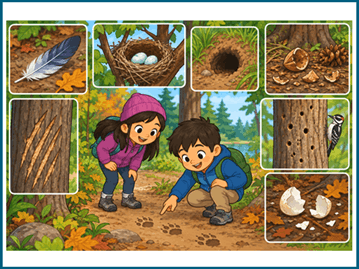
Wild animals are often nearby even when children cannot see them. Encourage your child to become a nature detective and search for clues.
Look for footprints, feathers, nests, burrows, holes, chewed nuts, scratched bark or pieces of eggshell. A pile of pine-cone scales might show where a squirrel has been eating. Small holes in a tree could have been made by insects or birds.
Ask children to use the evidence to make a sensible guess: What animal might have left this clue? What was it doing? How recently might it have been here?
Try these activities:
Photograph animal clues and try to identify them later.
Draw a footprint and record where it was found.
Measure a track without touching or damaging it.
Make a map showing the locations of different animal signs.
Write a short story about the animal that might have passed through the area.
Remind children not to reach into burrows, nests or holes.
Birds preparing for a new season
Some birds remain in the same area throughout the year, while others migrate to warmer places. Fall is a good time to observe birds gathering, feeding and travelling in groups.
Watch how the birds move. Do they hop, walk, glide or swoop? Are they searching on the ground, pecking at tree bark or eating berries? Listen for their songs and calls.
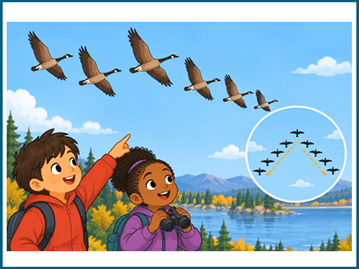
If you see a flock flying overhead, observe its formation. Some large birds fly in a V shape, which can help them conserve energy during a long journey.
Try these activities:
Count how many birds you see during five minutes.
Make a tally chart of different bird colors or sizes.
Listen to a bird call and imitate its rhythm.
Watch one bird and record everything it does for one minute.
Research whether a bird you observed migrates or remains nearby during winter.
A pair of binoculars can help, but children can make useful observations without any special equipment.
Insects and spiders
As the temperature drops, insects and spiders may become less active. Children can still find them around plants, under fallen leaves, beside buildings and on tree trunks.
Look for ants, beetles, caterpillars, ladybugs, flies and spiders. You may also discover signs of insects, including webs, cocoons, holes in leaves or tunnels beneath tree bark.
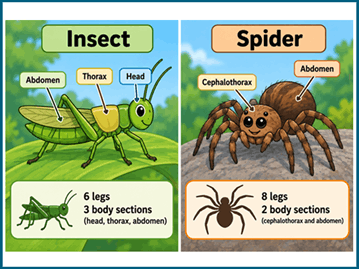
Discuss the differences between insects and spiders. Insects have six legs and three main body sections. Spiders have eight legs and two main body sections.
Try these activities:
Count the legs of a safely observed creature.
Draw a spiderweb and look for repeating patterns.
Search for leaves that have been nibbled by insects.
Use a magnifying glass to examine an empty web.
Compare where different small creatures are found: in sunlight, shade, dry leaves or damp soil.
Observe small creatures without picking them up or disturbing their homes.
Mushrooms and other fungi
Cool, damp fall weather often creates good growing conditions for mushrooms. Look for them on the ground, on fallen logs, around tree roots and on decaying wood.
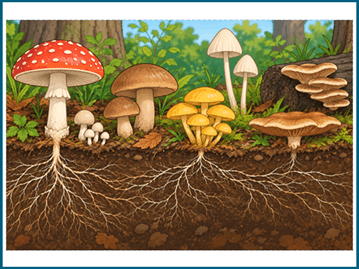
Mushrooms may be round, flat, tall, tiny, smooth or spotted. Some grow alone, while others appear in groups. The visible mushroom is only one part of a larger fungus, much of which may be hidden in the soil or wood.
Fungi are important decomposers. They help break down dead plants and return nutrients to the soil.
Try these activities:
Count how many different mushroom shapes you can find.
Photograph mushrooms rather than collecting them.
Compare where mushrooms grow and where they do not.
Draw a mushroom and label its cap and stalk.
Look for other examples of decomposition, such as crumbling wood or leaves breaking down.
Never touch or eat wild mushrooms. Some poisonous mushrooms look similar to harmless varieties.
Fall weather
Encourage children to use their senses to describe the weather. Does the air feel cool, cold, warm, damp or dry? Is the wind gentle or strong? Is the sky clear, cloudy or grey?
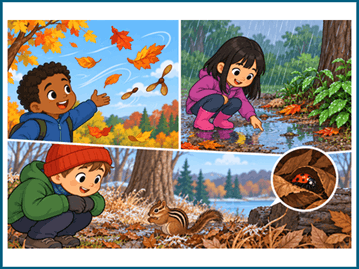
Notice how the weather affects the surroundings. Wind may carry leaves and seeds. Rain may create puddles, soften the soil and make colors appear brighter. Cool temperatures may change how active insects and animals are.
If you take several nature walks during the season, compare the weather from one walk to the next.
Try these activities:
Estimate the temperature and then check it with a thermometer.
Use a ribbon to observe the wind’s direction and strength.
Identify different types of clouds.
Record the weather with words and symbols.
Make a weekly chart comparing temperature, clouds, wind and rainfall.
Ask your child to predict what the weather might be like on the next walk and explain the reason for the prediction.
The sounds and smells of fall
Nature observation involves more than looking. Find a safe place to stop and remain quiet for one minute.
Children may hear leaves rustling, birds calling, insects buzzing, squirrels moving, water flowing or footsteps crunching on a path. Some sounds will be close, while others will come from farther away.
Fall also has distinctive smells. Damp soil, fallen leaves, pine needles and wood smoke can all provide information about the surroundings.
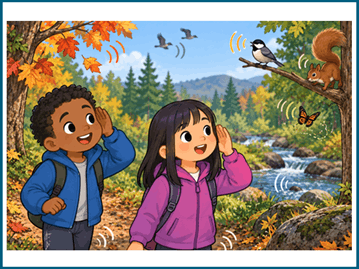
Try these activities:
Count how many different sounds you hear in one minute.
Sort sounds into natural and human-made categories.
Point in the direction of each sound.
Create words that imitate sounds, such as crunch, rustle and tap.
Make a sound map by placing yourself in the center of a page and marking where each sound originated.
Encourage children to describe smells without tasting or closely sniffing unfamiliar plants or fungi.
Signs that winter is approaching
Fall is a season of preparation and change. Look for evidence that plants, animals and people are getting ready for winter.
Some trees lose their leaves, plants stop flowering and grasses turn brown. Squirrels gather and bury food. Birds migrate or change their feeding habits. People begin wearing warmer clothes, and the amount of daylight gradually decreases.
Ask your child, “What evidence can you find that winter is coming?” Encourage them to support their ideas with something they observed.
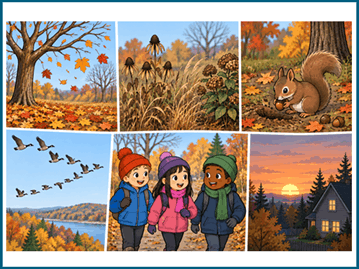
Try these activities:
Make a list of changes that would not have been visible during summer.
Compare a bare tree with one that still has leaves.
Record the sunset time once a week.
Draw the same outdoor location in fall and predict how it will look in winter.
Create a chart showing how a plant, animal and person each prepare for colder weather.
Questions to ask on a nature walk
Open-ended questions help children observe carefully, make comparisons and explain their ideas. There does not always have to be one correct answer.
Try asking:
What do you notice first?
What do you notice when you look more closely?
How are these two objects alike?
How are they different?
Why do you think this happened?
What clues support your idea?
What has changed since summer?
What do you predict will happen next?
What would you like to investigate?
What do you think this place will look like in winter?
Give your child enough time to think before answering. Questions such as “What makes you think that?” can encourage deeper explanations.
Make a fall nature journal
A nature journal gives children a place to record observations over time. It can be a notebook, several sheets of paper stapled together or a collection of printed observation pages.
After each walk, children can record:
the date and location;
the temperature and weather;
plants and animals they observed;
colors, shapes, sounds and smells;
questions they would like to investigate;
drawings of leaves, seeds or animal clues; and
changes since the previous walk.
Younger children can draw pictures and dictate a sentence to an adult. Older children can write detailed descriptions, label diagrams or organize information in charts.
Create a fall nature collection
Children may enjoy collecting a small number of safe, fallen objects such as leaves, twigs, acorns and pine cones. Before collecting anything, check the rules for your location. Objects should not be removed from protected areas, and living plants should be left undisturbed.
At home, children can:
sort the objects by color, shape, size or texture;
arrange them from smallest to largest;
make patterns with leaves, stones or seeds;
measure and compare them;
create a nature collage; or
choose one object to draw in detail.
Return unwanted natural objects outdoors rather than throwing them away.
Practice descriptive writing
A fall walk can also inspire writing. Ask children to choose one object or moment from the walk and describe it carefully.
Encourage them to include sensory details:
What did it look like?
How did it move?
What sound did it make?
How did it feel?
What did it remind you of?
Younger children might write one or two sentences, such as, “The red leaf had five sharp points. It spun as it fell.” Older children can write a full paragraph, poem or short nature report.
Add math to your walk
Nature provides many opportunities to practise elementary math skills.
Children can:
count pine cones, birds or red leaves;
make tally charts;
measure leaves and twigs;
compare quantities;
create repeating patterns;
sort objects into groups;
estimate the height of a tree; or
graph the colors of collected leaves.
Keep the activities short and playful. The purpose is to show children that math can help us describe and understand the world around us.
Revisit the same location
One of the best ways to study seasonal change is to return to the same place throughout the fall. Visit every week or two and observe what has changed.
Is the temperature lower? Are there fewer leaves on the trees? Have the birds or insects changed? Are mushrooms growing in new places? Is sunset arriving earlier?
Children begin to understand seasonal change more clearly when they observe it happening over time.
Turn an ordinary walk into an investigation
A fall nature walk helps children practise important science skills, including observation, comparison, classification, measurement and prediction. It can also support reading, writing, math and vocabulary development.
Most importantly, nature walks encourage curiosity. Children learn that interesting discoveries can be found in ordinary places when they slow down and pay attention.
You do not need to identify every bird, tree or insect. It is perfectly fine to say, “I don’t know. How could we find out?” Asking questions and searching for evidence are central parts of science.