


Help your child recognize equivalent fractions with fraction strips, shaded shapes, number lines and missing-number practice for grades 3–5.
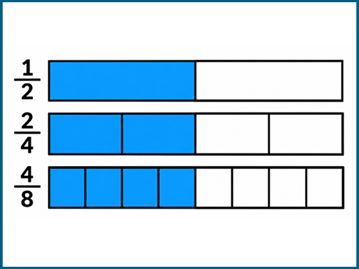
Equivalent fractions name the same amount. For example, 1/2, 2/4 and 4/8 are equivalent. Start with models so your child can see why the fractions are equal before working with numbers.
Compare fraction strips
Line up strips of the same length divided into halves, fourths and eighths. One half covers the same length as two fourths or four eighths:
1/2 = 2/4 = 4/8
Ask: “How many eighths cover one half?”
Use shaded shapes
Draw two equal-sized rectangles. Divide one into 3 equal parts and shade 2. Divide the other into 6 equal parts and shade 4.
Both show the same shaded amount: 2/3 = 4/6. The parts are smaller, but more are shaded.
Our grade 3 equivalent fraction coloring worksheets give children practice showing equivalent fractions with shaded models.

Find equivalent fractions on a number line
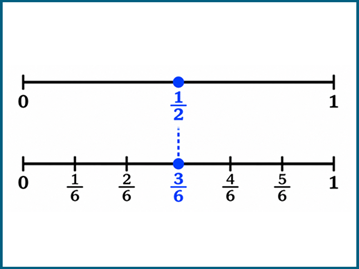
Equivalent fractions share the same point on a number line. On two aligned number lines from 0 to 1, mark 1/2 on one and 3/6 on the other. The marks line up because 1/2 = 3/6.
Solve missing-number questions
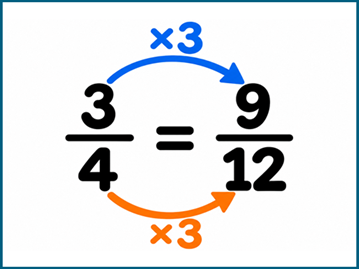
Multiply or divide the numerator and denominator by the same nonzero number.
Example: 3/4 = __/12
Since 4 × 3 = 12, multiply the numerator by 3 too:
3 × 3 = 9, so 3/4 = 9/12.
To find an equivalent fraction with smaller numbers, divide both: 6/8 = 3/4.
Try our grade 4 equivalent fractions worksheets for missing numerators and denominators.
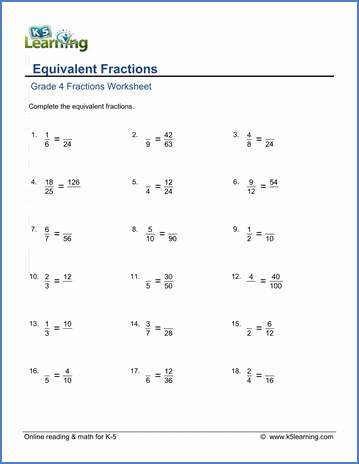
For more practice, our grade 5 three equivalent fractions worksheets ask students to complete sets of three.

Try it together
1. 1/2 = __/8
2. 2/3 = 6/__
3. 3/5 = __ /10 = 9/ __
Answers: 1. 4; 2. 9; 3. 6 and 15.
If your child gets stuck, return to a model. Check that each whole is the same size and divided into equal parts. When using numbers, change both the numerator and denominator by the same factor.