


Reading is more than sounding out words. It is a complex process with three big pillars working together: decoding, fluency, and comprehension. When one of these building blocks is weak, a child may read but not really understand, or understand but struggle to read smoothly.
Let’s look at each piece, why it matters, and how families and teachers can support it.
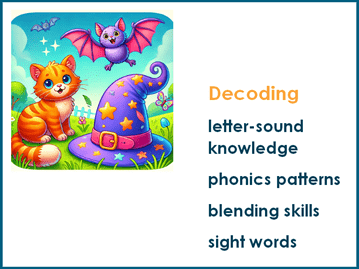
Decoding: Learning how words work
Decoding is the ability to turn printed letters into spoken sounds. It’s where reading begins.
Children use:
letter-sound knowledge
phonics patterns
blending skills
sight words
If a child struggles with decoding, reading feels like solving a puzzle every time.
How to strengthen decoding
Practice phonics patterns (CVC words, digraphs, blends).
Read decodable texts.
Play word-building games with magnetic letters.
Teach word families (cat, bat, hat).
Fluency: Reading with flow
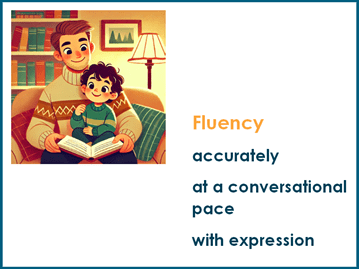
Once decoding becomes automatic, fluency emerges. Fluency means a child can read:
accurately
at a conversational pace
with expression
A fluent reader doesn’t just say the words, they sound like they’re talking.
Signs a child needs fluency support
Sounding out every word.
Long pauses between words.
Monotone reading.
Losing place in the text.
How to build fluency
Reread familiar books.
Echo reading (adult reads, child copies).
Reader’s theater scripts.
Timed “smooth reading” practice.
Fluency bridges decoding and meaning. It frees a child’s brain to focus on understanding.
Comprehension: Making meaning
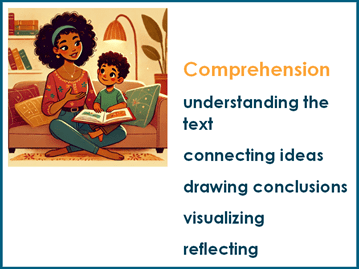
Comprehension is the goal of reading. It includes:
understanding the text
connecting ideas
drawing conclusions
visualizing
reflecting
A child can decode and read fluently but still struggle with comprehension if they don’t actively think about what they read.
Ways to strengthen comprehension
Ask “before, during, and after” questions.
Encourage predicting and inferring.
Talk about unfamiliar vocabulary.
Retell stories.
Use graphic organizers.
Comprehension grows with practice, discussion, and exposure to rich language.
How these three skills work together
Think of reading like driving a car:
Decoding is learning how to start the car and move it.
Fluency is driving smoothly without stalling.
Comprehension is knowing where you’re going and why.
A child needs all three to become an independent reader.
What parents and teachers can do
Read aloud daily
Talk about books
Celebrate small progress
Model good reading habits
Give choice in what children read
Most importantly, make reading enjoyable.
Discussion questions for teachers
Decoding
How do you identify students who lack foundational phonics skills even if they appear to be reading words?
What decoding practices or programs have you found most effective?
How often should decoding continue beyond early grades—what does “phonics instruction” look like in grade 3 or 4?
How do you support students who have decoding delays without pulling them from whole-class reading experiences?
How can teachers better communicate decoding needs to families?
Fluency
What routines help you monitor fluency growth regularly?
How do you balance fluency practice without making reading feel like a race?
Which activities (e.g., repeated reading, reader’s theater) have been most successful in your classroom?
How do you support fluent readers who still lack comprehension?
How do you integrate expression and phrasing into fluency instruction?
Comprehension
What strategies help reluctant readers think deeply about texts, not just answer trivia questions?
How do you help students make inferences rather than rely on literal recall?
What tools or graphic organizers do your students respond best to?
How do vocabulary gaps impact comprehension, and how do you address them?
What adjustments do you make for English Language Learners when teaching comprehension?
Whole-child and instructional reflection
How do decoding, fluency, and comprehension assessments inform your small-group planning?
How can teachers collaborate across grades to ensure the three pillars are continuously developed?
What role does classroom environment (book access, read-aloud culture, peer talk) play in reading success?
Discussion questions for parents
Decoding
How does your child react when they encounter an unfamiliar word?
Do you feel confident helping your child sound out words? What support would help you?
What activities at home support letter-sound connections?
Fluency
When your child reads aloud, do they sound robotic or natural?
How often do you reread books together, and does your child enjoy it?
What helps your child read with more expression?
Comprehension
After reading, can your child tell you what happened in their own words?
Do you ask questions while reading? If so, which types seem to help thinking?
What kinds of books spark deeper conversations with your child?
Reading habits and attitude
Does your child choose to read for pleasure, or do they avoid reading?
What reading routines work best in your home (bedtime, weekend mornings, etc.)?
What barriers make reading at home difficult (time, confidence, interest)?
Partnership with school
What information do you wish teachers shared more often about reading progress?
How do you prefer to get reading support ideas: videos, printouts, workshops, or brief tips?
What would make reading more joyful or easier for your child?
Joint discussion questions for parent-teacher nights
How can school and homework together to reinforce decoding skills well beyond Grade 1?
What does “fluency” look and sound like to parents and teachers—are expectations the same?
How can we encourage comprehension talk outside the classroom (dinner table, car rides)?
How do we build a shared reading culture between home and school?
What role do libraries, book swaps, and reading choice play in motivation?