


Children love comparing things, like who runs fastest, whose snack is bigger, which pet is the cutest. Comparative and superlative adjectives give them the language to express exactly that. In this post, we’ll break down what these adjectives are, how to use them correctly, and fun ways to help kids practice.
What are comparative and superlative adjectives?
Adjectives describe nouns, and comparative and superlative adjectives help kids compare two or more things.
Comparative adjectives compare two things.
For example: taller, faster, more beautiful
Superlative adjectives compare three or more things.
For example: tallest, fastest, most beautiful
Think of comparatives as choosing between two items, and superlatives as picking the “winner” of the whole group.
How to form comparative adjectives
There are two main ways to form comparatives:
1. Add “-er” to short adjectives.
These are usually one-syllable adjectives:
big → bigger
small → smaller
fast → faster
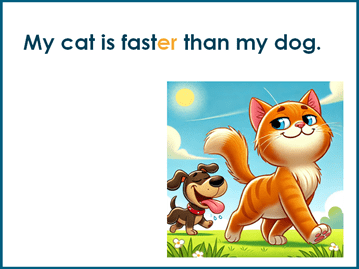
For example: My cat is faster than my dog.
2. Use “more” before longer adjectives.
Use this for adjectives with two or more syllables:
careful → more careful
beautiful → more beautiful
exciting → more exciting
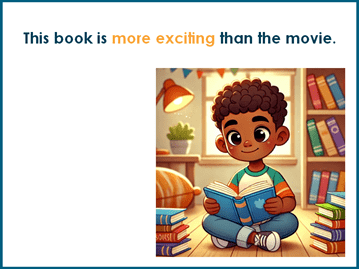
For example: This book is more exciting than the movie.
How to form superlative adjectives
Superlatives show that something is the most or least in a group of three or more.
1. Add “-est” to short adjectives.
big → biggest
short → shortest
young → youngest
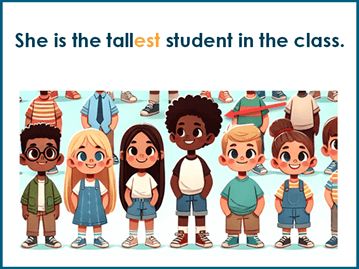
For example sentence: She is the tallest student in the class.
2. Use “most” before longer adjectives.
careful → most careful
beautiful → most beautiful
interesting → most interesting
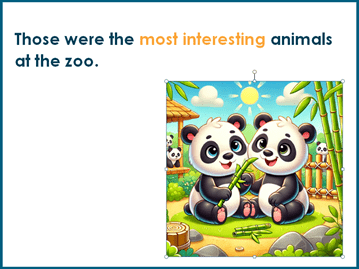
For example: Those were the most interesting animals at the zoo.
Important spelling rules kids should know
Double the final consonant
If a one-syllable adjective ends in a single vowel + single consonant:
hot → hotter, hottest
thin → thinner, thinnest
Change “y” to “i”
If the adjective ends with y:
happy → happier, happiest
funny → funnier, funniest
Irregular adjectives (special cases)
These don’t follow the usual patterns:
good → better, best
bad → worse, worst
far → farther/further, farthest/furthest
Quick comparison chart for kids
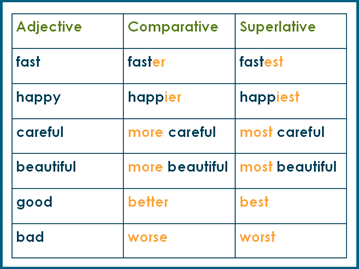
You can share this chart with students or add it to a grammar notebook.
Simple ways to practice at school or at home
Comparison hunt
Have kids walk around the room comparing objects:
“This pencil is longer than that one.”
“My notebook is heavier than yours.”
Superlative showdown
Give students a set of items such as markers, books, or toys. Ask:
Which is the biggest?
Which is the lightest?
Which is the brightest?
“-er / -est” poster craft
Kids choose an adjective and draw three pictures
big → bigger → biggest
funny → funnier → funniest
Smooth sentences challenge
Give students simple sentences to expand
The dog is fast. → The dog is faster than the cat.
It is a nice day. → It is the nicest day of the week.
Activities like these make grammar feel playful instead of rule-heavy.