


By grade 2, children are usually becoming more confident readers and writers. They know many basic letter-sound relationships and common spelling patterns, but they are also beginning to discover something tricky about English: the same sound can often be spelled in several different ways.
A child may know exactly what sounds they hear in a word but still choose the wrong letters to represent those sounds.
For example, a Grade 2 student might write:
boet instead of boat
plae instead of play
nite instead of night
grean instead of green
becaus instead of because
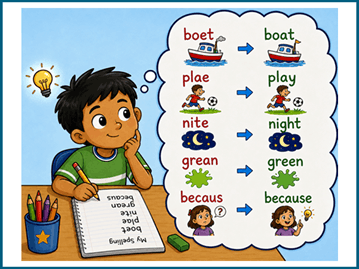
These mistakes can actually show that a child is thinking carefully about sounds. The spelling may be incorrect, but the child is trying to apply patterns they already know.
Common spelling patterns that can be confusing
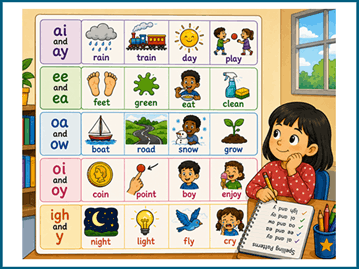
In grade 2, children begin working with more vowel teams and alternative ways of spelling vowel sounds. They may confuse patterns such as:
ai and ay — rain, train, day, play
ee and ea — feet, green, eat, clean
oa and ow — boat, road, snow, grow
oi and oy — coin, point, boy, enjoy
igh and y — night, light, fly, cry
Children may also continue to mix up long and short vowel sounds, particularly when they encounter unfamiliar words.
For example:
hop and hope
kit and kite
cap and cape
can and cane
A single letter can completely change the vowel sound, so children need plenty of practice seeing, reading, and writing these different patterns.
Why these mistakes happen
English spelling is more complicated than simply writing one letter for every sound. Children gradually learn that words are built from spelling patterns, and that the same sound may be represented in several ways.
Take the long a sound. Children might encounter it in:
rain
play
eight
break
cake
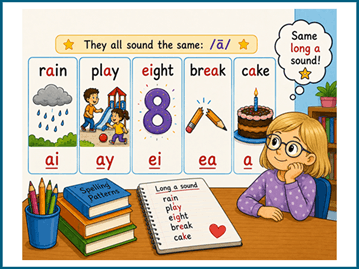
All five words contain a similar vowel sound, but it is spelled differently in each one.
The same thing happens with the long e sound:
see
eat
happy
these
At first, a child may choose a spelling that makes sense based on another word they already know. A child who knows green, for example, might reasonably try to spell clean as cleen.
Learning which spelling belongs in which word takes time and repeated exposure through both reading and writing.
Help children notice where patterns appear
One useful grade 2 spelling skill is learning that some spelling patterns are more common in certain positions within words.
For example, ai often appears in the middle of a word:
rain
train
paint
wait
The spelling ay often appears at the end:
day
play
stay
way
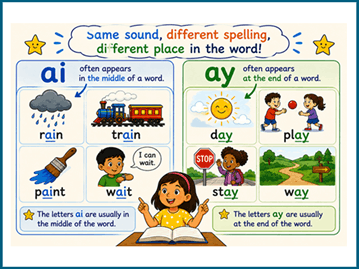
Similarly, oi is commonly found in the middle of words such as coin and point, while oy often appears at the end of words such as boy and toy.
These aren't perfect rules (English has plenty of exceptions) but noticing these patterns gives children a useful starting point when they are unsure how to spell a word.
Encourage children to compare words
When a child misspells a word, simply providing the correct spelling isn't always the most useful response. Instead, help them connect the word to a pattern they already know.
If a child writes snale instead of snail, you might ask:
“Can you think of another word that rhymes with snail?”
They might think of mail, rail, or tail. Now they may have a familiar spelling pattern they can use.
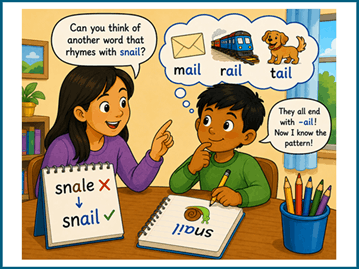
Comparing words helps children understand that spelling isn't just about memorizing thousands of individual words. Many words belong to families that share common patterns.
How parents can help
Instead of relying only on random weekly word lists, encourage children to notice and practise spelling families.
For example, practise the ai pattern with:
train
rain
brain
snail
paint
wait
tail
Then compare those words with ay words:
play
day
stay
away
today
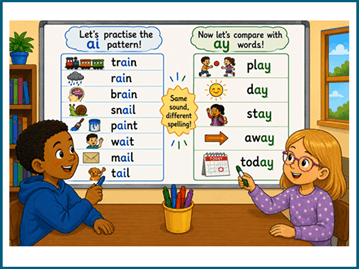
Ask your child what they notice. Where does ai usually appear? Where does ay usually appear?
You can do the same with other common grade 2 patterns, such as ee/ea, oa/ow, and oi/oy.
Try word sorting
Word sorting is a simple way to make spelling patterns more visible.
Write several words on small pieces of paper and ask your child to sort them according to their spelling.
For example:
ee: green, feet, sleep, need
ea: clean, read, dream, team
After sorting the words, read each group aloud together. Ask your child what is the same about the words and what is different.
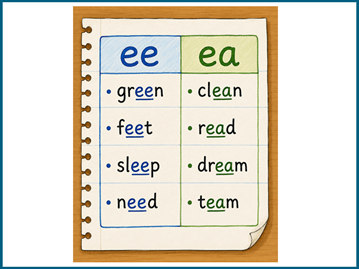
This encourages children to actively look for patterns instead of simply memorizing spellings.
Build new words from familiar words
Another useful strategy is to start with a word your child can already spell and change one part of it.
For example:
rain → train → brain
or:
day → play → stay
or:
boat → coat → goat
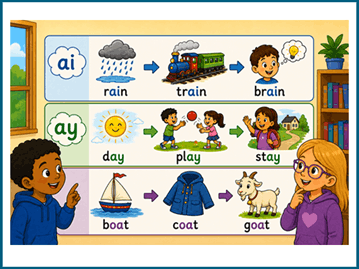
Children begin to see that knowing how to spell one word can help them spell several others.
Keep reading
Regular reading is one of the most important ways children develop stronger spelling skills.
Every time children read, they see correctly spelled words in context. Frequently encountered words such as because, people, could, and there gradually begin to look familiar.
Over time, children develop a stronger visual memory for words. They may even begin to recognize that a misspelled word “doesn't look right” before they can explain exactly which spelling rule has been broken.
Reading aloud together, independent reading, library books, comics, nonfiction books, and even simple instructions or recipes can all provide valuable exposure to written language.
Don't expect every word to be perfect
Grade 2 children are still experimenting with spelling. Correcting every mistake in every piece of writing can make writing feel frustrating and slow.
Instead, choose a few useful mistakes to discuss, especially ones connected to spelling patterns your child is currently learning.
If your child writes “I went to plae with my frend,” you might focus on play because it reinforces the ay pattern, while leaving another error for a different day.
The goal is not perfect spelling overnight. It is helping children gradually build a larger collection of spelling patterns they recognize and can use independently.
As children read, write, compare words, and notice patterns, confusing spellings become increasingly familiar. With enough exposure and practice, children begin moving from “What letters could make this sound?” to the more advanced question: “Which spelling pattern does this word use?”
That shift is an important part of becoming a confident grade 2 speller.