


By grade 3, children are usually comfortable spelling many common words and familiar sound patterns. But spelling also becomes noticeably more challenging. Words get longer, children encounter more prefixes and suffixes, and they begin learning that changing a word can sometimes change its spelling too.
A grade 3 student might write:
stoped instead of stopped
runing instead of running
happyness instead of happiness
carefull instead of careful
begining instead of beginning
wich instead of which
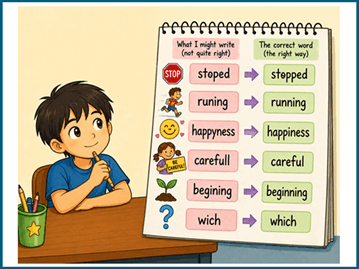
These mistakes are common because children are moving beyond simply matching letters to sounds. They now need to think about spelling patterns, word parts, syllables, and rules that determine what happens when words change.
Common spelling patterns that can be confusing
By grade 3, children are working with many of the vowel patterns they learned in earlier grades, but they are also encountering more complicated words and spelling patterns.
Some commonly confused patterns include:
ou and ow — cloud, round, cow, town
aw and au — saw, draw, August, launch
er, ir, and ur — her, bird, turn
tion — action, station, question
tch and ch — catch, kitchen, much, lunch
dge and ge — bridge, badge, huge, age
The er, ir, and ur spellings can be particularly tricky because they often sound very similar:
her
bird
turn
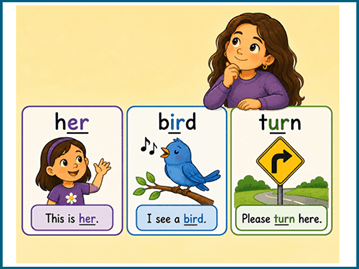
Children can't always hear which spelling they need. They gradually learn the correct spelling by seeing, reading, and writing these words many times.
Why Grade 3 spelling mistakes happen
In earlier grades, children can often make a reasonable attempt at spelling a word by sounding it out. By grade 3, that strategy doesn't always work.
Consider these words:
jumping
running
making
happier
Each word begins with a familiar base word, but something happens when the ending is added.
jump → jumping
run → running
make → making
happy → happier
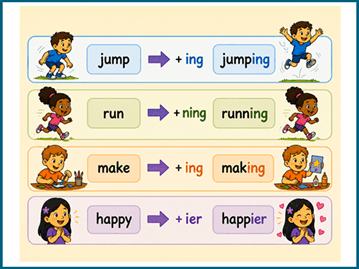
Children now need to pay attention not only to sounds, but also to how words are built.
This is an important change in spelling development. Instead of asking only, “What sounds do I hear?” children begin asking, “What is the base word, and what happens when I add an ending?”
Adding -ing and -ed
Adding endings such as -ing and -ed is a major source of grade 3 spelling mistakes.
Sometimes the ending can simply be added:
jump → jumping
help → helped
play → playing
rain → rained
But other words change.
A final e is often dropped before adding -ing:
make → making
hope → hoping
write → writing
smile → smiling
And in some short words, the final consonant is doubled:
run → running
sit → sitting
stop → stopped
hop → hopping
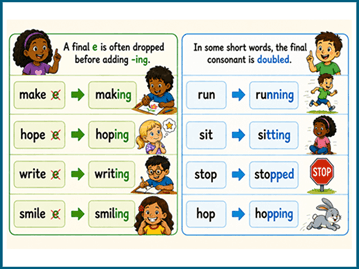
A child who writes runing is applying the perfectly reasonable idea of simply adding -ing to run. Now they need to learn that certain words require an additional spelling change.
Double consonants can be tricky
Knowing when to double a consonant takes practice.
Compare:
hop → hopping
hope → hoping
sit → sitting
visit → visiting
run → running
rain → raining
Looking at words side by side helps children notice that doubling doesn't happen every time an ending is added.
One useful strategy is to start with simple examples and ask children what they notice:
run → running
swim → swimming
stop → stopping
Then compare them with:
rain → raining
help → helping
jump → jumping
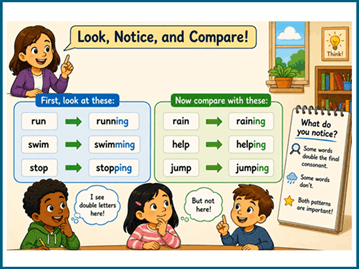
Rather than expecting children to memorize a complicated rule immediately, repeated comparison helps them begin to recognize the pattern.
Watch what happens to words ending in y
Words ending in y can cause another common group of grade 3 spelling mistakes.
Sometimes the y stays:
play → played
enjoy → enjoyed
stay → stayed
But sometimes the y changes to i:
happy → happier
funny → funnier
carry → carried
cry → cried
Children may write happyness, funnyer, or carryed because they haven't yet learned when the final y changes.
Comparing groups of words can make the pattern easier to see.
Y stays:
play → played
stay → stayed
enjoy → enjoyed
Y changes:
cry → cried
carry → carried
happy → happier
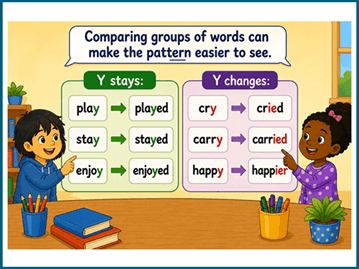
Ask your child what they notice about the letter immediately before the y. Looking for these small clues helps children become more thoughtful spellers.
Prefixes and suffixes become more important
By grade 3, children are also working with more prefixes and suffixes.
Common prefixes include:
un- — unhappy, unsafe, unfair
re- — replay, rewrite, reread
dis- — dislike, disagree, disappear
Common suffixes include:
-ful — helpful, careful, thankful
-less — fearless, careless, hopeless
-ness — kindness, sadness, darkness
-ly — slowly, quickly, quietly
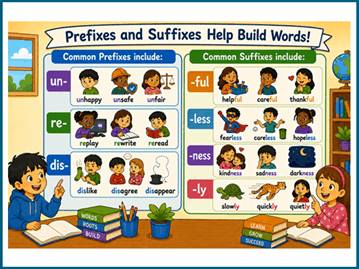
Understanding these word parts can make longer words much less intimidating.
For example, instead of trying to remember unhelpful as one long string of letters, a child can break it into:
un + help + ful
Likewise:
care + less = careless
kind + ness = kindness
quick + ly = quickly
Children begin to see that knowing how to spell one base word can help them spell many related words.
Help children look for the base word
When your child is struggling with a longer word, encourage them to look for a smaller familiar word inside it.
For example:
helpful → help
careless → care
slowly → slow
teacher → teach
jumping → jump
unhappy → happy
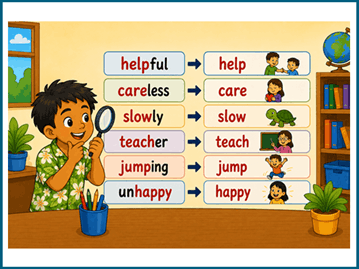
If a child writes helful, instead of immediately giving the correct spelling, you might ask:
“What word do you see inside helpful?”
Once the child identifies help, it becomes easier to see why the p needs to stay.
This strategy becomes increasingly useful as children begin spelling longer words.
Break longer words into syllables
Grade 3 students encounter many longer words that can seem difficult when they try to spell the whole word at once.
Encourage children to say the word slowly and break it into parts.
For example:
remember → re / mem / ber
fantastic → fan / tas / tic
important → im / por / tant
computer → com / pu / ter
Clapping the syllables or tapping them on the table can help children hear the different parts of the word.
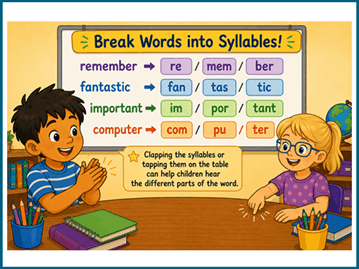
After breaking the word apart, children can think about the spelling of each section separately.
This doesn't solve every spelling problem, but it makes longer words feel much more manageable.
Encourage children to compare related words
Word families are still useful in grade 3, but the comparisons can become more sophisticated.
Instead of simply comparing rhyming words such as rain, train, and brain, children can compare words that share a base:
help
helpful
helping
helper
helpless
Or:
care
careful
careless
caring
Or:
happy
unhappy
happier
happiest
Ask your child, “Which part stays the same?”
This helps children understand that words have meaningful parts and that recognizing those parts can provide clues about spelling.
Try word sorting
Word sorting continues to be a useful spelling activity in grade 3.
Instead of sorting only by vowel patterns, children can sort words according to what happens when an ending is added.
For example:
Double the consonant:
running
sitting
stopping
hopping
Just add -ing:
jumping
helping
raining
playing
Drop the e:
making
hiding
smiling
writing
After sorting, ask your child to explain why they placed each word in that group.
Explaining the pattern aloud encourages children to think about spelling rather than simply memorize the words.
Build word families
Choose one familiar base word and see how many related words your child can build.
For example:
help
helps
helping
helped
helper
helpful
helpless
Or:
play
plays
played
playing
player
replay
playful
Children begin to realize that learning one word can give them a head start on spelling many others.
You can turn this into a quick game by choosing a base word and seeing how many related words your child can think of in two minutes.
Keep a personal tricky-word list
By grade 3, children often have particular words they misspell again and again.
Instead of giving them a huge list of unrelated spelling words, keep a small personal list of words that are genuinely difficult for them.
It might include words such as:
because
people
friend
different
really
which
there
could
Choose just a few words at a time. Encourage your child to look at the word carefully, say it, cover it, write it, and then check the spelling.
The goal is repeated exposure rather than trying to memorize a long list all at once.
Keep reading
Regular reading remains one of the best ways to strengthen spelling.
As grade 3 children read longer stories, chapter books, nonfiction, comics, instructions, and other texts, they repeatedly see spelling patterns.
This repeated exposure helps build visual memory.
Eventually, a child may look at runing and think:
“That doesn't look right.”
They may not immediately remember the doubling rule, but recognizing that something looks unusual is an important step toward becoming an independent speller.
Reading also exposes children to words that are difficult to learn through spelling rules alone, such as:
because
enough
people
thought
could
would
The more often children see these words, the more familiar their spellings become.
Don't correct everything at once
Grade 3 students are expected to write more than they did in earlier grades. If every spelling error is corrected every time they write, children can become so focused on spelling that they lose confidence in expressing their ideas.
Instead, choose a few mistakes that connect to patterns your child is currently learning.
If your child writes:
“The dog stoped runing and started barkng.”
You might focus on stopped and running because both reinforce the consonant-doubling pattern.
Another spelling mistake can wait for another day.
The goal is to help children become more aware of spelling patterns while still encouraging them to enjoy writing.
Spelling becomes more about how words work
One of the biggest changes in Grade 3 spelling is that children begin moving beyond sounds.
They still use phonics, but they also start thinking about:
vowel and consonant patterns
base words
prefixes
suffixes
syllables
word families
spelling changes when endings are added
A child who once asked, “What letters make this sound?” may now begin asking, “What is the base word?” or “Do I need to change anything before I add the ending?”
That is an important step forward.
With regular reading, writing, word sorting, and opportunities to compare related words, children gradually build a much stronger understanding of how English spelling works. The goal isn't to memorize every word at once. It is to give children enough patterns and strategies that they know what to try when they aren't sure how to spell a word.
And that is what helps turn a developing grade 3 speller into a more confident and independent writer.