

As children move through elementary school, their spelling develops in predictable stages. They first learn to connect letters with sounds, then discover spelling patterns, and eventually learn more complex rules involving prefixes, suffixes, root words, and exceptions
Understanding the kinds of mistakes children typically make at each grade level can help parents support their kids' spelling. Rather than viewing spelling errors as failures, it is often more helpful to see them as clues about what a child is ready to learn next.
Let's look at some of the most common spelling mistakes children make in Grades 1 through 5 and how you can help them become more confident spellers.
Grade 1: Spelling words the way they sound
Most grade 1 students are beginning to understand the relationship between letters and sounds. They often spell words exactly as they hear them.
What children are learning in grade 1
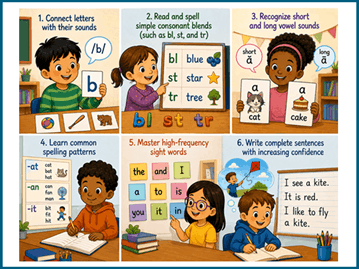
In grade 1, children are learning to:
connect letters with their sounds
read and spell simple consonant blends (such as bl, st, and tr)
recognize short and long vowel sounds
learn common spelling patterns
master high-frequency sight words
write complete sentences with increasing confidence
Because these skills are still developing, spelling mistakes are completely normal.
For example, a child might write:
sed instead of said
frend instead of friend
luv instead of love
kum instead of come
becos instead of because
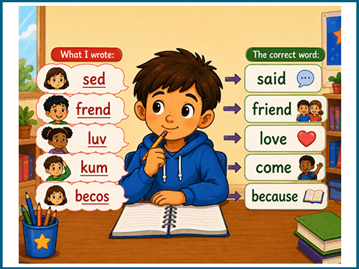
Although these spellings are incorrect, they actually show that the child is listening carefully to the sounds in words. This is an important step in learning to spell.
Many grade 1 children use invented spelling (also called phonetic spelling). They write words using the sounds they hear, even if the spelling is not yet correct. This is a healthy part of learning to read and write because it shows children are thinking about how sounds connect to letters.
Children at this age also commonly:
leave out silent letters
confuse short vowel sounds
forget doubled consonants
mix up vowel teams such as ai, ay, ee, and ea
spell unfamiliar words using only the sounds they hear
Why these mistakes happen
Beginning readers are still building their understanding of phonics. They have learned that letters represent sounds, but they have not yet discovered that English spelling contains many patterns, exceptions, and historical spellings.
Words such as said, come, and does simply cannot be spelled correctly by sounding them out alone.
How parents can help
Keep spelling practice positive and short. Ten minutes of focused practice each day is usually far more effective than one long session each week.
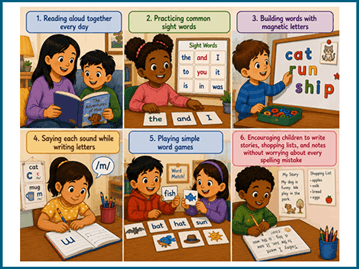
Good activities include:
reading aloud together every day
practicing common sight words
building words with magnetic letters
saying each sound while writing letters
playing simple word games
encouraging children to write stories, shopping lists, and notes without worrying about every spelling mistake
At this stage, avoid expecting perfect spelling in every piece of writing. Encourage your child to use the sounds they know while gradually introducing the correct spellings of high-frequency words.
Try not to correct every spelling mistake. Constant correction can make young writers hesitant to experiment with new words. Instead, praise their effort first, then focus on one or two spelling corrections at a time.
The more children read, the more often they see words spelled correctly. Regular reading is one of the most effective ways to improve spelling naturally over time.
Remember: If your grade 1 child writes frend, sed, or nite, don't panic. These are normal developmental spelling mistakes. They show your child is listening carefully to sounds and beginning to understand how written language works.
Grade 1 spelling worksheets
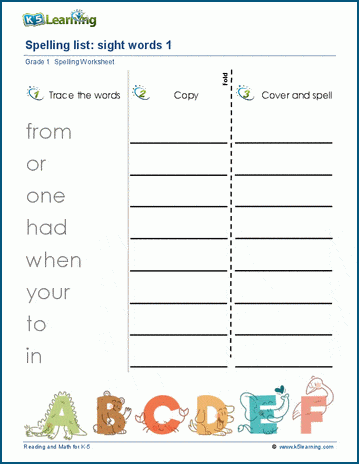
Are you looking for extra practice? Our grade 1 spelling worksheets give children opportunities to practise common sight words, phonics patterns, and everyday vocabulary while building confidence one word at a time.
For example, this worksheet asks students to spell grade 1 sight words: