

By grade 4, most children have moved well beyond spelling simple words the way they sound. They are comfortable with many common spelling patterns and can usually spell familiar words correctly.
But grade 4 brings a new challenge: the words are getting longer and the spelling rules are getting more complicated.
A grade 4 student might write:
definate instead of definite
begining instead of beginning
hopeing instead of hoping
carefull instead of careful
disapear instead of disappear
These mistakes are different from the phonetic spelling mistakes children often make in the early grades. Grade 4 students are beginning to work with prefixes, suffixes, word roots, doubled consonants, silent letters, and words whose spelling changes when an ending is added.
In other words, children are no longer just learning how to spell individual words. They are learning how words are built.
What children are learning in grade 4
In grade 4, children are learning to:
spell longer, multisyllable words
add common prefixes and suffixes
recognize base words and word families
understand when consonants need to be doubled
know when to drop a final e
change y to i when adding certain endings
spell commonly confused homophones
recognize more irregular and exception words
use spelling patterns to work out unfamiliar words
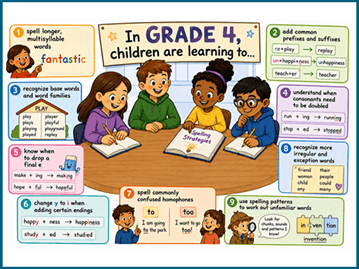
These skills allow children to tackle a much larger vocabulary, but they also create plenty of opportunities for mistakes.
Common grade 4 spelling mistakes
Making mistakes when adding suffixes
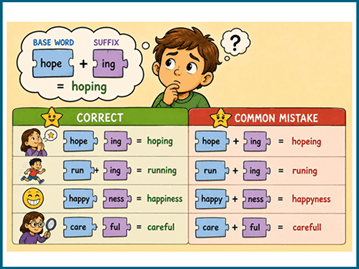
One of the biggest spelling challenges in grade 4 is knowing what happens to a word when an ending such as -ing, -ed, -er, -est, -ful, -less, or -ly is added.
For example:
hope + ing → hoping
run + ing → running
happy + ness → happiness
care + ful → careful
A child might write:
hopeing instead of hoping
runing instead of running
happyness instead of happiness
carefull instead of careful
The child usually knows the base word and the suffix. The tricky part is remembering whether the spelling of the base word needs to change.
Forgetting to double consonants
Children often have trouble deciding when a final consonant should be doubled before adding an ending.
For example:
run → running
begin → beginning
stop → stopped
plan → planned
This can lead to spellings such as:
runing
begining
stoped
planed
It becomes even more confusing because consonants are not always doubled:
help → helping
rain → raining
open → opening
Rather than simply memorizing individual words, children benefit from seeing groups of words that follow the same spelling pattern.
Forgetting to drop the final e
Many words ending in a silent e drop that e when an ending beginning with a vowel is added.
For example:
make → making
hope → hoping
write → writing
use → using
Grade 4 students may write:
makeing
hopeing
writeing
using
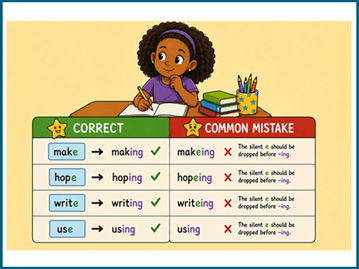
These mistakes often happen because children correctly remember how to spell the base word but haven't yet mastered what happens when the suffix is added.
Getting confused when a word ends in y
Words ending in y can also cause trouble.
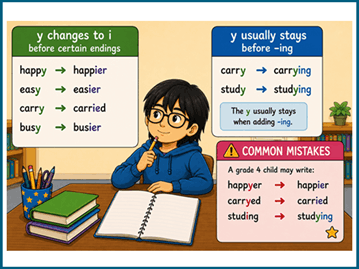
In many words, the y changes to i before certain endings:
happy → happier
easy → easier
carry → carried
busy → busier
But the y usually stays when adding -ing:
carry → carrying
study → studying
A grade 4 child may therefore write happyer, carryed, or studing while learning when the spelling change applies.
Misspelling prefixes
Grade 4 students begin using more words containing prefixes such as un-, re-, dis-, mis-, pre-, and in-.
For example:
unhappy
rewrite
disagree
misplace
preview
incorrect
Children may hear the word correctly but leave out or add letters:
disapear instead of disappear
misunderstand spelled with a missing letter
realy instead of really
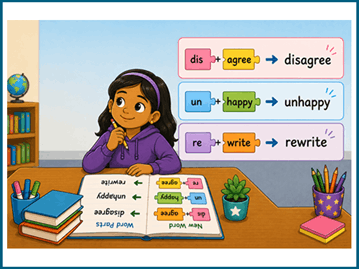
Learning to break a word into meaningful parts can make these longer words much easier to spell.
For example:
dis + agree → disagree
un + happy → unhappy
re + write → rewrite
Struggling with longer words
By grade 4, children are expected to read and write increasingly complex vocabulary. Longer words can be difficult because children have to remember several syllables and spelling patterns at once.
For example:
remember
different
important
probably
favorite
interesting
A child may leave out an unstressed syllable or letter and write something such as probly instead of probably or diffrent instead of different.
Breaking longer words into syllables can help:
re / mem / ber
diff / er / ent
im / por / tant
pro / ba / bly
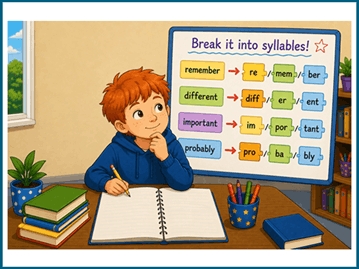
Clapping, tapping, or slowly saying each syllable can help children notice parts of a word they might otherwise miss.
Mixing up homophones
Grade 4 students are also expected to use more commonly confused words correctly.
These may include:
there, their, they're
to, too, two
your, you're
its, it's
hear, here
weather, whether
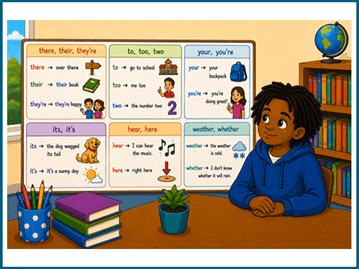
The difficulty here isn't usually sounding out the word. The words sound the same, so children have to think about meaning.
For example:
Their dog is friendly.
They're walking their dog over there.
Seeing homophones used in complete sentences helps children connect each spelling with its meaning.
Misspelling words that don't follow obvious patterns
English contains many words that don't behave exactly as children expect.
Words such as:
because
please
which
enough
favorite
friend
probably
through
may still cause problems in grade 4.
Children often develop their own logical versions of these words based on what they hear. For example, probly makes sense if that is how the word sounds when people say it quickly.
These words often need repeated exposure through reading, writing, and focused spelling practice.
Why these mistakes happen
Grade 4 spelling is more demanding because children are moving from relatively simple sound-based spelling to understanding the structure of words.
They are learning that spelling can provide clues about a word's meaning and its relationship to other words.
For example:
help → helpful → helpless
care → careful → careless
agree → disagree → agreement
happy → unhappy → happiness
Recognizing the base word can help a child spell several related words rather than memorizing each one separately.
At the same time, grade 4 students are writing longer stories, reports, responses, and assignments. They are thinking about ideas, sentence structure, punctuation, vocabulary, and spelling all at once. It is normal for spelling mistakes to appear even in words a child can spell correctly during a spelling exercise.
How parents can help
At this age, spelling practice can focus less on memorizing long lists and more on understanding how words work.
Look for the base word
When your child struggles with a longer word, ask whether there is a smaller word hiding inside it.
For example:
careless → care + less
unhappy → un + happy
replaying → re + play + ing
This encourages children to see words as groups of meaningful parts.
Group words by spelling rule
Instead of practising unrelated words, group words that follow the same pattern.
For example, practise doubling the final consonant:
run → running
stop → stopping
plan → planning
begin → beginning
Then compare these with words that don't double:
help → helping
rain → raining
open → opening
Seeing words side by side makes spelling patterns easier to notice.
Practice word families
Choose one base word and see how many related words your child can build.
For example:
help
helpful
helpless
helper
helping
helped
Or:
care
careful
careless
carefully
caring
cared
This builds spelling skills while also strengthening vocabulary.
Break long words into syllables
Long words can feel much easier when they are divided into smaller parts.
For example:
remember → re / mem / ber
fantastic → fan / tas / tic
important → im / por / tant
computer → com / pu / ter
Clapping the syllables or tapping them on the table can help children hear the different parts of the word.
Encourage proofreading
By grade 4, children can begin taking more responsibility for checking their own spelling.
Instead of immediately pointing out a mistake, try asking:
"Can you find one word in this sentence that doesn't look quite right?"
This encourages children to look closely at their own writing and develop independent proofreading skills.
It can also help to have children read their writing once for meaning and then a second time specifically for spelling.
Keep a personal spelling list
If your child repeatedly misspells the same words, create a small personal spelling list.
Five or ten useful words that your child actually uses in their writing can be more valuable than a long list of unrelated words.
Review the words regularly, use them in sentences, and remove them from the list once they have become automatic.
Keep reading
Reading remains one of the best ways to strengthen spelling.
As children read novels, nonfiction books, magazines, instructions, and other texts, they repeatedly see correctly spelled words in context. Over time, familiar spellings begin to look right, making it easier for children to notice when something is wrong in their own writing.
Don't expect perfect spelling
By grade 4, it can be tempting to assume that children should know how to spell most words correctly. But their vocabulary is expanding rapidly, and the words they are attempting are much more difficult than they were a few years ago.
A child who writes begining, hopeing, or disapear is often applying a spelling rule but hasn't completely mastered it yet.
Rather than correcting every mistake, look for patterns.
Does your child frequently forget doubled consonants? Do suffixes cause trouble? Are longer words missing syllables? Does your child mix up homophones?
Identifying the type of mistake makes it much easier to know what to practise.
Remember, grade 4 spelling mistakes are often a sign that children are experimenting with more sophisticated language. They are learning that words have roots, prefixes, suffixes, patterns, and exceptions. With regular reading, writing, and focused practice, these more complicated spelling rules gradually become automatic.
Grade 4 spelling worksheets
Are you looking for extra practice? Our grade 4 spelling worksheets help children practise increasingly challenging vocabulary, spelling patterns, prefixes, suffixes, and commonly misspelled words while building confidence as independent writers.
/spelling-worksheets/fourth-grade-4
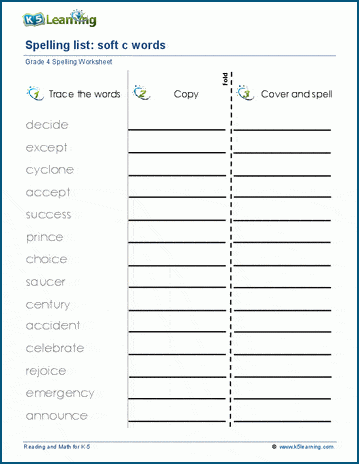
For example, this worksheet gives students practice spelling soft c and g words: