

By grade 5, most children can spell many everyday words correctly. They understand common spelling patterns, know how prefixes and suffixes work, and are usually comfortable spelling longer words.
But grade 5 spelling brings a new challenge. The words children encounter in reading and writing are becoming longer, more academic, and less predictable.
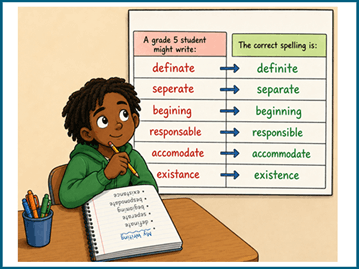
A grade 5 student might write:
definate instead of definite
seperate instead of separate
begining instead of beginning
responsable instead of responsible
accomodate instead of accommodate
existance instead of existence
At this stage, spelling mistakes are often less about sounding out words and more about remembering spelling rules, recognizing word parts, and knowing which spelling belongs to a particular word.
Understanding the kinds of spelling mistakes grade 5 students commonly make can help parents see what their child needs to practice.
Longer words can be difficult to spell
By grade 5, children are reading and writing many more multisyllable words.
Words such as:
environment
temperature
necessary
different
probably
government
can be tricky because some syllables are much easier to hear than others.
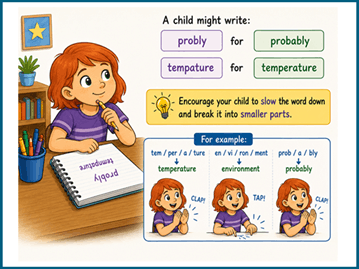
A child might write probly for probably or tempature for temperature because that is close to how the word sounds when it is spoken.
Encourage your child to slow the word down and break it into smaller parts.
For example:
tem / per / a / ture
en / vi / ron / ment
prob / a / bly
Clapping, tapping, or saying each syllable separately can help children notice parts of a word that disappear in everyday speech.
Prefixes and suffixes become more complicated
Grade 5 students use an increasing number of prefixes and suffixes as their vocabulary grows.
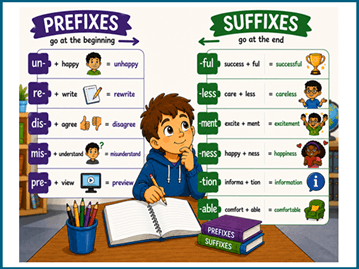
They may work with prefixes such as:
un- — unhappy
re- — rewrite
dis- — disagree
mis- — misunderstand
pre- — preview
and suffixes such as:
-ful — successful
-less — careless
-ment — excitement
-ness — happiness
-tion — information
-able — comfortable
The challenge is that adding a prefix or suffix sometimes changes the spelling of the base word.
For example:
happy → happiness
begin → beginning
excite → excitement
possible → possibility
Help your child look for the base word first. Seeing happy inside happiness or comfort inside comfortable makes a long word feel much more manageable.
Doubling consonants can still cause mistakes
Even in grade 5, children may forget when a consonant needs to be doubled before adding an ending.
For example:
begin → beginning
occur → occurred
prefer → preferred
regret → regretted
Students may write begining or prefered because they know the base word but haven't yet remembered the spelling change.
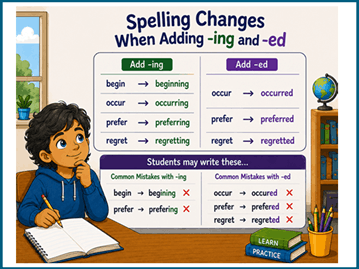
It can help to compare word pairs:
begin → beginning
visit → visiting
prefer → preferred
offer → offered
Looking at words side by side helps children begin to notice when doubling happens and when it doesn't.
Changing y to i can become confusing
Children have usually encountered the y to i spelling rule before grade 5, but it becomes harder as they use more complex words.
For example:
happy → happier
happy → happiness
beauty → beautiful
easy → easily
But the rule doesn't always apply.
Compare:
enjoy → enjoyed
play → playful
stay → staying
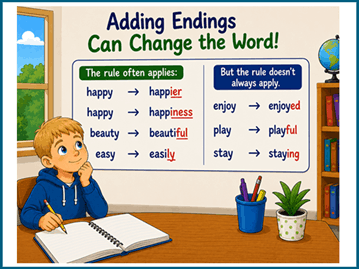
Children need repeated practice to recognize when the final y changes and when it stays.
Unstressed vowels are easy to miss
One of the biggest spelling challenges in longer words is the unstressed vowel.
Say separate aloud. The middle vowel isn't especially clear. Is it seperate or separate?
The same problem occurs in words such as:
definite
different
family
chocolate
interesting
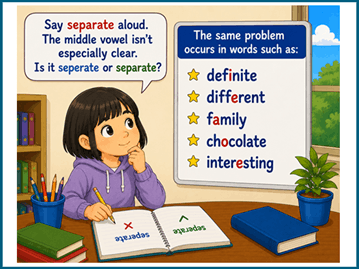
Children may leave out a vowel or choose the wrong one because they can't clearly hear it.
These words often need to be learned visually rather than spelled entirely by sound.
Encourage your child to look carefully at the word, say it slowly, write it, cover it, and then try to spell it from memory.
Words ending in -tion, -sion and -cian can be tricky
By grade 5, children encounter many words ending with the "shun" sound.
But that sound can have several spellings:
-tion: action, information, direction
-sion: decision, division, confusion
-cian: musician, magician, electrician
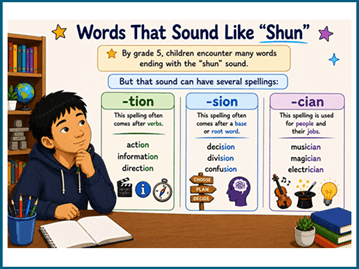
A student who relies only on sound may have difficulty knowing which ending to use.
Rather than memorizing these words individually, encourage your child to group them according to their endings. Seeing several examples together makes the patterns easier to recognize.
Homophones can still cause problems
Grade 5 students may know how to spell two homophones but still choose the wrong one when writing.
Common examples include:
their / there / they're
your / you're
its / it's
to / too / two
whether / weather
whose / who's
accept / except
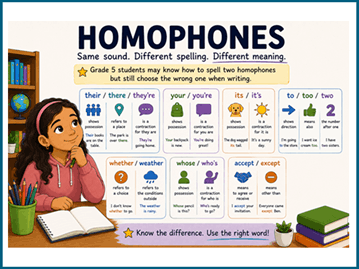
At this age, the challenge is often not spelling the word itself. It is understanding which word belongs in the sentence.
Instead of asking, "How do you spell it?" ask, "What does the word mean in this sentence?"
For example:
They're going to the park.
The word means they are, so they're is the correct spelling.
Irregular words still need to be remembered
English has plenty of words that don't behave the way children expect.
Grade 5 students may struggle with words such as:
necessary
business
rhythm
foreign
guarantee
immediately
especially
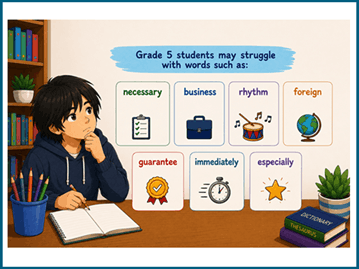
Sounding these words out can help, but it won't always lead to the correct spelling.
For difficult words, encourage your child to notice the part that causes trouble.
For necessary, for example, they might focus on remembering that the word has one c and two s's.
For business, they can notice that the spelling contains the word busy, even though the pronunciation changes.
Academic vocabulary adds another challenge
Grade 5 students are also expected to use more subject-specific vocabulary in science, social studies, and math.
They may need to spell words such as:
fraction
equation
organism
ecosystem
electricity
government
population
geography
These words can seem intimidating, but many become easier when children recognize familiar roots, prefixes, and suffixes.
For example:
geo + graphy
popul + ation
electr + icity
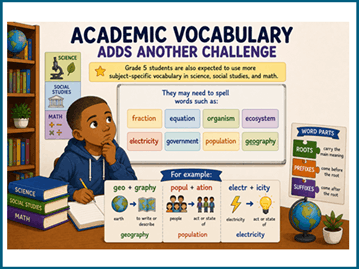
Encourage your child to look for meaningful word parts rather than trying to memorize the entire word as one long string of letters.
How parents can help with grade 5 spelling
At this age, spelling practice shouldn't be limited to memorizing a list of words for a weekly test.
Instead, help your child become a spelling detective.
When they misspell a word, look at the mistake together.
Ask:
What part of the word did you spell correctly?
Is there a base word you recognize?
Is there a prefix or suffix?
Is there a spelling rule that might help?
Which part of the word do you need to remember?
You can also keep a small list of words your child frequently misspells. Practice five or six at a time rather than trying to tackle a long list all at once.
Word sorting can also be useful. For example, children could sort words according to their endings:
-tion: action, direction, information
-sion: decision, division, confusion
Or they could group words by spelling changes:
double the consonant: beginning, preferred, regretted
change y to i: happiness, easily, beautiful
The goal is to help children see spelling as a system of patterns rather than a collection of unrelated words.
Spelling mistakes are useful clues
By grade 5, children may become more self-conscious about spelling mistakes. But mistakes can tell you a lot about what they already understand and what they need to learn next.
A child who writes begining understands the base word begin and knows that -ing needs to be added. They simply haven't mastered the consonant-doubling rule yet.
A child who writes seperate is representing the sounds they hear but needs to remember the correct unstressed vowel.
Instead of simply correcting the word, help your child identify why the spelling was difficult.
Grade 5 spelling worksheets
We have a section dedicated to grade 5 spelling worksheets for students to practice two-letter blend and three-letter blend words, as well as prefixes and suffixes.
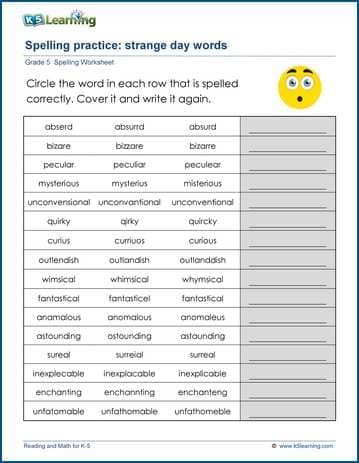
This worksheet, for example, ask students to circle the correctly spelled word and then write it.