


Learning addition is about more than getting the right answer. Strong math students learn how numbers work together, and they use different strategies to solve problems efficiently. When kids understand multiple addition strategies, they become more confident, flexible thinkers, and much less dependent on memorization.
Below are some of the most important addition strategies elementary students should learn, with examples, tips and practice worksheets to help them choose the best one for each problem.
Counting on
Counting on means starting with the larger number and counting forward, instead of counting both numbers from the beginning.
For example:
8 + 3
Start at 8 and count on: 9, 10, 11
So, 8 + 3 = 11
This strategy helps students move beyond counting everything with fingers. It builds number sense and encourages kids to recognize that addition is about adding to a number, not starting over.
Best used when: one addend is small
Kid-friendly reminder: “Start with the big number.”
Making 10
Making 10 is a powerful mental math strategy where students break apart numbers to make a 10 first.
For example:
8 + 5
8 needs 2 to make 10
Take 2 from 5 → 10 + 3 = 13
Because 10 is such a friendly number, this strategy makes harder facts much easier to solve. It also prepares students for future work with place value and multi-digit addition.
Best used when: numbers are close to 10 (7, 8, or 9)
Kid-friendly reminder: “Make a 10. It makes math easier!”
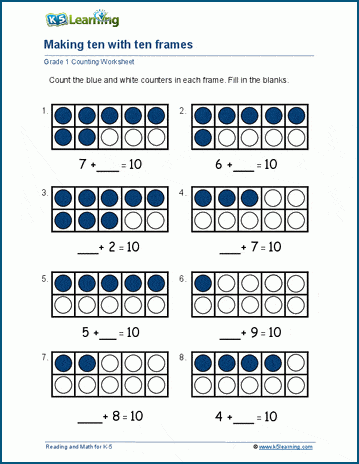
Making 10 with 10 frames worksheets
In our grade 1 base 10 blocks section, we have a series of worksheets for students to practice making ten with ten frames.
Doubles
Doubles are addition facts where the same number is added to itself.
Examples:
4 + 4 = 8
6 + 6 = 12
These facts are usually some of the first that students memorize. Knowing doubles well gives kids a strong foundation for learning other strategies.
Best used when: both numbers are the same
Kid-friendly reminder: “Same plus same.”
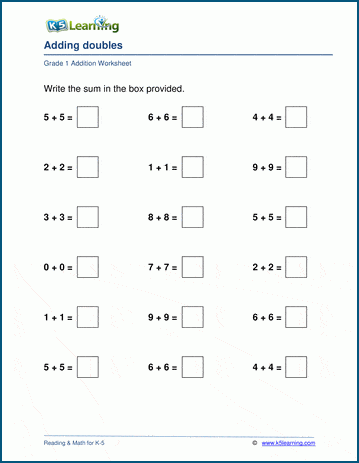
Adding doubles worksheets
Here’s a set of worksheets that help students practice adding doubles.
Near doubles
Near doubles build on what students already know about doubles. Kids use a double fact and then adjust by 1.
Example:
6 + 7
6 + 6 = 12
Add 1 more → 13
This strategy shows students that math facts are connected, not isolated. It helps reduce the number of facts they need to memorize.
Best used when: numbers are only 1 apart
Kid-friendly reminder: “Double it, then fix it.”
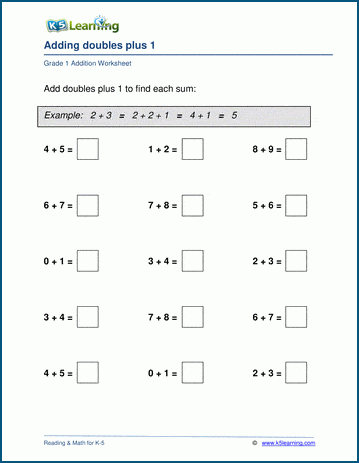
Adding near doubles worksheets
These worksheets have students practice adding doubles plus one.
Break apart
With breaking apart, students split numbers into smaller, easier pieces.
Example:
12 + 5
12 + 3 = 15
15 + 2 = 17
This strategy strengthens mental math and helps students see numbers as flexible rather than fixed.
Best used when: adding larger or teen numbers
Teacher tip: encourage students to explain why they broke the number apart the way they did.
Using a number line
A number line shows addition as movement forward.
For example:
4 + 6
Start at 4 and jump forward 6 spaces → 10
This visual strategy is especially helpful for students who need to see the math happening.
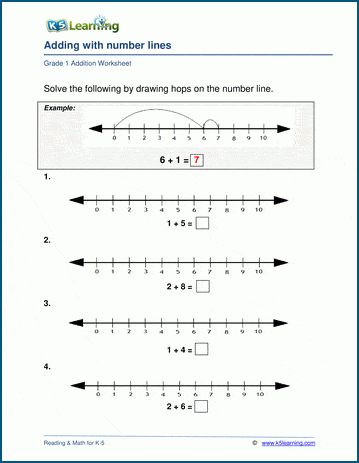
Number lines worksheets
These worksheets ask students to solve addition problems using a number line.
Turn-around facts
Turn-around facts teach students that the order of numbers doesn’t change the sum.
For example:
3 + 8 = 8 + 3 = 11
Understanding this concept reduces frustration and cuts the number of facts students must learn nearly in half.
Big idea: addition is flexible
Compensation
Compensation means adjusting numbers to make them easier, then fixing the answer.
For example:
19 + 6
20 + 6 = 26
Subtract 1 → 25
This strategy is excellent for mental math and prepares students for real-world problem solving.
Why teaching multiple strategies matters
When students learn more than one way to add, they:
develop stronger number sense
solve problems more efficiently
explain their thinking more clearly
build confidence in math
The goal isn’t for kids to use every strategy every time. The goal is for them to choose the strategy that makes the problem easiest.