
 Halloween W'sheets!

Some words seem to pop up everywhere in school.
Children encounter them in reading passages, math problems, science experiments, social studies lessons, and classroom discussions. These are called academic words; words that help students understand instructions, explain their thinking, and learn new ideas.
Learning these words gives children a huge advantage. When students know academic vocabulary, they are often better able to understand what they read, follow directions, and express their ideas clearly.
What are academic words?
Some words are useful in almost every school subject.
You might see them in a reading lesson, hear them during a science experiment, or find them in a math problem. These are called academic words.
Academic words are words that help students learn, think, discuss ideas, and explain their understanding. Unlike everyday words such as dog, happy, or jump, academic words are used across many different subjects.
For example, the word compare can appear in:
Reading: Compare the two characters.
Math: Compare the fractions.
Science: Compare the results of the experiment.
Social Studies: Compare the two civilizations.
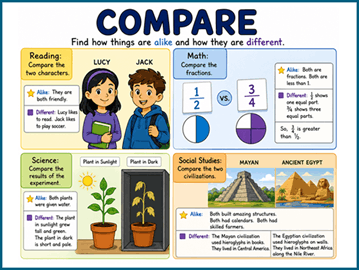
The word evidence is another academic word:
In science, evidence might come from an experiment.
In reading, evidence comes from the text.
In social studies, evidence may come from historical documents.
Because academic words appear so often, learning them gives children a big advantage. Students who understand academic vocabulary are often better able to:
follow classroom instructions,
understand what they read,
explain their thinking,
write clearly, and
learn new concepts more easily.
Teachers sometimes call these Tier 2 vocabulary words. These are high-utility words that appear frequently in books, classroom discussions, and lessons across many subjects.
Words like analyze, predict, infer, summarize, and evaluate may seem challenging at first, but they become powerful tools that children use throughout elementary school and beyond.
Why are academic words important?
Imagine a child is asked:
"Use evidence from the text to explain why the character changed."
To answer this question, the child needs to understand several academic words:
evidence
explain
character
Even if the child can read every word in the passage, not understanding the academic vocabulary can make the question confusing.
That's why learning academic words is so important. These words help children unlock what teachers are asking and give them the language they need to show what they know.
Let’s dive into what academic words kids should learn.
The 100 most important academic words
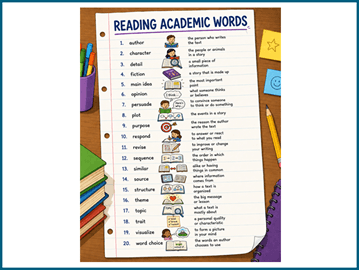
Reading & Writing
Word Meaning
author The person who wrote a book, story, or article
character A person or animal in a story
detail A small piece of information
fiction A made-up story
main idea The most important point
opinion What someone thinks or believes
persuade Convince someone to agree or do something
plot The events that happen in a story
purpose The reason something exists or is written
respond Answer or react
revise Improve by making changes
sequence Put things in order
similar Almost the same
source Where information comes from
structure How something is organized
theme The big message or lesson of a story
topic The subject being discussed
trait A characteristic or quality
visualize Form a picture in your mind
word choice The words an author chooses to make their writing interesting or clear
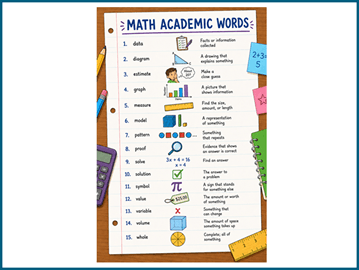
Math
Word Meaning
data Facts or information collected
diagram A drawing that explains something
estimate Make a close guess
graph A picture that shows information
measure Find the size, amount, or length
model A representation of something
pattern Something that repeats
proof Evidence that shows an answer is correct
solve Find an answer
solution The answer to a problem
symbol A sign that stands for something else
value The amount or worth of something
variable Something that can change
volume The amount of space something takes up
whole Complete; all of something
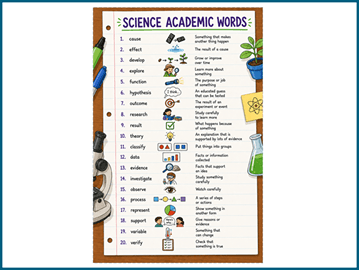
Science
Word Meaning
cause Something that makes another thing happen
effect The result of a cause
develop Grow or improve over time
explore Learn more about something
function The purpose or job of something
hypothesis An educated guess that can be tested
outcome The result of an experiment or event
research Study carefully to learn more
result What happens because of something
theory An explanation that is supported by lots of evidence
classify Put things into groups
data Facts or information collected
evidence Facts that support an idea
investigate Study something carefully
observe Watch carefully
process A series of steps or actions
represent Show something in another form
support Give reasons or evidence
variable Something that can change
verify Check that something is true
Social Studies
Word Meaning
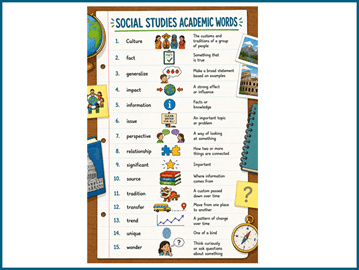
Culture The customs and traditions of a group of people
fact Something that is true
generalize Make a broad statement based on examples
impact A strong effect or influence
information Facts or knowledge
issue An important topic or problem
perspective A way of looking at something
relationship How two or more things are connected
significant Important
source Where information comes from
tradition A custom passed down over time
transfer Move from one place to another
trend A pattern of change over time
unique One of a kind
wonder Think curiously or ask questions about something
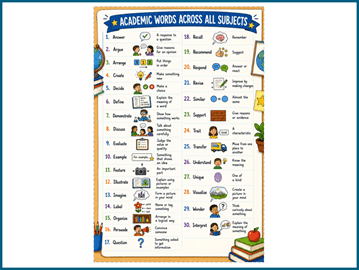
Words used across all subjects
Word Meaning
Answer A response to a question
Argue Give reasons for an opinion
Arrange Put things in order
Create Make something new
Decide Make a choice
Define Explain the meaning of a word
Demonstrate Show how something works
Discuss Talk about something carefully
Evaluate Judge the value or quality
Example Something that shows an idea
Feature An important part
Illustrate Explain using pictures or examples
Imagine Form a picture in your mind
Label Name or tag something
Organize Arrange in a logical way
Persuade Convince someone
Question Something asked to get information
Recall Remember
Recommend Suggest
Respond Answer or react
Revise Improve by making changes
Similar Almost the same
Support Give reasons or evidence
Trait A characteristic
Transfer Move from one place to another
Understand Know the meaning
Unique One of a kind
Visualize Create a picture in your mind
Wonder Think curiously about something
Interpret Explain the meaning of something
Which words should children learn first?
If you're wondering where to start, focus on these 20 high-impact words:
analyze
compare
contrast
describe
determine
evaluate
evidence
explain
identify
infer
interpret
observe
organize
predict
process
reason
relationship
summarize
support
classify
These words appear in reading, math, science, and social studies, making them some of the most useful words a child can learn.
How parents can help
You don't need vocabulary drills or long word lists.
Instead, try using academic words naturally:
"Can you predict what will happen next?"
"What evidence do you have?"
"How are these two animals similar? Can you compare them?"
"Can you summarize the story?"
"What do you infer from this picture?"
The more children hear and use these words, the more confident they become.
Final thoughts
Academic vocabulary is one of the strongest predictors of success in school. These words help children understand instructions, make sense of what they read, explain their ideas, and learn new concepts.
The good news? Children don't need to master thousands of words at once. Learning even a few of these high-value academic words can make reading, writing, and learning much easier.